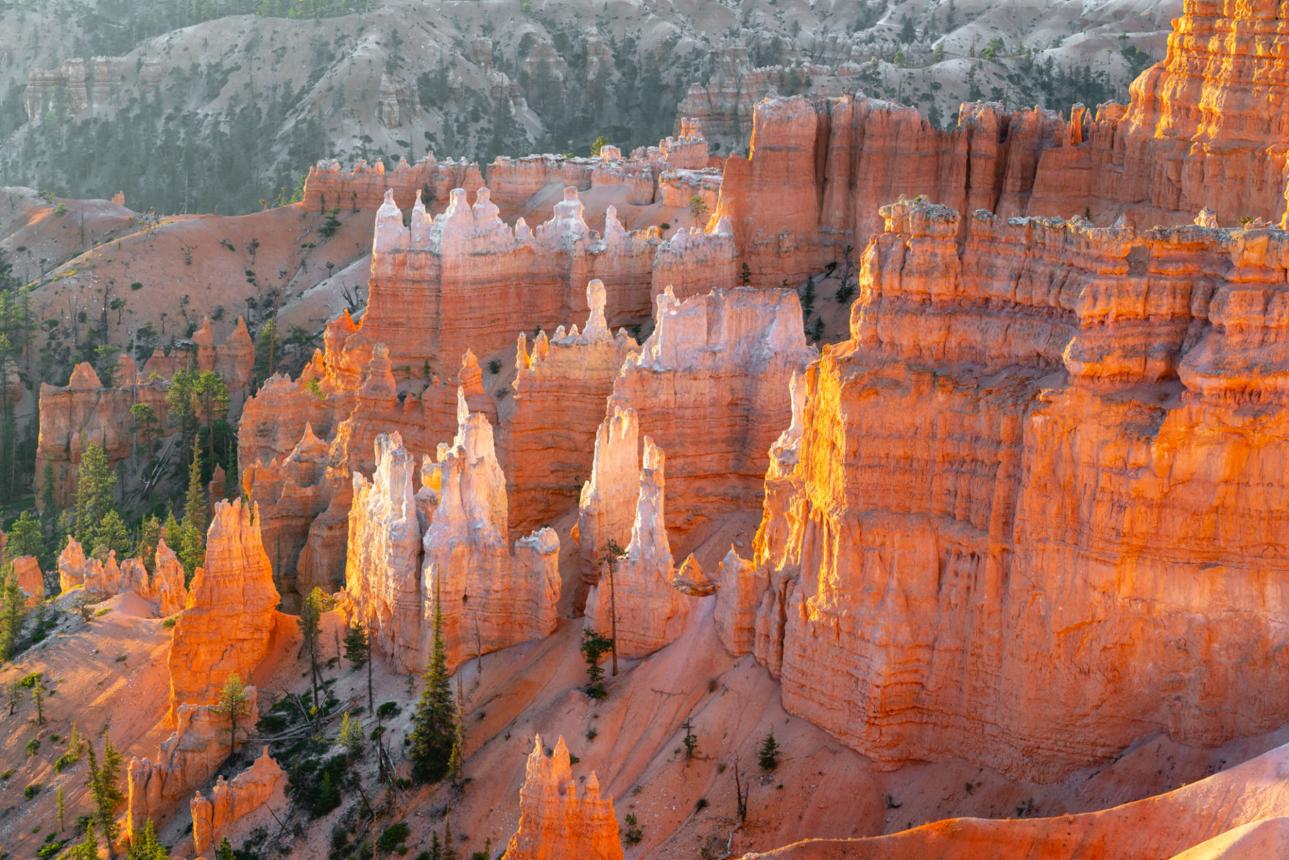
Bryce Canyon National Park in southern Utah is renowned for its otherworldly appearance. Unlike the other national parks, Bryce Canyon does not contain cliffs and deep canyons. It has thousands of tall rock spires called hoodoos. They appear from the natural amphitheater and form a stunning landscape characterized by bright orange, red, pink, and cream-colored rocks.
The fact that Bryce Canyon is not really a canyon is revealed by its main feature – enormous natural amphitheaters located on the edges of the Paunsaugunt Plateau. The largest and well-known one is the Bryce Amphitheater, where many hoodoos can be seen in great numbers.
Unusual geology, high altitude, and ever-changing lighting conditions make Bryce Canyon especially interesting for tourists who come to Utah by car.
The Hoodoos: Bryce Canyon’s Signature Feature
It is these hoodoos that give Bryce Canyon National Park its iconic identity.
These large structures have formed over many thousands of years because of erosion caused to layers of sedimentary rock. The freeze-and-thaw process is also a key factor. Water seeps into cracks in the rock, where it freezes and expands, causing the cracks to become wider. In the end, weaker areas of the rock erode away leaving behind only stronger areas.
What you get are spindly towers of rock that look as though they can hardly support themselves.
They even come in different colours based on minerals and the lighting conditions. Orange, red, yellow, pink and white are some of the colours seen at Bryce Canyon.
Bryce Amphitheater
For many tourists, the Bryce Amphitheater forms the highlight of the national park. There are several well-known viewpoints that allow you to have a look at the unique natural formation that boasts thousands of hoodoos.
- One such viewpoint is the Sunrise Point, which is usually visited early in the morning as soon as the sun starts shining on the rock formations.
- The other viewpoint is the Sunset Point, which offers a totally different view of the formation, and is very popular among tourists.
- Besides the viewpoints mentioned above, there are also the Inspiration Point and the Bryce Point.
Hiking among the Hoodoos
One of the best ways to enjoy Bryce Canyon is to move away from the viewpoint and go down into the amphitheatre.
- Navajo Loop Trail is one of the most popular hiking trails at Bryce Canyon. It goes down surrounded by high rock walls and formations providing you an opportunity to see the size of the hoodoos from below.
- Another interesting hiking trail is the Queen’s Garden Trail. This trail leads through an amazing landscape of strange formations and colorful rocks.
- A combination of parts of these two hiking trails will give you a chance to make a longer tour around the amphitheatre.
- To hike among the hoodoos is totally different feeling than to watch them from the rim. It is amazing how something which from above seems to be a set of small rocks turns into huge walls and towers on the ground.
Scenic Drives and Viewpoints
For tourists who prefer touring in their cars, there is the opportunity of taking the tour via the scenic road within the park that provides visitors with access to various points of view.
The route enables tourists to see various regions of Bryce Canyon National Park without having to go for long-distance hikes. Tourists have a chance to take photographs of the scenery from varying levels and angles.
Touring southern Utah can include visiting Bryce Canyon National Park as part of an itinerary of other sites.
A Dark Sky Destination
Bryce Canyon is also special during the night time.
Its high altitude and less presence of artificial lights make it great place for star gazing. The sky is very likely to contain a large number of stars on a clear day. The Milky Way can also be very impressive during good conditions.
For people who like to study astronomy, the park’s programs and conditions should be checked before a visit.
Bryce Canyon through the Seasons
There are significant differences from season to season at Bryce Canyon.
- In spring, there may be cold weather with snowfall, but the area will start experiencing changes to warmer weather.
- The summer months are favorable due to better and milder daytime temperatures than the hot desert regions of Utah. Nonetheless, thunderstorms are common during the afternoons.
- The fall season provides cooler weather and color change in the surrounding vegetation.
- The winter makes the hoodoos look amazing with their contrast of red rocks and snow cover.
Due to the higher elevation of the area, one has to expect changes in weather at all times.
Wildlife Around the Park
While the hoodoos are the primary draw, Bryce Canyon is also home to a wide range of fauna.
Mule deer, foxes, squirrels, birds, and other forms of fauna can be spotted by visitors when they explore the park. However, the forested areas and open landscapes offer a completely different kind of environment compared to the highly developed amphitheatre area.
It is not always possible to spot these fauna; however, those visitors that devote more time to the trails have a better chance.
Photography at Bryce Canyon
Bryce Canyon is one of the most interesting spots in Utah for landscape photography.
- The strange forms of the hoodoos give an infinite variety of compositional options, while the play of light and shadow can radically change their appearance depending on the time of day.
- It is especially useful to photograph at dawn since the low light can paint the rocks in rich colors.
- At sunset, there may also be interesting pictures due to long shadows on the amphitheatre.
- There are also amazing winter photos with freshly fallen snow on the hoodoos.
- A wide angle lens can show the grandeur of the amphitheatre, and a telephoto lens can focus on certain formations.
Things to Know Before Visiting
Since Bryce Canyon has an elevated location, it is essential that tourists do not take the effects of the altitude lightly, especially during shorter hiking trips.
- Comfortable shoes, drinking water, sun protection, and clothes that suit the weather conditions are crucial. It is easy for the weather to suddenly turn, especially during the winter season.
- A good idea is to hike popular trails early in the morning when temperatures are cooler.
- Before travelling, visitors should check current park conditions, road information, trail status and any seasonal restrictions.
Bryce Canyon as Part of a Utah Road Trip
A tour of Bryce Canyon becomes even more interesting when included in the larger road trip to national parks in Utah.
Bryce Canyon may be visited along with such other places as Zion National Park, Capitol Reef National Park, Arches National Park, and Canyonlands National Park.
Southern Utah becomes a perfect place for those who are looking forward to making a road trip to multiple locations with varied landscapes.
It is advisable to plan your route well using reliable GPS navigation and mapping service, since the distance between the attractions may be quite large.
Why Bryce Canyon Is Worth Visiting
The main thing that Bryce Canyon offers its visitors is uniqueness. There are many national parks which provide huge mountains, waterfalls, forest or valleys, but Bryce offers totally another kind of attraction – a giant natural amphitheatre full of thousands stone pillars.
Exploration of the place changes from the view point you use to see it. Looking at the park from the rim, people can understand the true scale of the landscape. Exploring it from the trail, people feel the presence of the dramatic hoodoos around them. Watching it during the night, people immerse in the darkness of the landscape under the starry sky.
This fact gives Bryce Canyon a special meaning.
Final Thoughts
Bryce Canyon National Park | Utah is the place which should be visited for its unique colours, geology and scale. The fantastic hoodoos in the park were formed by nature during an unimaginably long period of time.
If people are interested in hiking, photographing, geology, watching the stars or just traveling hrough the American Southwest, there are lots of things to discover in the Bryce Canyon.Top of Form











No responses yet