
What a GPS Tracker Actually Is (And Why It Is Not an AirTag)
The first thing to understand is that “tracker” is a broad word, and not all trackers work the same way. The distinction matters enormously depending on what you are trying to track.
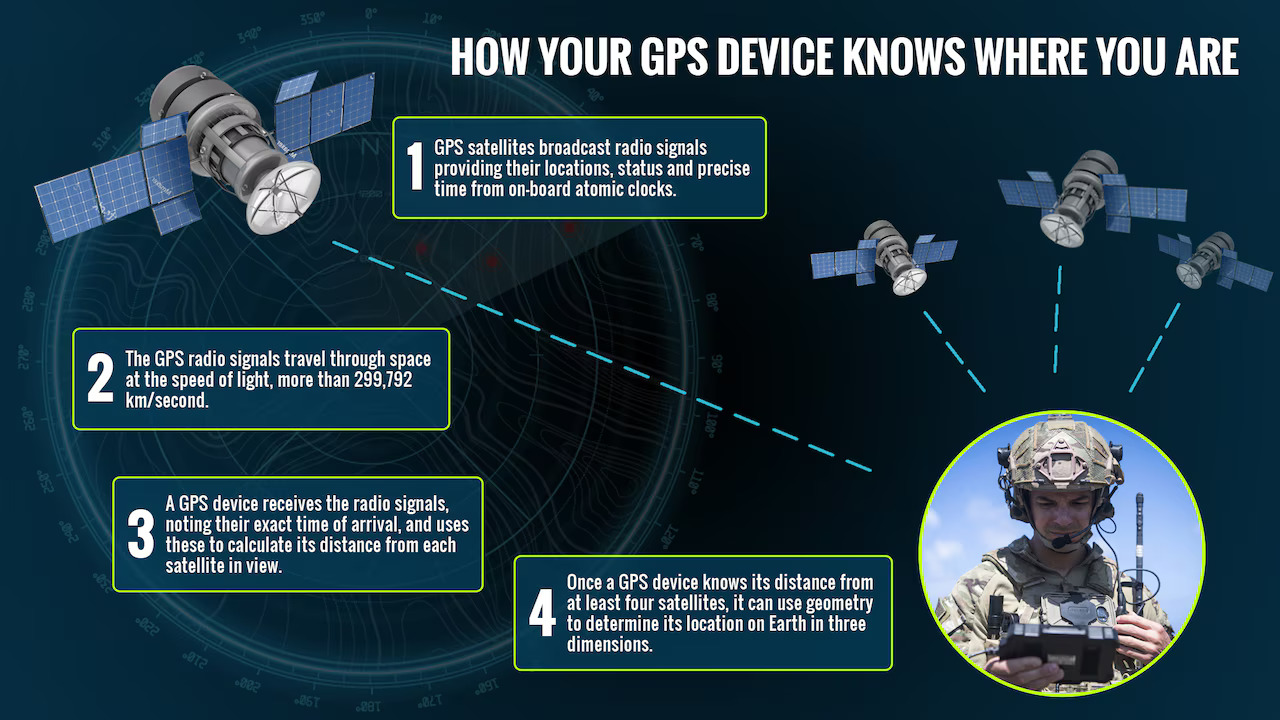
A true GPS tracker communicates directly with satellites orbiting roughly 12,000 miles above the Earth. The device receives signals from multiple satellites, calculates its own position, and then sends that location data over a cellular network (usually 4G LTE) to a cloud platform. You log into an app or a web dashboard and see where the device is in real time. The key advantage is independence: the tracker does not need anyone else’s phone to be nearby. As long as it can see the sky and has cellular coverage, it reports its location.
Bluetooth trackers like the Apple AirTag and Tile Pro operate on a completely different principle. They broadcast a short-range Bluetooth signal and rely on nearby smartphones from compatible ecosystems to detect them and anonymously relay their location. This works reasonably well in dense urban environments where many people are walking around with phones. It falls apart almost everywhere else.
A 2025 field study conducted for the Missouri Department of Transportation put this to the test. Researchers evaluated tracking devices in highway work zone conditions, including urban and rural sites with varying cellular coverage. In controlled testing, they compared performance when a smartphone was present versus powered off. The Bluetooth-based trackers were evaluated strictly as standalone devices, without assuming continuous access to nearby phones. The results were stark: in the smartphone-disabled phase, which simulated real operational conditions where workers are prohibited from using personal phones, the AirTag and Tile Pro could not meet the reliability and data accessibility requirements. The study concluded that Bluetooth-based tracking devices were not suitable for continued evaluation in that context.
In simpler terms: if you want to track a vehicle, a trailer, a boat, or a piece of equipment that might travel through areas where nobody is carrying the right phone, a Bluetooth tracker is the wrong tool. A GPS tracker is the right one.
How GPS Accuracy Works (And What You Can Realistically Expect)
The U.S. government operates the GPS constellation and commits to broadcasting signals with a daily global average user range error of 2.0 meters or less, with 95 percent probability. Actual performance is typically much better. On a sample day in April 2021, the global average error across all satellites was just 0.643 meters, or about 2.1 feet.
But here is the critical caveat: that number describes the signal in space, not what your device shows on a map. Your actual accuracy depends on satellite geometry, whether buildings or trees are blocking the signal, atmospheric conditions, and the quality of the receiver in your device. A typical GPS-enabled smartphone achieves accuracy within about 4.9 meters (16 feet) under open sky, but that degrades near buildings, bridges, and trees.
For a dedicated GPS tracker mounted under a car or on a trailer, expect real-world accuracy in the range of 5 to 15 meters in good conditions, and worse in dense urban areas or indoors. Some trackers supplement GPS with Wi-Fi-based positioning when satellite signals are weak, which can keep reported errors in the 3 to 8 meter range, though this depends on how many known Wi-Fi networks are nearby.
It is also worth noting that the U.S. government does not degrade civilian GPS accuracy. The old “Selective Availability” feature, which intentionally introduced errors into civilian signals, was turned off in May 2000. Since then, civilian users have had access to the same signal accuracy as military users, though military receivers can use dual frequencies to further reduce atmospheric errors.
The Real-World Performance of a Popular Magnetic Tracker
To understand what a consumer-grade GPS tracker actually delivers, it helps to look at a specific product that has accumulated substantial user feedback. The Global-View.Net Hidden Magnetic GPS Tracker, sold as the “USA Tech” model on Amazon, is a representative example. It has hundreds of ratings and a 4.3-star average.
The core design is simple: a rectangular device with strong magnets on the back that attaches to any flat metal surface in about ten seconds. No wiring, no professional installation. One user reported attaching it to the metal inner fender of a car and finding it still in place after “crazy driving”. The device includes a SIM card, a charger, and access to a cloud-based tracking platform with a mobile app.
The advertised battery life is where things get interesting. Global-View.Net claims up to six months of standby with 30 minutes of daily driving, and about two months of real-time tracking per charge. But user reports tell a different story. One reviewer stated the advertised 4 to 6 weeks of battery life was actually “less than 2 weeks with light usage. 12-13 days to be exact”. Another user reported getting about two months when charged via USB and using maximum settings for live updates. The discrepancy suggests that battery life varies widely depending on how frequently the device reports its location, how strong the cellular signal is, and how much the vehicle moves.
The subscription costs $18 per month with no contract, covering the data plan, cloud platform access, and up to 12 months of data storage. Coverage extends to over 140 countries. The device supports geofence alerts (notifications when it enters or leaves a designated area) and speed alerts. One user noted that alerts work but can be slow, arriving 2 to 7 minutes after the triggering event.
How This Compares to Other Tracker Options
The Global-View.Net device is not the only option, and the differences between trackers matter depending on your use case.
Tracki Mini GPS Tracker is one of the most portable options, weighing just 1.26 ounces. It offers flexible battery modes ranging from two to three days with real-time updates to about 10 months when set to report once per day. It works in 187 countries. The trade-off is that frequent real-time tracking drains the small battery quickly, and an optional battery extender can push real-time operation to about two weeks.
Optimus 2.0 prioritizes battery longevity for a battery-powered tracker, lasting up to a month per charge with one-minute updates. It includes an SOS button and supports reporting intervals from every 10 seconds to every minute. Some users have reported reception or charging issues.
LandAirSea 54 is built for durability. Its sealed, waterproof casing handles dust and extreme temperatures, and it can last up to three weeks with three-minute updates. The internal magnet allows discreet placement in a wheel well or under a bumper. The Missouri DOT study found it demonstrated strong performance in durability, accuracy, connection reliability, and battery life, though its larger size and weight made it unsuitable for worker-worn use. The study recommended it for vehicle, equipment, or fleet-based tracking.
Americaloc GL300W uses CAT M1 technology and offers detailed tracking with 10-, 30-, or 60-second update intervals. Battery life with one-minute updates is about 10 to 14 days. It supports shareable live location links and operates in over 182 countries.
For fleet operations, enterprise solutions like Verizon Connect and Samsara integrate GPS tracking with electronic logging devices, dash cameras, and compliance tools. These are more expensive and complex but offer capabilities that standalone trackers cannot match.
The U.S. Government’s GPS Ground System Problem (And Why It Does Not Affect Your Tracker)
In April 2026, the Pentagon canceled its contract with RTX for the Next-Generation GPS Operational Control Segment, known as OCX. The project was supposed to provide ground control infrastructure for the newest GPS III satellites, which are designed to be more jam-resistant and precise than earlier models.
The cancellation came after 15 years of development. The program was initially expected to be completed in early 2016 at a cost of $3.7 billion. By the time it was killed, it was ten years late and the projected cost had nearly doubled to $6.27 billion. The Space Force stated that the system “was unable to deliver needed capabilities on an operationally relevant timeline at an acceptable level of risk.” Colonel Stephen Hobbs, commander of Mission Delta 31, said the team discovered “problems across a broad range of capability areas that would put current GPS military and civilian capabilities at risk”.
The important thing to understand is that this does not mean GPS is broken. The satellites themselves are fine. The 32 operational GPS satellites, including nine GPS III satellites, continue broadcasting signals. The OCX program was about building a new ground control system to fully utilize the advanced capabilities of those satellites, particularly encrypted M-Code signals for military users. The existing ground system, known as the Architecture Evolution Plan, continues to operate and has been upgraded over the years.
For anyone using a civilian GPS tracker, none of this matters. Your device relies on the free, open GPS signals broadcast from space. Those signals are not going away, and their accuracy commitments remain in effect.
What to Look For When Buying a GPS Tracker
Based on the technical realities and user feedback, here is what actually matters when choosing a tracker.
Battery life versus update frequency. These are in direct tension. A tracker that reports every 10 seconds will drain its battery far faster than one that reports every minute or every five minutes. For vehicle tracking where the device can be recharged periodically, frequent updates are fine. For long-term covert tracking of a trailer or equipment, you need to accept less frequent updates or pay for a device with a larger battery.
Subscription costs. Almost every cellular GPS tracker requires a monthly data plan. Prices range from around $18 to $25 per month for consumer devices, with enterprise fleet solutions costing more. Some devices offer annual plans at a discount. Always factor the subscription into the total cost of ownership.
Mounting and concealment. Magnetic mounts are convenient but require a flat metal surface. If you are tracking a trailer with aluminum or composite panels, you will need a different mounting approach. Waterproof and rugged casings matter for equipment exposed to weather.
Real-time versus historical tracking. Some devices prioritize live location updates, while others emphasize trip history and reporting. Think about whether you need to watch a vehicle move in real time or simply review where it has been.
Coverage area. If you are tracking assets that might cross borders, check the device’s international coverage. Global-View.Net covers 140 countries, Tracki covers 187, and Americaloc covers 182.
Conclusion
GPS trackers are purpose-built tools for a specific job: reporting location independently of nearby smartphones. They are not interchangeable with Bluetooth trackers, and they are not affected by the U.S. military’s ground system procurement problems. The technology is mature, the signals are free, and the consumer market offers options at a range of price points and capability levels.
The most important decision is not which device has the longest advertised battery life or the flashiest app. It is whether the tracker’s actual reporting behavior matches what you need it to do. A device that claims six months of standby but only lasts two weeks under real-world conditions is not a bargain. A device that reports every 10 seconds but dies in two days is useless for tracking a trailer parked for a month. Read the user reviews, understand the subscription costs, and choose based on how you will actually use it.











No responses yet