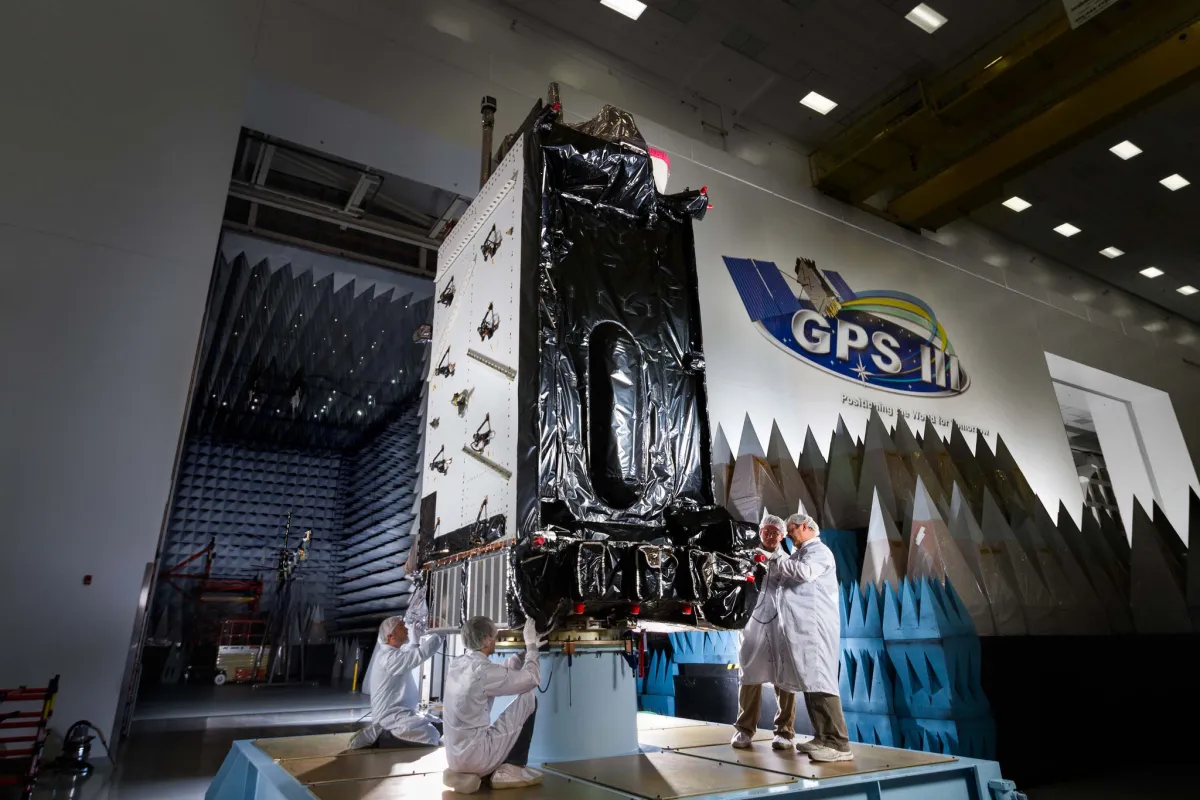

The US Space Force launched the final GPS III satellite on April 21, 2026, completing a constellation of 32 operational satellites that officials describe as the strongest and most resilient to date. The launch, designated GPS III SV10, carries experimental payloads that will inform the next generation of GPS technology. With the GPS III block now fully deployed, Lockheed Martin has shifted production to GPS IIIF satellites, which will deliver more than 60 times the anti-jamming capability of legacy systems and include search-and-rescue payloads for civilian first responders.
The Final GPS III Goes to Orbit
The GPS III SV10 satellite launched from Cape Canaveral Space Force Station at 2:53 a.m. Eastern time, securing signal acquisition shortly after separation and entering management at Lockheed Martin’s Denver Launch & Checkout Operations Center pending formal acceptance into the GPS operational control network.
The mission was the fourth consecutive GPS launch on an accelerated schedule, completed in under seven weeks from manifest adjustment to launch. Col. Ryan Hiserote, Space Systems Command’s System Delta 80 commander and GPS III-8 mission director, described the flexibility as “a remarkable achievement compared to traditional timelines”.
The launch brought the active GPS constellation to 32 satellites, providing added redundancy and resiliency with additional vehicles on orbit.
What Makes GPS III Different
The GPS III series delivered substantial capability improvements over legacy satellites. According to Lockheed Martin and Space Force officials, GPS III satellites provide three times greater accuracy, eight times stronger anti-jamming capability, and secure M-Code signals for military users worldwide.
For civilians, these improvements translate to more reliable smartphone navigation, faster emergency response location, and more precise timing for financial markets and telecommunications networks. The constellation serves billions of users globally.
Experimental Payloads Aboard SV10
The final GPS III satellite carries several technology demonstrations that will inform future GPS development:
Optical crosslink demonstration payload — This will test optical communication capabilities allowing GPS satellites to communicate directly with each other in space, increasing on-orbit resiliency by reducing dependence on ground stations.
Digital Rubidium Atomic Frequency Standard clock — A new space-qualified atomic clock that will enhance long-term timing and precision for future GPS missions. Qualification of this clock expands the sourcing capabilities for future spacecraft.
Laser retroreflector array — The second use of this technology, which enables NASA to conduct scientific research by delivering precise range measurements and improving long-term determination of Earth’s center.
3D printed omnidirectional antenna — The first use of this technology, which demonstrates advanced manufacturing techniques that reduce production time and cost by nearly 60 percent. The antenna is part of the telemetry, tracking and command subsystem used to communicate with ground systems.
Col. Stephen A. Hobbs, Combat Forces Command Mission Delta 31 commander, said the crosslink demonstration would allow the team to “evaluate next-generation capabilities that can enhance the resilience and responsiveness of our space systems”.
GPS IIIF: The Next Generation
With the GPS III block complete, attention has turned to the GPS IIIF series, which Lockheed Martin is actively producing at its Denver facilities. The company has received a $514 million contract for GPS IIIF Space Vehicles 23 and 24, bringing its total GPS IIIF commitment to 14 spacecraft.
The GPS IIIF satellites will introduce several new capabilities:
Regional Military Protection — This capability provides a 63-fold increase in anti-jam capability, allowing warfighters to access stronger GPS signals in contested electronic warfare environments.
Additional M-Code-enabled satellites — These provide secure, encrypted GPS connections for military users, with anti-spoofing protection.
Digital navigation payload — This increases accuracy and reliability of the IIIF spacecraft.
Search and rescue payload — GPS IIIF SV11, the first IIIF satellite to launch, will carry a search-and-rescue payload that will allow first responders to navigate to emergencies in remote locations.
Starting with SV13, GPS IIIF satellites will be built on the evolved LM2100 Combat Bus, which provides increased cyber-hardening and improved spacecraft power, propulsion and electronics. The bus also includes additional size, weight and power capacity to accommodate future capability insertions.
Production Milestones
Lockheed Martin has completed the “core mate” phase — marking the official birth of a satellite — for three GPS IIIF satellites: SV11, SV13 and SV14. SV11 will be the first IIIF satellite to launch.
The company is using augmented reality and digital twins to accelerate production rates and ensure capabilities are delivered to warfighters quickly.
“Core mate of SV11 showcases the production momentum behind the next-generation GPS IIIF satellites as we continue to invest in advanced manufacturing,” said Christina Mancinelli, vice president of Global Communications & Navigation at Lockheed Martin. “With three GPS IIIF satellites past core mate, we’ve taken pivotal steps toward accelerating production”.
Ground Segment Modernization
In addition to satellite production, Lockheed Martin received a $105 million contract to continue modernization of the GPS ground segment. This follows the cancellation of the OCX ground control system program earlier in 2026, which officials determined could not deliver needed capabilities on an operationally relevant timeline.
The Space Force is pursuing incremental upgrades to the existing Architecture Evolution Plan ground system rather than continuing investment in the failed OCX program.
What This Means for Civilian Users
The GPS constellation continues to underpin critical infrastructure for civilian users. Banking transactions, telecommunications networks, emergency response services, and everyday navigation all depend on GPS timing and positioning signals.
The new GPS IIIF satellites will broadcast all civil signals, including the interoperable L1C and L5 signals, at greater accuracy and reliability than previous generations. The L5 signal is particularly important for safety-of-life applications because it operates in a protected aviation band.
For the roughly six billion civilian users of GPS worldwide, the completion of GPS III and the transition to GPS IIIF represents a continuation of the system’s modernization without disruption to existing services. The constellation remains operational and will continue to provide positioning, navigation and timing services as new satellites are added in the coming years.











No responses yet