
Introduction
Wireless technology has become one of the most important foundations of the American digital economy. From smartphones and connected vehicles to cloud computing, online entertainment, industrial automation, and smart homes, modern communication networks support an enormous range of everyday activities.
In 2026, the United States continues to invest in faster, more reliable, and more flexible wireless connectivity. Fifth-generation mobile technology, commonly known as 5G, is already supporting consumer and business applications, while sixth-generation wireless technology, or 6G, is moving through research, planning, and early development.
The next stage of wireless innovation is not simply about downloading files faster. Future networks are expected to support more connected devices, improved responsiveness, intelligent network management, and new applications that combine communications with artificial intelligence and advanced sensing.
American telecommunications companies, research institutions, equipment manufacturers, and government agencies are working on different parts of this transition. Spectrum availability, network infrastructure, cybersecurity, and international technology standards will all influence how quickly new capabilities become commercially available.
The National Telecommunications and Information Administration (NTIA) and industry organizations are also examining how the United States can prepare its spectrum resources for future wireless systems. In April 2026, the NTIA announced a milestone in its review of the 2.7 GHz band for potential commercial wireless use, identifying spectrum planning as an important part of the country’s 6G ambitions.
For more information, readers can consult the NTIA’s April 2026 announcement on spectrum planning for 6G.
This article explores how 5G is evolving in the United States, what researchers are developing for 6G, how these technologies could affect businesses and consumers, and which challenges must be addressed before the next generation of wireless connectivity becomes widely available.
What Is 5G Technology?
5G is the fifth generation of cellular network technology. It was developed to improve mobile connectivity and support applications that require greater capacity, responsiveness, and device connectivity than earlier generations of cellular networks could provide.
The actual performance of a 5G connection depends on several factors, including spectrum bands, network design, signal strength, device capabilities, congestion, and the availability of backhaul connections.
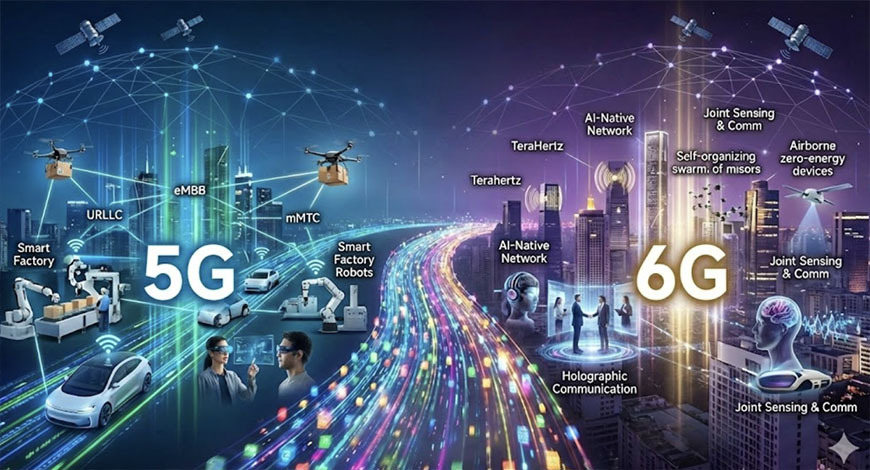
There are three broad capabilities commonly associated with 5G.
Enhanced mobile broadband: This capability supports high-speed internet access for activities such as video streaming, large downloads, cloud applications, and high-quality video calls.
Ultra-reliable, low-latency communications: This category focuses on applications that require dependable communication and low delays. Specialized implementations may support industrial automation and other time-sensitive systems, although performance requirements depend on the application.
Massive machine-type communications: This capability is intended to support large numbers of connected devices, including sensors, meters, and monitoring equipment.
Not every commercial 5G network offers all these capabilities to the same degree. Many consumer networks prioritize mobile broadband, while specialized industrial applications may require additional infrastructure and carefully configured services.
For American consumers, the most visible benefit is often improved mobile internet performance in locations with suitable 5G coverage.
For businesses, the technology can support connected equipment, remote monitoring, cloud-based workflows, and new digital services.
How 5G Is Changing Mobile Connectivity in America
The US wireless industry includes major carriers such as AT&T, Verizon, and T-Mobile, alongside smaller providers, infrastructure companies, and mobile virtual network operators.
These companies operate networks using different spectrum holdings, deployment strategies, and coverage arrangements. As a result, the experience of using 5G can differ between cities, suburban communities, rural areas, and individual buildings.
One important factor is the type of spectrum used.
Low-band spectrum can provide relatively broad coverage and better penetration into buildings, although available bandwidth may limit peak speeds.
Mid-band spectrum offers a useful balance between coverage and capacity and has become an important part of many 5G deployments.
High-band millimeter-wave spectrum can deliver very high speeds in suitable conditions but generally covers shorter distances and is more sensitive to obstacles.
Operators combine these approaches according to local requirements, available spectrum, and network economics.
The continued development of 5G also involves improving network equipment, expanding capacity, upgrading software, and connecting cell sites to reliable high-capacity infrastructure.
This means that a better 5G experience does not necessarily require an entirely new generation of mobile technology. Improvements to existing networks can also increase capacity, reliability, and coverage.
The Growing Role of Spectrum in US Wireless Development
Wireless spectrum consists of ranges of electromagnetic frequencies used for transmitting information through radio signals.
Spectrum is a limited resource that must be managed carefully because different services may rely on the same or nearby frequency ranges.
Mobile operators need suitable spectrum to provide coverage and capacity. Satellite services, aviation systems, public safety communications, and other technologies may also depend on particular frequency bands.
As demand for wireless data grows, US regulators and industry groups are examining how additional spectrum could be made available for commercial services while managing interference and protecting existing users.
In June 2026, Reuters reported that the Federal Communications Commission was pursuing plans for a 2027 auction involving upper C-band spectrum relevant to 5G capacity. Such developments demonstrate that spectrum planning remains important even while researchers prepare for 6G.
The status of specific auctions, allocations, and technical rules can change. Readers should verify current decisions through the Federal Communications Commission before treating a proposal as finalized.
Spectrum decisions can influence network investment for years. The frequency bands available to operators affect the coverage, performance, and cost of future mobile services.
What Is 6G Technology?
6G refers to the next generation of wireless communication technology being researched and developed for the period beyond 5G.
Unlike 5G, which already supports commercial mobile services, 6G is still in its development and standardization stages. Its precise capabilities, technical specifications, and commercial rollout schedule are not yet fully settled.
Research organizations are exploring how 6G might combine communication, artificial intelligence, advanced sensing, and improved network efficiency.
Potential objectives include higher data capacity, more responsive services, improved support for connected machines, and more intelligent use of network resources.
However, expected performance figures frequently discussed in early 6G research should not be interpreted as guaranteed speeds that consumers will receive. Real-world performance will depend on final standards, available spectrum, hardware, network deployment, and the application being used.
The US-based Next G Alliance, an industry initiative focused on North American wireless leadership, is working on research priorities and a roadmap for future generations of wireless technology.
Its September 2026 6G spectrum recommendations discuss the spectrum resources and policy considerations that could help support future commercial 6G networks.
This work illustrates that 6G development involves more than inventing a faster radio. It also requires spectrum planning, equipment development, security research, standards coordination, and investment across the wider technology ecosystem.
How Artificial Intelligence Could Improve 6G Networks
Artificial intelligence is expected to play an important role in the development of future wireless networks.
Modern cellular networks already use sophisticated software to manage traffic, allocate resources, monitor equipment, and identify performance problems. AI-assisted systems could expand these capabilities by helping operators analyze changing network conditions and make better operational decisions.
Intelligent Network Management
A future network could use AI-assisted tools to predict periods of high demand and allocate available resources more efficiently.
For example, a network serving a busy stadium may experience a sudden increase in mobile traffic before, during, and after an event.
Intelligent network management could help operators anticipate demand, monitor congestion, and adjust network resources where technically possible.
The effectiveness of these systems would depend on reliable data, suitable automation, and safeguards against incorrect decisions.
AI-Optimized Connectivity
Different applications have different communication requirements.
Video streaming may prioritize consistent throughput, while an industrial monitoring system may require predictable communication and rapid notification of unusual conditions.
AI-assisted network management could help identify these differences and support more suitable allocation of resources.
However, the network must still operate within its technical capacity and the service commitments made to customers.
Automated Network Maintenance
Wireless infrastructure includes antennas, radios, fiber connections, power systems, and software platforms.
AI-assisted monitoring may help operators identify patterns that indicate equipment degradation or unusual network behavior.
Predictive maintenance could allow technicians to investigate certain problems before they cause major service interruptions.
Such systems would supplement, rather than eliminate, engineering expertise and physical maintenance.
Smart Cities and the Internet of Things
The Internet of Things, or IoT, describes connected devices that collect, transmit, or exchange information.
These devices range from household thermostats and industrial sensors to traffic monitoring equipment and utility meters.
5G can support IoT applications where cellular coverage, capacity, or mobility is important. Future wireless technologies may expand these possibilities by improving network intelligence and supporting new forms of connected sensing.
Intelligent Transportation Systems
Cities can use connected sensors and communication systems to monitor traffic conditions, coordinate transportation services, and identify operational problems.
Wireless connectivity can help transfer information from roadside equipment, vehicles, and monitoring systems to authorized platforms.
However, transportation safety applications require careful engineering, dependable communications, and appropriate fallback mechanisms. Ordinary mobile internet should not automatically be treated as a safety-critical control system.
Smart Energy Management
Utilities can use connected devices to monitor electricity consumption, identify equipment problems, and coordinate selected operations.
Wireless networks may support remote monitoring and the transfer of information from distributed equipment.
The benefits depend on device design, network coverage, data quality, and integration with existing utility systems.
Connected Buildings
Offices, hotels, hospitals, and commercial buildings can use connected sensors to monitor temperature, occupancy, energy use, and equipment conditions.
Wireless connectivity can simplify certain deployments by reducing dependence on dedicated wired connections.
Nevertheless, building operators must consider device security, maintenance, interoperability, and the consequences of network outages.
5G and the Future of American Manufacturing
Manufacturing is an important potential application area for advanced wireless technology.
Factories increasingly use connected equipment, automated inspection systems, robotics, and digital monitoring tools. Reliable communication between devices can help support more coordinated production processes.
A private 5G network can provide dedicated wireless connectivity within a facility. Depending on the design, it may allow a manufacturer to manage its own local coverage, access controls, and network configuration.
This can be useful in environments where mobility, flexible equipment layouts, or large numbers of connected devices make conventional networking arrangements less convenient.
For example, a manufacturer might use wireless connectivity to collect information from mobile equipment, coordinate certain industrial devices, or transmit inspection data to an analytics platform.
However, private 5G is not automatically better than Wi-Fi or wired Ethernet for every industrial requirement.
Businesses should compare latency, reliability, coverage, interference, device compatibility, security, installation costs, and maintenance needs before selecting a network.
The best approach may involve several technologies working together rather than replacing existing infrastructure completely.
The Relationship Between 5G, Cloud Computing, and Edge Computing
Cloud computing allows organizations to run applications and store data using remote computing infrastructure.
Edge computing moves selected processing tasks closer to where information is generated or used.
These approaches can complement wireless connectivity.
A connected industrial sensor, for example, might transmit information over a private wireless network to a nearby edge computer. The edge system could process the information locally, while selected data is sent to a cloud platform for long-term analysis.
This arrangement may reduce the need to transmit every raw data point to a distant server.
For applications that require fast local responses, edge computing can help reduce communication delays associated with remote processing. However, the actual result depends on network architecture, processing requirements, and the location of the relevant systems.
Potential applications include industrial monitoring, video analytics, connected vehicles, and selected augmented-reality systems.
The combination of 5G, edge computing, and cloud platforms can create useful opportunities, but it also introduces integration and cybersecurity challenges.
Organizations need clear data management policies, reliable interfaces, and suitable controls over which systems can exchange information.
Satellite Connectivity and the Evolution of Wireless Networks
Traditional mobile networks rely heavily on terrestrial infrastructure, including cell towers and connected backhaul systems.
Satellite communications can provide another way to reach devices in locations where conventional networks are unavailable or difficult to deploy.
In the United States, companies are exploring satellite-to-device services intended to extend selected communication capabilities to compatible smartphones.
In October 2026, Reuters reported that SpaceX had announced an agreement to acquire an additional low-band spectrum portfolio, subject to regulatory approval. The report described the company’s plans to expand its Starlink Mobile capabilities and compete more directly with terrestrial wireless providers.
The announcement reflects growing interest in combining satellite infrastructure with mobile communications. The final capabilities and deployment arrangements depend on spectrum rights, regulatory approvals, satellite capacity, and network development.
Readers can review the Reuters report on SpaceX’s announced spectrum acquisition.
Satellite-to-device services should not be confused with 6G itself. They are a related development in the broader connectivity market.
In the future, terrestrial cellular networks and satellite systems may complement each other by serving different coverage requirements.
For consumers, the practical benefit will depend on which services are available, which devices are compatible, and whether the service supports messaging, voice, data, or only selected functions.
Cybersecurity Challenges for 5G and 6G
As wireless networks connect more devices and applications, cybersecurity becomes increasingly important.
Modern networks carry personal communications, business information, authentication data, and traffic associated with connected infrastructure.
A vulnerability in a network component or connected application may create risks beyond a single device.
Potential concerns include compromised user accounts, insecure device software, exposed management interfaces, supply-chain vulnerabilities, and attacks against poorly configured connected equipment.
Future networks that make greater use of AI may also introduce new risks involving automated decisions, data integrity, and unauthorized access to network management systems.
Telecommunications operators and equipment suppliers need to build security into system design and maintenance rather than relying exclusively on protection at the network perimeter.
Businesses deploying private 5G should also secure their local infrastructure, restrict administrative access, maintain software updates, and monitor suspicious activity.
IoT devices require similar attention. A connected sensor should not have unrestricted access to every system within a factory or building.
Network segmentation, identity controls, encryption where appropriate, security monitoring, and incident response procedures can help reduce exposure.
No network technology eliminates cyber risk completely. Security depends on the full system, including devices, applications, infrastructure, and the people who manage them.
Challenges Facing the Development of 6G
Although 6G research offers exciting possibilities, several major challenges must be addressed before widespread commercial deployment.
Spectrum Availability
Future networks may require access to suitable spectrum resources to deliver their intended performance.
Spectrum must be coordinated with existing users, and regulatory decisions can take years to complete.
Infrastructure Costs
New wireless capabilities may require upgraded radios, antennas, fiber connections, data centers, and other supporting equipment.
Network operators must determine whether the expected demand and revenue justify the investment.
Energy Efficiency
Greater network capacity can increase energy requirements if equipment and infrastructure are not designed efficiently.
Researchers are exploring ways to reduce power consumption through improved hardware, software, and network management.
Device Compatibility
New networks require compatible equipment. Consumers and businesses may need new devices or upgraded hardware before they can benefit from future capabilities.
Security and Reliability
As networks become more sophisticated, operators must manage larger software ecosystems, more connected devices, and additional dependencies.
Security testing, resilient architecture, and reliable recovery procedures will remain essential.
Standards and International Cooperation
Global wireless technologies depend on technical standards that allow equipment and services to work across different networks and markets.
Coordination between governments, researchers, manufacturers, and operators is necessary to support interoperability and commercial adoption.
These challenges demonstrate why 6G should be viewed as a long-term development program rather than an immediate replacement for 5G.
How 5G and 6G Could Affect American Businesses
Wireless innovation can create opportunities for companies in many industries, but the benefits depend on the problems being solved.
Retailers may use connected sensors and wireless devices to monitor inventory and improve operations.
Logistics companies can use cellular connectivity to support vehicle tracking, remote monitoring, and communication with distributed equipment.
Healthcare organizations may use connected devices to support selected monitoring and administrative applications, subject to appropriate clinical and privacy requirements.
Manufacturers can investigate private wireless networks for equipment connectivity and operational data collection.
Technology startups may develop applications that combine mobile connectivity with cloud services, AI, and connected devices.
However, businesses should not invest in new wireless infrastructure simply because it is described as next-generation technology.
They should begin by identifying a specific operational need and determining whether existing Wi-Fi, wired networking, or commercial cellular services can meet it.
A pilot project can help assess performance, integration requirements, security risks, and costs before a larger deployment.
The strongest business case is one that demonstrates measurable benefits rather than relying on theoretical maximum speeds.
What Consumers Should Know About 5G in 2026
For most consumers, 5G remains the practical wireless technology to consider when buying a smartphone or selecting a mobile service.
Actual performance depends on the carrier, the device, the location, and the type of 5G spectrum being used.
Before switching providers, consumers should examine coverage maps, service plans, device compatibility, data policies, and performance in the places they visit most frequently.
A phone advertised as supporting 5G may not deliver the same experience across every carrier or location.
Consumers should also remember that a higher peak speed does not automatically make every application noticeably better. Many everyday activities, such as messaging and browsing, already work well on capable existing networks.
6G, meanwhile, remains under development. People purchasing a smartphone in 2026 should not assume that an announced research capability is already available as a consumer service.
The best purchasing decision is based on current network coverage, device reliability, battery life, software support, and affordability.
The Future of Wireless Connectivity in the United States
The future of American wireless connectivity will likely involve several technologies working together.
5G networks will continue to evolve through improvements to infrastructure, spectrum use, and network software. Research into 6G will continue to explore new communication methods, AI integration, sensing capabilities, and more efficient network architectures.
Satellite connectivity may expand coverage options in some locations, while edge computing could support applications that benefit from local data processing.
Businesses will continue evaluating private wireless networks, connected industrial equipment, and IoT services where reliable connectivity can improve their operations.
Government policy and spectrum management will remain important because the availability of suitable frequencies influences network performance and investment decisions.
At the same time, the industry will need to address affordability, cybersecurity, energy consumption, and the digital divide between communities with different levels of network access.
The transition to 6G will take time. Research results must be translated into standards, tested in equipment, supported by compatible devices, and deployed through commercial networks.
For that reason, the most realistic outlook is one of gradual development rather than an overnight replacement of existing services.
Conclusion
5G and 6G technology represent important stages in the evolution of wireless connectivity in the United States.
5G already supports mobile broadband, connected devices, and specialized business applications. Continued improvements to network infrastructure and spectrum availability can strengthen its usefulness over time.
6G research is exploring how future networks might combine communications, artificial intelligence, advanced sensing, and improved resource management. These capabilities could eventually support new applications in manufacturing, transportation, connected infrastructure, and digital services.
However, 6G remains a developing technology, and its final specifications, commercial availability, and real-world performance are not yet settled.
For American consumers, the priority is choosing reliable mobile services that meet current needs. For businesses, the opportunity lies in identifying specific applications where better connectivity can produce measurable improvements.
For the telecommunications industry, long-term success will depend on spectrum planning, investment, interoperability, energy efficiency, and cybersecurity.
As research and deployment continue, the combination of 5G, future 6G systems, satellite connectivity, cloud computing, and AI may help shape the next era of American digital infrastructure.
Frequently Asked Questions
1. What is the difference between 5G and 6G?
5G is the fifth generation of cellular technology and is already commercially available. 6G is the next generation under research and development, with potential improvements in capacity, intelligent network management, sensing, and support for advanced applications.
2. Is 6G available in the USA in 2026?
6G is not yet a widely available commercial mobile service. Research, spectrum planning, technical development, and standardization work are underway, but consumers should continue to rely on existing cellular services.
3. Which US companies provide 5G services?
Major US wireless carriers include AT&T, Verizon, and T-Mobile. Availability, coverage, speed, and service terms vary by provider and location.
4. How will AI improve future wireless networks?
AI may help network operators predict demand, allocate resources, detect faults, and optimize certain network operations. Its effectiveness will depend on data quality, system design, security, and appropriate human oversight.
5. What is the role of spectrum in 5G and 6G?
Spectrum provides the radio frequencies used to transmit wireless signals. The bands available to operators influence coverage, capacity, performance, and the cost of deploying networks.
6. Can 5G support smart cities and IoT devices?
Yes. 5G can support connected sensors, industrial equipment, transportation systems, and other IoT applications. The suitability of the technology depends on the required coverage, device density, reliability, and cost.
7. Will 6G replace 5G immediately?
No. New generations of wireless technology typically require years of research, standardization, equipment development, and deployment. 5G is expected to remain important while 6G capabilities are developed and introduced.
8. Why is cybersecurity important for future wireless networks?
Wireless networks connect smartphones, businesses, infrastructure, and many other devices. Strong security controls help protect information, prevent unauthorized access, and maintain service reliability as networks become more interconnected.
9. How can businesses prepare for future wireless technology?
Businesses can review their connectivity needs, improve network security, assess existing infrastructure, test suitable applications, and monitor developments in standards and commercial services. They should invest based on measurable requirements rather than speculative promises.











No responses yet