
Introduction
The U.S. is building the manufacturing backbone for quantum computing. In mid-September 2026, two foundational CHIPS Act awards were finalized: $1 billion** to Anderon, IBM’s pure-play quantum foundry subsidiary, and **$375 million to GlobalFoundries for its Quantum Technology Solutions business . Together, the $1.375 billion in federal funding represents the largest coordinated investment in quantum manufacturing infrastructure in American history.
These aren’t research grants. They’re investments in the physical capacity to produce quantum processors at scale—the 300mm wafers, the cryogenic electronics, the specialized photonics that quantum computers require. And they come with a clear strategic logic: the country that manufactures quantum hardware will define the quantum era.
Anderon: America’s First Purpose-Built Quantum Foundry
On September 16, 2026, Anderon LLC, an IBM company, announced the finalization of its $1 billion award under the CHIPS and Science Act with the U.S. Department of Commerce . The award executes the preliminary letter of intent signed between IBM and the Commerce Department in May 2026 .
The Facility
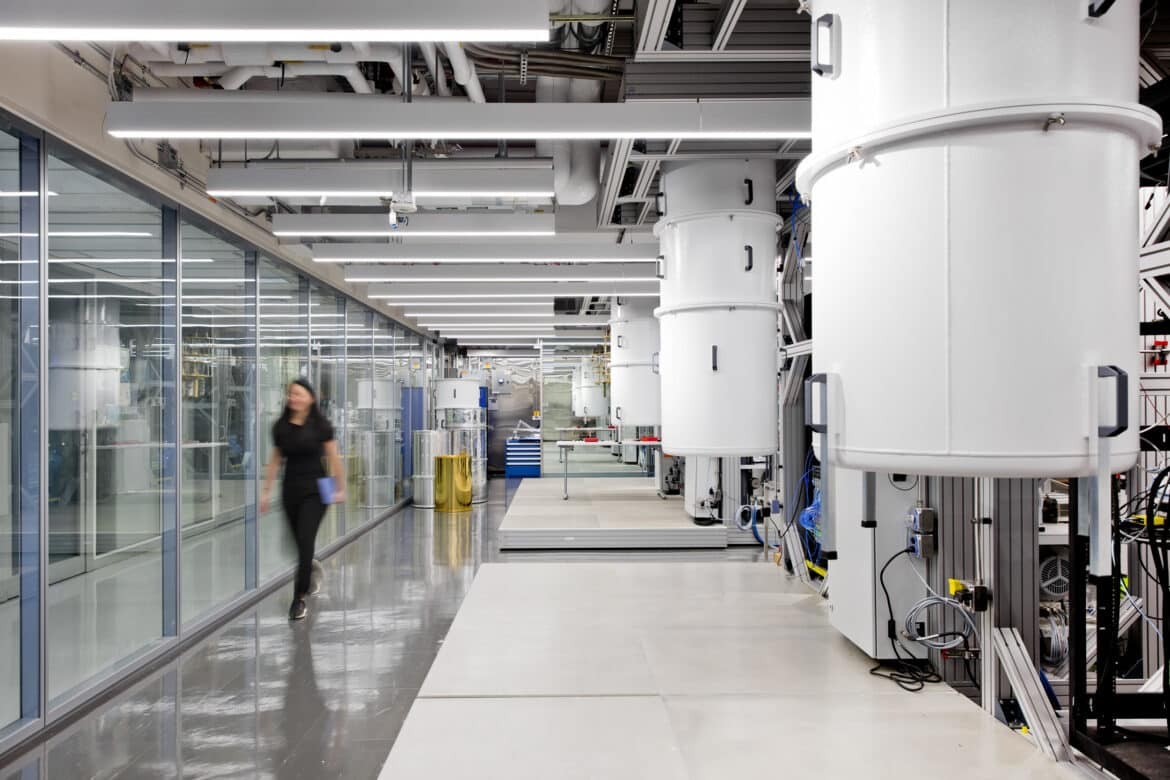
Anderon operates a state-of-the-art 300-millimeter pure-play quantum wafer foundry in Albany, New York, backed by an additional $1 billion investment from IBM . The company describes itself as “the world’s most advanced pure-play quantum foundry,” purpose-built to serve the quantum industry as an open commercial foundry .
Unlike a captive fab that produces only for its parent company, Anderon offers quantum wafer manufacturing to customers across the ecosystem. Its specialized wafers support high-performance superconducting qubit arrays, quantum input/output signaling, and readout signal chain components .
Operational Progress
The foundry has already achieved a significant milestone: first quantum wafers are now running through its manufacturing line . This early production activity demonstrates the ability to translate pre-production research into commercial-grade quantum wafer technologies.
“We’re building a foundation that will let quantum move from research breakthroughs to real-world impact,” said Mukesh Khare, CEO of Anderon .
IBM’s Strategic Logic
For IBM, Anderon serves a dual purpose. It provides the manufacturing foundation for IBM’s own quantum roadmap while also establishing a domestic supply chain that benefits the broader industry.
“IBM’s quantum roadmap requires a manufacturing foundation that can scale at the pace our work demands,” said Jay Gambetta, Director of IBM Research . “Anderon’s focus on wafer fabrication gives us exactly that and strengthens our ability to execute and accelerate progress toward the next era of quantum computing.”
The foundry’s operational roadmap includes expanding beyond superconducting qubit fabrication into complementary quantum modalities, including silicon photonics and spin-qubit architectures .
GlobalFoundries: $375 Million for Multi-Modality Quantum Manufacturing
One week earlier, on September 8, 2026, GlobalFoundries finalized its own $375 million award with the Commerce Department’s CHIPS Research and Development Office .
Quantum Technology Solutions
The funding accelerates GlobalFoundries’ Quantum Technology Solutions (QTS) business, established to help scale domestic quantum semiconductor manufacturing . Unlike Anderon’s focus on superconducting qubits, GlobalFoundries is building a foundry that serves multiple quantum architectures and modalities .
The company’s R&D efforts focus on three differentiated capabilities :
- Cryogenic CMOS process design kits – enabling control electronics that operate at the ultra-low temperatures quantum computers require
- Advanced packaging – integrating quantum chips with supporting electronics
- Heterogeneous integration – combining different materials and device types on a single platform
From Prototype to Production
The agreement reflects a critical transition in the quantum industry. Companies like Quantinuum have demonstrated working quantum processors, but moving from laboratory prototypes to commercial-scale production requires manufacturing infrastructure that doesn’t yet exist at scale.
GlobalFoundries is positioning itself as the foundry partner that bridges that gap. “Since launching, we have expanded engagement with customers and ecosystem partners who are leveraging GF’s R&D and manufacturing expertise to address some of the industry’s most challenging scaling requirements,” said Nicholas Sergeant, vice president and general manager of Quantum Technology Solutions .
The company is eligible to receive the full $375 million over five years, tied to the achievement of specified milestones .
The Quantinuum Connection: How the Foundries Fit Together
The two foundry awards aren’t happening in isolation. They’re directly connected to the quantum computing companies that received CHIPS funding in the same period.
Quantinuum, the trapped-ion quantum computing company that finalized its own $100 million CHIPS award on September 8, 2026, is partnering with both foundries .
Under the agreement, GlobalFoundries will fabricate Quantinuum’s next-generation ion traps and control electronics using 300mm wafer technology . This is a significant shift for trapped-ion quantum computing, which has historically relied on hand-assembled optical systems. Moving to semiconductor manufacturing processes could enable the reliability, repeatability, and scalability that commercial deployment requires.
Quantinuum is also working with Monarch Quantum to develop and manufacture scalable, reliable lasers and optical components .
“The road to large-scale, trapped-ion quantum computers relies on moving away from complex, sprawling optical setups to scalable, reliable integrated photonics engines,” said Dr. Timothy Day, CEO of Monarch Quantum .
This supply chain integration—quantum computing companies partnering with domestic foundries—is exactly what the CHIPS Act quantum investments were designed to achieve. As Tim Breen, CEO of GlobalFoundries, put it: “By bringing our expertise in high-volume, differentiated semiconductor manufacturing, we’re helping create a path to more scalable, reliable quantum hardware and advancing the next generation of American innovation” .
The Broader Quantum Manufacturing Ecosystem
The foundry awards are part of a larger effort to build domestic quantum manufacturing capacity.
NIST’s Quantum Manufacturing Engineering Center
In June 2026, NIST announced an agreement with SRI International to establish the Quantum Manufacturing Engineering Center (QMEC) , with an initial investment of $20 million . The center is designed to accelerate manufacturing of scalable, high-performance quantum components and systems.
“Quantum science promises to generate new knowledge and technologies that will supercharge scientific research and unlock enormous economic potential,” said Deputy Secretary of Commerce Paul Dabbar . “The new Quantum Manufacturing Engineering Center will bring together top experts to ensure both continued U.S. leadership in quantum technologies and that we are the epicenter of manufacturing quantum systems at scale.”
DOE’s Quantum Genesis Competition
The Department of Energy is also driving demand for quantum hardware. In September 2026, DOE launched the Quantum Genesis Q Competition, with up to $215 million in planned funding to demonstrate the world’s first fault-tolerant scientifically relevant quantum computers .
The competition targets systems with at least 100 logical qubits capable of performing hundreds of millions of fault-tolerant operations. Phase I provides fixed awards up to $1.5 million per awardee. Phase II includes a **$100 million general incentive pool** for systems demonstrating 100 logical qubits, with bonus pools of $50 million each for 150 and 200 logical qubits .
This creates a direct demand signal for the foundries. The quantum computing companies that win DOE funding will need access to the manufacturing capacity that Anderon and GlobalFoundries are building.
The Strategic Logic: Why Manufacturing Matters
The common thread across these investments is a recognition that quantum computing has reached a manufacturing problem.
For years, quantum research focused on demonstrating that qubits could be controlled with sufficient fidelity and coherence. That research has succeeded. Companies like Quantinuum have demonstrated systems with 99.92% two-qubit gate fidelities and published results in peer-reviewed journals.
But scaling from a laboratory system to a fault-tolerant quantum computer capable of solving real problems requires manufacturing at a scale that doesn’t yet exist. A system with 100 logical qubits might require thousands or tens of thousands of physical qubits, each with supporting control electronics, interconnects, and readout systems.
The foundries being built with CHIPS Act funding are designed to solve that problem. They’re not research facilities. They’re production facilities, built to manufacture quantum wafers at scale, with the process controls, testing capabilities, and supply chain integration that commercial production requires.
As Bill Frauenhofer, Executive Director of Semiconductor Investment and Innovation at the Commerce Department, said when the Anderon letter of intent was announced: “The Department of Commerce’s incentives strengthen and accelerate U.S. quantum leadership and technological resilience” .
What Comes Next
Anderon and GlobalFoundries now have the funding and the mandates to build domestic quantum manufacturing capacity. Quantinuum and other quantum computing companies have the funding to develop their hardware and the partnerships to manufacture it domestically. The DOE has a competition to drive demand for fault-tolerant systems.
What remains to be seen is whether this coordinated effort can produce commercially viable quantum computers on the timelines the government has set. The DOE’s Quantum Genesis competition targets demonstrations by 2028. The CHIPS Act awards run over five years.
The infrastructure is being built. The question is whether the technology will arrive to fill it.











No responses yet