
Introduction
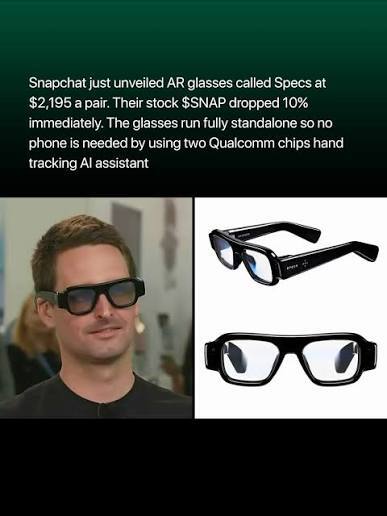
Snap Inc. is making its most ambitious bet yet on augmented reality. In mid-September 2026, the company launched Specs, a $2,195 pair of AR glasses that it is positioning not as a gadget, but as a new kind of computer .
The launch comes with heavyweight partners. Verizon is offering 5G connectivity through a specially designed charging case. Salesforce, Nvidia, and Amazon Web Services have signed on to bring enterprise AI tools to the device . And Snap has built an “anticipatory” AI service called Specs Intelligence that it says can understand your context and surface information before you ask for it .
But the price tag raises an obvious question. At $2,195—or $2,395 with the cellular charging case—Specs costs more than most laptops and nearly as much as a high-end gaming PC . Snap’s stock jumped 4.2% on the announcement, suggesting investors see potential . Whether consumers and businesses agree is another matter.
What Specs Actually Is
Snap CEO Evan Spiegel has been unusually direct about how he wants Specs to be understood. “Users need to understand that SPECS is a computer, not a pair of smart glasses for taking photos,” he said .
That distinction matters because it explains the price. Specs is not a pair of glasses with a camera and a Bluetooth connection. It has an integrated display that overlays digital content onto the wearer’s field of view. It can function as a wireless display for a PC or Mac, and supports Bluetooth peripherals like keyboards . It runs applications. It has an AI service that connects to your email, calendar, and other tools.
In other words, Snap is selling a wearable computer that happens to look like glasses.
The Hardware
The glasses weigh between 132 and 136 grams, which is heavier than a typical pair of eyeglasses but lighter than most VR headsets . They include an external LED that indicates when the device is actively recording—a privacy feature that Snap has emphasized. The company says Specs does not use facial recognition and does not continuously record audio, video, or images .
The charging case, sold with the glasses as part of a $2,395 bundle, provides four additional charges and cellular connectivity. In the U.S., that connectivity runs on Verizon’s 5G network, with data plans starting at $10 per month for Verizon customers and $20 for non-customers .
The Software: Specs Intelligence
The centerpiece of the software experience is Specs Intelligence, which Snap describes as an “anticipatory AI service” . It works across Specs, iPhone, and Mac, drawing from connected apps and tools to build context around a user’s goals, routines, and relationships. The idea is that it surfaces relevant information in your field of view without you having to explicitly ask for it.
Snap says users choose what to connect and what information Specs Intelligence can use. The company also states that personal content from connected accounts will not be used to train or fine-tune its AI models, and that Snap personnel cannot view or access personal content used with the service .
A preview is available in the U.S. through the Specs iOS app for users 18 and over.
The Enterprise Play: Salesforce, Nvidia, and AWS
Snap is not primarily targeting consumers with Specs. The company is pitching it as a workplace device for “deskless” workers—people on factory floors, in retail outlets, and in field service operations who need hands-free access to information but don’t have a desktop computer nearby .
The enterprise partnerships announced alongside the launch are central to that strategy:
Salesforce is integrating its Agentforce AI agent platform into Specs. Workers can pull up company data and automate routine tasks through the glasses .
Nvidia is powering the spatial AI, enabling Specs to interpret a worker’s visual environment and connect what it sees to relevant company data .
Amazon Web Services is providing an AI assistant framework that lets employees use voice commands to check inventory, look up product locations, and handle logistical queries .
Snap is also working with Trifork, an enterprise software company, and Hololight, an AR software firm, on additional workplace applications .
The pitch is straightforward: in environments where pulling out a phone or tablet is impractical, Specs offers a hands-free alternative. A field technician could see repair instructions overlaid on the equipment they’re working on. A retail worker could check stock without leaving the sales floor.
Consumer Features: Entertainment, Fitness, and Travel
Despite the enterprise focus, Snap has not neglected consumer use cases. The company announced a range of AR experiences designed to show what Specs can do beyond work .
Entertainment: The Specs browser supports streaming from YouTube and HBO Max on a virtual display that Snap says “feels like a 115-inch cinema screen placed about 10 feet away.” Spotify is also available. A partnership with HBO Max brings Harry Potter-themed experiences timed to the release of a new film this Christmas .
Fitness: Partnerships with the NBA and WNBA will deliver an interactive basketball training experience with AR visual guidance, drills, and progress tracking. Soccer and golf training applications are also in development .
Utilities: Real-time translation supports 60 languages. Augmented navigation overlays directions. A TripAdvisor integration surfaces information about nearby restaurants, landmarks, and attractions. A Shopify-powered experience lets users view products in 3D at full scale in their surroundings .
Multiplayer: Connected Lenses allow two Specs wearers to share digital experiences in the same physical space, with initial offerings including dominoes, chess, and table tennis .
The Pricing Problem
There is no way around it: $2,195 is a lot of money for a first-generation device. For context, that is more than an iPhone 16 Pro Max, more than most Windows laptops, and roughly the same as a high-end gaming PC .
Snap is clearly aware of the challenge. The company is opening a temporary showroom at Westfield Century City in Los Angeles starting October 1, where consumers can try Specs in person before buying . Verizon stores will also have demo units .
The comparison to Meta’s Ray-Ban smart glasses is inevitable. Meta’s device starts at around $300, but it does not have a display. It is a camera and audio device with AI features, not a computer. Snap is competing in a different category entirely—one where the only real comparison is Microsoft’s HoloLens, which costs $3,500 and has struggled to find a mainstream audience.
Snap’s bet is that the enterprise market will adopt Specs first, providing a revenue base while the consumer market matures. That is a familiar pattern in technology: expensive devices find their first home in business before becoming affordable enough for consumers. Whether that pattern holds for AR glasses remains to be seen.
What Comes Next
Specs is available for pre-order now with a $200 refundable deposit. Shipments are expected to begin later this fall in the U.S., U.K., and France . In France, Snap is partnering with Orange; in the U.K., with EE .
The company has not announced sales targets or production volumes. It has not said how many units it expects to ship or what it considers a successful launch.
What Snap has done is make a clear statement about where it thinks computing is headed. Spiegel’s framing—that Specs is “a computer, not a pair of smart glasses”—positions the device as a new platform rather than an accessory. Whether the world agrees will depend on whether developers build for it, enterprises adopt it, and consumers eventually decide they want one.
For now, Specs is a $2,195 bet that the future of computing is something you wear on your face.











No responses yet