
Introduction
Biotechnology is often associated with scientific research, laboratories, and the development of new medicines. However, turning a scientific discovery into a product that can be manufactured reliably and supplied to customers is an equally important challenge. This is where biomanufacturing plays a central role.
Biomanufacturing uses living cells, microorganisms, biological processes, or biological materials to produce medicines, chemicals, materials, and other useful products. It connects biotechnology research with industrial-scale production.
In the United States, biomanufacturing is becoming an increasingly important part of the healthcare and manufacturing economy. Pharmaceutical companies are investing in domestic production facilities, biotechnology businesses are developing more flexible manufacturing methods, and government programs are supporting efforts to strengthen supply chains.
During 2026, developments involving companies such as Amgen, Genentech, Johnson & Johnson, and Samsung Biologics have highlighted the scale of investment taking place in American manufacturing infrastructure. At the same time, federal initiatives are exploring ways to improve the production of advanced genetic medicines and essential pharmaceutical ingredients.
The industry is also adopting technologies such as artificial intelligence, automated laboratory equipment, advanced bioreactors, digital twins, and real-time process monitoring. These systems can help manufacturers improve consistency, identify production problems, and manage increasingly complex biological processes.
1. What Is Biomanufacturing?
Biomanufacturing is the use of biological systems to manufacture products on a commercial or industrial scale.
Unlike conventional manufacturing, which often relies on mechanical processing, chemical reactions, or the assembly of physical components, biomanufacturing uses biological materials as part of the production process.
These materials may include:
- Bacteria and other microorganisms.
- Yeast and fungal organisms.
- Mammalian cell cultures.
- Enzymes and biological catalysts.
- Plant-based biological systems.
- Engineered cells designed for specific production tasks.
Biomanufacturing is used in several industries, including pharmaceuticals, healthcare, agriculture, food production, industrial chemicals, and advanced materials.
For example, manufacturers can grow specially selected cells in controlled environments to produce therapeutic proteins. Other companies use microorganisms to create enzymes, ingredients, or materials for industrial applications.
The process requires careful control because living systems can respond to changes in temperature, nutrients, acidity, oxygen levels, and other environmental conditions.
Successful biomanufacturing therefore combines biology, engineering, chemistry, automation, quality control, and specialized facility management.
2. Why the USA Is Expanding Its Biomanufacturing Industry
The United States has a major biotechnology and pharmaceutical sector. However, the production of medicines and important biological ingredients depends on complex global supply chains.
When manufacturing is concentrated in a limited number of locations, disruptions can create difficulties for companies and healthcare providers.
Domestic biomanufacturing investment is intended to improve production capacity, strengthen supply chains, and support access to important products.
Strengthening medicine supply chains
Manufacturing medicines involves multiple stages, including raw material sourcing, biological production, purification, testing, packaging, and distribution.
A disruption at any stage can affect the availability of a finished product.
Expanding production capacity in the United States can provide additional manufacturing options and reduce dependence on individual overseas suppliers.
Supporting advanced treatments
Modern medicine increasingly includes complex biological products such as monoclonal antibodies, cell therapies, and genetic medicines.
These treatments require specialized manufacturing facilities, trained workers, and strict quality-control procedures.
Investment in advanced biomanufacturing can help companies prepare for future production requirements.
Creating skilled jobs
Biomanufacturing facilities require scientists, engineers, laboratory technicians, quality specialists, maintenance teams, and production operators.
New facilities can also generate construction, logistics, equipment, and supporting service opportunities.
Improving manufacturing capabilities
Companies are investing in modern equipment and production methods to improve consistency, flexibility, and operational efficiency.
The long-term objective is not simply to build more factories. It is to create facilities capable of manufacturing increasingly sophisticated products reliably.
3. AI Is Making Biomanufacturing More Intelligent
Artificial intelligence is becoming an important tool in advanced manufacturing.
Biological production processes can generate enormous amounts of information. Sensors monitor conditions inside production equipment, while laboratory systems collect data about product quality and biological performance.
AI can help manufacturers analyze these datasets and identify patterns.
Monitoring production conditions
Bioreactors require controlled conditions for cells or microorganisms to grow and produce the intended biological material.
Temperature, pH, oxygen levels, nutrient concentrations, and mixing conditions can all influence production.
AI-assisted monitoring tools can examine sensor information and identify unusual changes that may require investigation.
Predicting production problems
Machine-learning systems can analyze historical production records to identify patterns associated with equipment problems, unexpected changes, or process variation.
These insights may help manufacturing teams investigate issues earlier.
Improving process development
Developing a biological production process can involve testing different combinations of nutrients, operating conditions, and production parameters.
AI-assisted analysis can help researchers organize experiments and identify promising conditions for further testing.
Supporting quality management
AI tools may help review manufacturing records, detect unusual data patterns, and prioritize certain quality-control investigations.
However, pharmaceutical manufacturing requires validated processes and regulatory compliance. AI recommendations do not replace required laboratory testing, professional judgment, or quality assurance.
4. Advanced Bioreactors Are at the Center of Modern Production
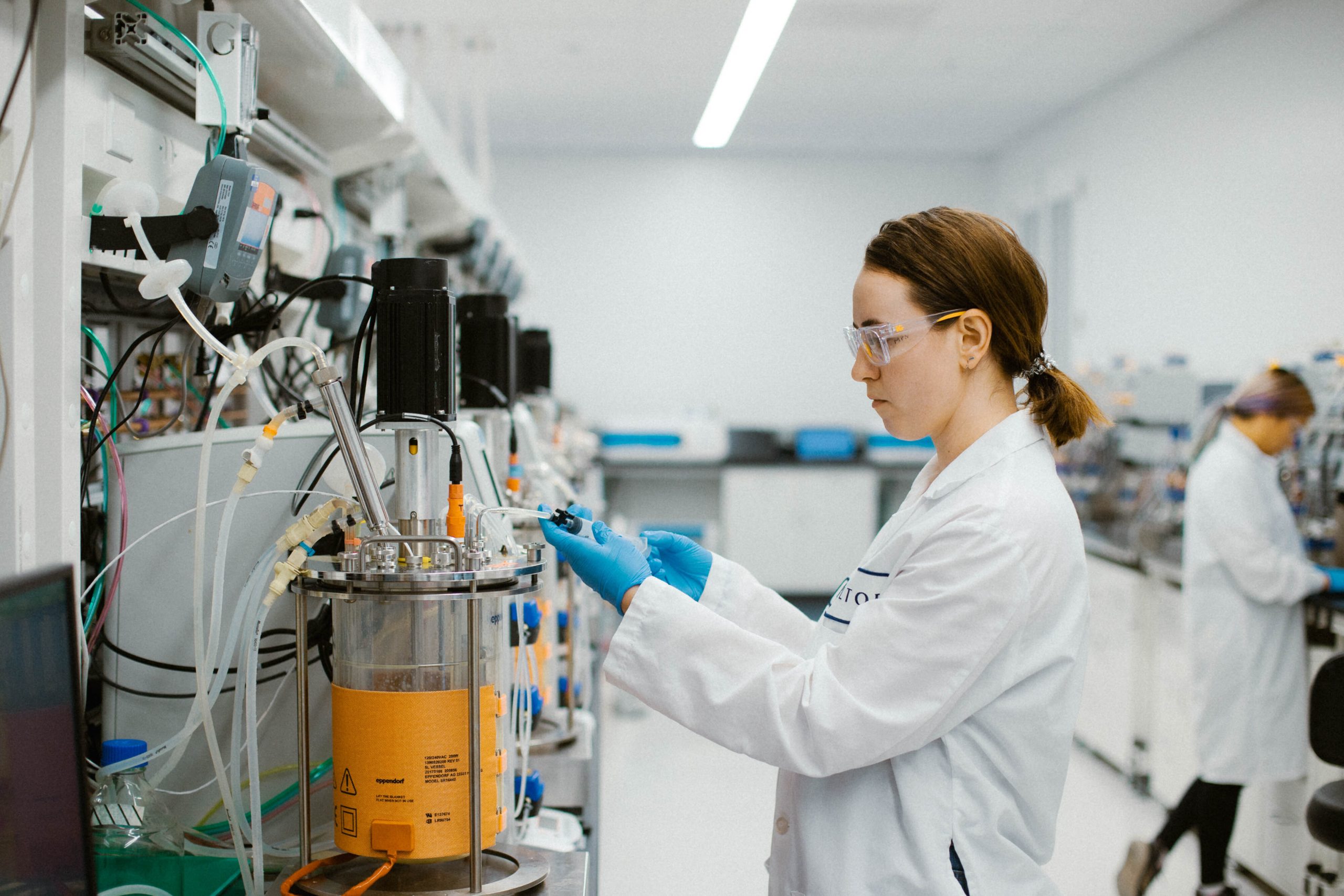
A bioreactor is a specialized vessel or system designed to support biological processes under controlled conditions.
It provides an environment where cells or microorganisms can grow and produce a target substance.
Bioreactors are essential in the production of many biological medicines, enzymes, and industrial biotechnology products.
How bioreactors work
A typical bioreactor system may control:
- Temperature.
- Acidity or pH.
- Oxygen supply.
- Nutrient delivery.
- Mixing and circulation.
- Foam formation.
- Biological growth conditions.
The exact requirements depend on the organism, cell type, and product being manufactured.
Single-use bioreactor technology
Some facilities use disposable or single-use production equipment instead of relying entirely on large stainless-steel systems.
Single-use bioreactors use specialized bags and other components designed for controlled biological production.
Potential advantages include reduced cleaning requirements, faster changeovers, and flexibility when manufacturing different products.
However, manufacturers must also consider material compatibility, supply availability, waste management, scale limitations, and validation requirements.
Continuous biomanufacturing
Traditional biological manufacturing often uses batch processes, in which production takes place in defined stages.
Continuous manufacturing aims to maintain production through a more connected process, potentially improving equipment utilization and reducing certain delays.
The approach can be valuable, but biological systems are complex. Continuous production requires reliable monitoring, process control, and strong quality assurance.
5. Biologics Manufacturing Is Becoming More Important
Biologics are medicines produced using biological systems rather than relying exclusively on conventional chemical synthesis.
They include products such as therapeutic proteins, monoclonal antibodies, and certain vaccines.
These medicines can be used to treat cancer, autoimmune conditions, metabolic diseases, and other serious health conditions.
Why biologics require specialized facilities
Biological products can be sensitive to temperature, contamination, and changes in manufacturing conditions.
Their production may involve several stages:
- Cell-line development.
- Cell culture.
- Bioreactor production.
- Harvesting.
- Purification.
- Formulation.
- Filling and packaging.
- Quality testing.
Each stage must be carefully controlled to protect product quality and patient safety.
Growing manufacturing capacity
In January 2026, Genentech announced that it had increased its planned investment in a new biomanufacturing facility in Holly Springs, North Carolina, to approximately $2 billion.
The expansion is intended to increase production capacity and support the company’s broader US manufacturing strategy.
The project is expected to support more than 2,000 jobs, including construction and manufacturing positions.
In August 2026, Genentech reported a major construction milestone and highlighted the use of an AI-powered digital twin to create a virtual representation of manufacturing operations.
This development illustrates how modern pharmaceutical facilities are combining physical manufacturing infrastructure with advanced digital systems.
6. Cell Therapy Manufacturing Is Expanding in the USA
Cell therapy is an advanced area of medicine that uses living cells as part of a treatment.
Some cell therapies involve collecting cells, modifying or preparing them, testing them, and returning them to a patient under controlled medical procedures.
Manufacturing these treatments can be particularly challenging because certain products are highly specialized and may be prepared for individual patients.
Why cell therapy production is complicated
Cell-based treatments may require:
- Specialized collection and processing equipment.
- Controlled manufacturing environments.
- Strict identity and traceability systems.
- Temperature-controlled transportation.
- Detailed quality testing.
- Coordination between manufacturing facilities and healthcare providers.
Unlike many conventional medicines, some individualized cell therapies cannot simply be manufactured in large quantities and stored for general distribution.
Johnson & Johnson’s Pennsylvania investment
On February 18, 2026, Johnson & Johnson announced an investment of more than $1 billion in a next-generation cell therapy manufacturing facility in Montgomery County, Pennsylvania.
The company said the project would support more than 4,000 construction jobs and approximately 500 biomanufacturing jobs once operational.
The investment is part of the company’s wider commitment to expand its US manufacturing and research infrastructure.
This project demonstrates how advanced therapies are influencing the design of new pharmaceutical manufacturing facilities.
7. Automated and Distributed Manufacturing Could Change Genetic Medicine Production
One of the most interesting developments in 2026 involves efforts to make genetic medicine production more flexible and accessible.
Some genetic medicines require specialized manufacturing processes that can be expensive and time-consuming.
A centralized production model may also create transportation and scheduling challenges, particularly when treatments require carefully controlled handling.
ARPA-H’s GIVE program
On September 1, 2026, the Advanced Research Projects Agency for Health (ARPA-H) announced five teams selected for its Genetic Medicines and Individualized Manufacturing for Everyone program, known as GIVE.
The initiative is intended to support the development of automated and distributed manufacturing technology for individualized RNA-based genetic medicines.
ARPA-H announced that the program could provide up to $125 million in research and development funding.
The goal is to explore a different production model in which advanced manufacturing systems could eventually make certain genetic medicines closer to the patients who need them.
This is an ambitious research and development effort, not evidence that fully distributed production is already widely available.
Why distributed manufacturing matters
If successful, distributed production systems could offer several potential benefits:
- More flexible manufacturing capacity.
- Reduced dependence on a limited number of production sites.
- New approaches to individualized treatments.
- Better integration of automated equipment.
- Opportunities to improve manufacturing accessibility.
The technology still needs to demonstrate safety, quality, reliability, and regulatory compliance before widespread implementation.
8. Domestic Pharmaceutical Manufacturing Is Receiving Regulatory Attention
Building a modern pharmaceutical facility requires significant investment, but construction alone does not make a site ready to produce approved medicines.
Manufacturers must meet applicable regulatory standards, establish validated production processes, and demonstrate that their products consistently meet quality requirements.
The US Food and Drug Administration plays a central role in overseeing pharmaceutical manufacturing and product quality.
FDA PreCheck pilot program
On June 29, 2026, the FDA announced seven participants selected for its PreCheck pilot program.
The initiative is designed to encourage domestic pharmaceutical manufacturing by supporting earlier regulatory engagement for companies developing new US production facilities.
The program aims to make facility development and regulatory preparation more predictable while supporting domestic manufacturing capacity and supply-chain resilience.
It does not remove the requirement for companies to meet applicable regulatory standards or obtain necessary approvals.
Why early regulatory engagement matters
Pharmaceutical factories are highly specialized environments.
Facility design, equipment selection, contamination controls, production procedures, and quality systems must work together.
Early technical discussions can help manufacturers identify potential issues during development rather than waiting until a facility is close to completion.
This can support more effective planning and reduce the risk of expensive design changes.
9. Major Company Investments Are Reshaping US Biomanufacturing
Several developments in 2026 demonstrate the scale of investment across American pharmaceutical and biotechnology manufacturing.
Amgen expands US manufacturing
On May 4, 2026, Amgen announced an additional $300 million investment in its US manufacturing network.
The company said this brought its planned US manufacturing commitments announced over the preceding year to nearly $2 billion.
The investment included an expansion of its biologics manufacturing facility in Juncos, Puerto Rico.
The project is intended to strengthen production capacity, support advanced manufacturing technology, and reinforce the company’s supply network.
Samsung Biologics opens its first US manufacturing facility
On March 31, 2026, Samsung Biologics celebrated the opening of its first US manufacturing facility in Rockville, Maryland.
The acquisition of the manufacturing campus involved an investment of approximately $353 million and retained more than 500 local jobs.
The facility adds 60,000 liters of drug-substance manufacturing capacity to the company’s operations.
The development represents an important step in expanding the company’s manufacturing presence in the United States.
Roche and Genentech expand production
Genentech’s approximately $2 billion Holly Springs facility represents another major investment in US biologics manufacturing.
The project combines large-scale production infrastructure with digital technology, including an AI-powered digital twin.
Together, these developments show how global pharmaceutical companies are investing in American manufacturing capacity while introducing modern production systems.
10. Industrial Biomanufacturing Is Moving Beyond Medicine
Biomanufacturing is not limited to pharmaceutical products.
Biological systems can also be used to create materials, chemicals, enzymes, and ingredients for other industries.
This broader field is often described as industrial biotechnology.
Bio-based chemicals
Some microorganisms can produce chemicals that are traditionally manufactured through petroleum-based processes.
Companies are exploring biological methods to manufacture selected ingredients and industrial compounds.
The environmental and economic advantages depend on production efficiency, feedstocks, energy use, and the complete manufacturing process.
Advanced biological materials
Research organizations and biotechnology companies are exploring materials produced through engineered biological systems.
Examples include specialized proteins, bio-based polymers, and other materials with potential applications in textiles, packaging, construction, and manufacturing.
Agricultural and food applications
Biomanufacturing can support the production of enzymes, fermentation-derived ingredients, and other materials used in food and agricultural industries.
These applications demonstrate how biological production methods could become relevant to multiple sectors of the American economy.
11. How Digital Twins Are Improving Biomanufacturing Facilities
Digital twin technology is becoming increasingly useful in advanced industrial environments.
A digital twin is a virtual representation of a physical facility, process, or piece of equipment.
In biomanufacturing, a digital twin may combine information from production sensors, equipment systems, engineering models, and operational databases.
Monitoring factory performance
Digital systems can help manufacturers understand equipment performance, production conditions, and selected operational activities.
Supporting facility design
Engineers can use digital models to study facility layouts, equipment placement, and connections between different production areas.
Improving maintenance planning
A digital model connected to equipment information may help maintenance teams understand operating conditions and plan inspections.
Exploring process changes
Virtual models can support analysis of proposed changes before they are introduced into physical manufacturing operations.
However, a digital twin is only as useful as the data and models behind it. It cannot independently guarantee product quality or replace required production validation.
12. Challenges Facing the US Biomanufacturing Industry
Despite major investments, biomanufacturing faces several challenges.
High facility costs
Advanced pharmaceutical facilities require specialized construction, cleanrooms, production equipment, water systems, environmental controls, and quality laboratories.
The cost of developing and operating these facilities can be substantial.
Skilled workforce requirements
Biomanufacturing depends on workers with knowledge of biology, engineering, chemistry, quality assurance, automation, and regulated production.
Companies must invest in education, technical training, and workforce development.
Complex regulatory requirements
Manufacturers must follow applicable good manufacturing practices and other regulatory requirements.
Maintaining product consistency requires validated processes, documented procedures, testing, and strong quality-management systems.
Raw material supply chains
Biological production depends on specialized materials, including culture media, filters, single-use components, laboratory supplies, and other manufacturing inputs.
Supply disruptions can affect production schedules.
Technology integration
Modern facilities may combine robotics, AI systems, sensors, laboratory equipment, and production software.
Connecting these systems securely and reliably requires careful engineering.
Scale-up difficulties
A process that works in a laboratory does not automatically work at industrial scale.
Changes in mixing, oxygen transfer, temperature control, and other conditions can affect biological performance.
Companies must conduct careful development and validation before moving production to larger facilities.
13. The Future of Biomanufacturing in the USA
The future of American biomanufacturing is likely to involve greater automation, more flexible production systems, improved digital monitoring, and stronger connections between research and industrial manufacturing.
Several developments deserve attention.
AI-supported production systems
AI may become more widely used to analyze manufacturing data, support process development, and identify unusual operating conditions.
More flexible manufacturing facilities
Facilities may increasingly be designed to handle different biological products or production processes, subject to equipment and regulatory requirements.
Automated genetic medicine production
Programs such as ARPA-H’s GIVE initiative could help advance new methods for producing individualized genetic medicines.
Stronger domestic supply networks
Companies may continue investing in American manufacturing facilities and supplier relationships to improve production resilience.
More industrial biotechnology applications
Biological manufacturing could expand into additional areas, including advanced materials, specialty chemicals, agriculture, and food ingredients.
Digital manufacturing infrastructure
Digital twins, connected sensors, and automated process-control systems may become increasingly important in the management of complex facilities.
The pace of development will depend on technical performance, investment, regulation, market demand, and the ability to manufacture products economically.
Conclusion
Biomanufacturing is becoming a major part of the future of American biotechnology and industrial production. It connects biological research with large-scale manufacturing and supports the production of medicines, advanced therapies, chemicals, and specialized materials.
Developments in 2026 show that the United States is investing in new manufacturing facilities, advanced biologics production, cell therapy infrastructure, and more flexible genetic medicine manufacturing approaches.
Companies such as Amgen, Genentech, Johnson & Johnson, and Samsung Biologics are contributing to this changing industrial landscape. Meanwhile, initiatives from the FDA and ARPA-H are supporting new approaches to domestic pharmaceutical production and manufacturing innovation.
However, success will depend on more than investment announcements. Companies must develop reliable processes, train skilled workers, maintain strict quality standards, secure supply chains, and demonstrate that new technologies can operate safely at commercial scale.
As AI, automation, digital twins, and advanced biological production systems continue to improve, biomanufacturing could become an increasingly important source of innovation, skilled employment, and industrial competitiveness in the United States.
The next generation of American manufacturing may not rely only on machines and conventional materials. It may also increasingly depend on the ability to use biology as a precise, scalable, and carefully controlled production technology.
Frequently Asked Questions (FAQs)
1. What is biomanufacturing?
Biomanufacturing is the use of living cells, microorganisms, enzymes, or other biological systems to produce medicines, chemicals, materials, and other commercial products.
2. Why is biomanufacturing important in the USA?
It supports pharmaceutical production, advanced medicine development, domestic supply-chain resilience, industrial innovation, and skilled employment.
3. How is AI used in biomanufacturing?
AI can analyze production data, monitor biological processes, identify unusual patterns, support process development, and assist with manufacturing quality management.
4. What is a bioreactor?
A bioreactor is a controlled vessel or system used to grow cells or microorganisms and support biological production processes.
5. What is biologics manufacturing?
Biologics manufacturing involves producing medicines using biological systems. Products can include therapeutic proteins, monoclonal antibodies, and certain vaccines.
6. What is cell therapy manufacturing?
It is the specialized production and processing of living cells for medical treatment. Some processes involve preparing cells for individual patients under carefully controlled conditions.
7. What is the ARPA-H GIVE program?
The Genetic Medicines and Individualized Manufacturing for Everyone program is an ARPA-H initiative intended to advance automated and distributed manufacturing technology for individualized RNA-based genetic medicines.
8. Which companies are investing in US biomanufacturing?
Companies with notable 2026 manufacturing developments include Amgen, Genentech, Johnson & Johnson, Samsung Biologics, and others.
9. What is the FDA PreCheck pilot program?
It is an FDA initiative intended to support domestic pharmaceutical manufacturing through earlier regulatory engagement with selected companies developing new US manufacturing facilities.
10. What is the future of biomanufacturing?
Future developments may include AI-assisted production, automated facilities, flexible bioreactors, digital twins, advanced cell therapies, and broader applications of industrial biotechnology.











No responses yet