
Introduction: Why Carbon Capture Technology Is Gaining Attention in the USA
The United States is entering a new phase of industrial and energy innovation. Artificial intelligence, advanced manufacturing, electricity demand, and infrastructure investment are changing how American companies operate. At the same time, industries are looking for practical ways to reduce carbon dioxide emissions while maintaining reliable production and energy supplies.
One technology receiving increasing attention is carbon capture. It involves separating carbon dioxide from industrial emissions or, in some cases, removing it directly from the atmosphere. The captured carbon dioxide can then be transported for suitable uses or placed in approved long-term storage.
Carbon capture is not a single technology. It includes several approaches designed for different applications, ranging from chemical processing systems installed at industrial facilities to direct air capture machines that remove carbon dioxide from ambient air.
In the United States, research and development programs are exploring ways to improve capture efficiency, reduce operating costs, develop carbon transportation infrastructure, and verify long-term storage. The US Department of Energy (DOE) supports research, pilot projects, and demonstration programs across the carbon management sector. Its Carbon Management program provides information about these initiatives.
The sector also faces important challenges. Carbon capture systems can require substantial energy, expensive equipment, suitable storage locations, and extensive monitoring. Some technologies are still developing, and announced projects do not always reach commercial operation.
For this reason, carbon capture should be understood as one potential component of a broader climate and industrial strategy—not a universal solution to every emissions problem.
What Is Carbon Capture Technology?
Carbon capture technology separates carbon dioxide (CO₂) from a gas stream or removes it from the atmosphere. Depending on the system, the captured carbon dioxide may be compressed, transported, used in an industrial process, or stored underground.
The purpose and climate impact depend on the complete process. Capturing carbon dioxide is only one stage. Its eventual destination, the energy required for capture, the reliability of storage, and any additional emissions must also be considered.
For example, a cement plant may capture some of the carbon dioxide produced during manufacturing. A direct air capture facility, by contrast, removes carbon dioxide from the surrounding air, where its concentration is much lower than in many industrial exhaust streams.
Both approaches can contribute to carbon management, but they have different engineering requirements and cost structures.
The Main Types of Carbon Capture Technology
1. Point-source carbon capture
Point-source systems capture carbon dioxide from identifiable sources such as industrial plants, processing facilities, and certain power generation installations. Because the gas stream may contain a relatively concentrated amount of CO₂, separation can be more practical than removing the same quantity from ambient air.
2. Direct air capture
Direct air capture (DAC) removes carbon dioxide directly from the atmosphere. These systems use chemical materials or other separation methods to extract CO₂ from air. The carbon dioxide must then be managed through storage or another destination.
3. Carbon capture and storage
Carbon capture and storage (CCS) refers to capturing carbon dioxide and placing it in suitable long-term storage, commonly in carefully selected geological formations. Storage projects require appropriate site characterization, regulatory approvals, monitoring, and safeguards.
4. Carbon capture, utilization, and storage
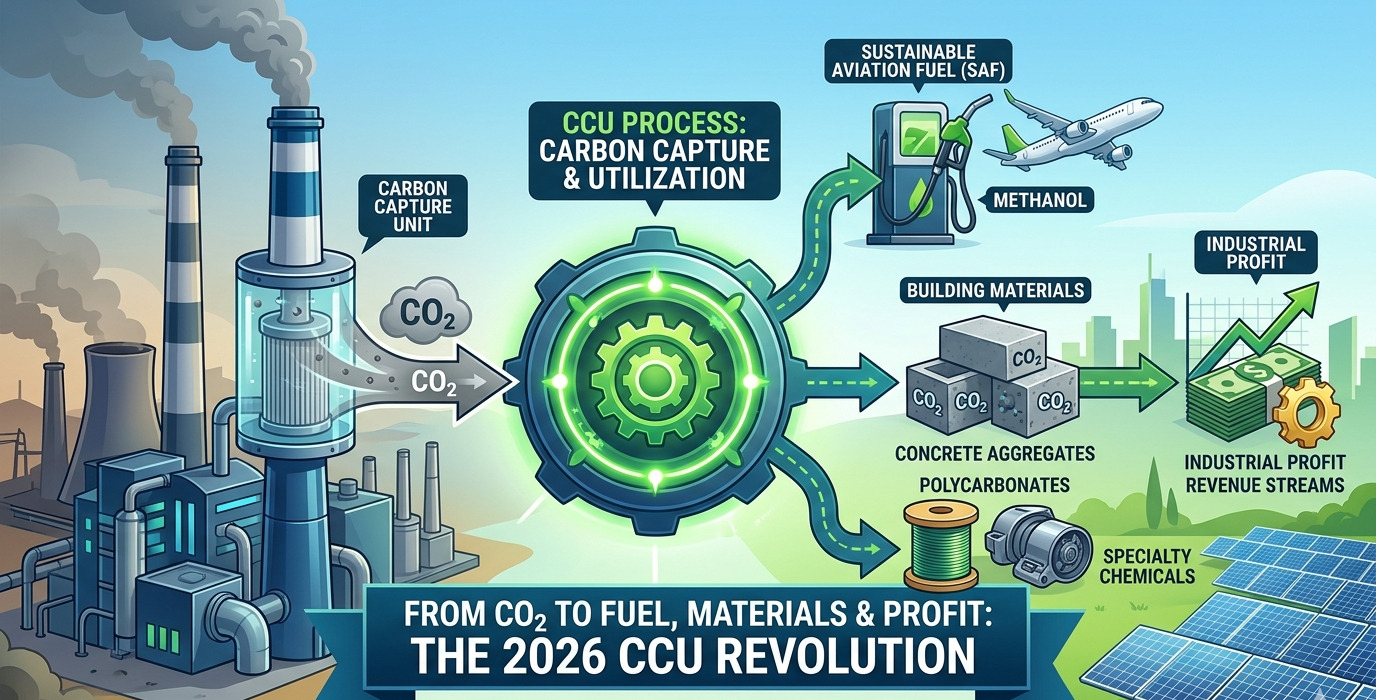
Carbon capture, utilization, and storage (CCUS) includes approaches in which captured carbon dioxide is used in products or industrial processes, with some projects also storing a portion of it.
Utilization does not automatically mean permanent carbon removal. The environmental benefit depends on what the carbon dioxide is used for, how long it remains contained, and the emissions associated with the process.
How Carbon Capture Systems Work
The specific engineering depends on the technology and the source of the carbon dioxide. However, many projects follow a similar sequence.
Step 1: Identify the Carbon Dioxide Source
Engineers first assess the gas stream or atmospheric conditions. Important factors include carbon dioxide concentration, temperature, pressure, contaminants, and the amount of gas that must be processed.
These characteristics help determine which capture method is suitable.
Step 2: Separate the Carbon Dioxide
Capture equipment separates carbon dioxide from other gases or from ambient air.
Some systems use liquid solvents that absorb CO₂ and release it when heated. Others use solid sorbents, membranes, or alternative separation techniques.
Different methods have different energy requirements, operating limitations, and equipment costs.
Step 3: Condition and Compress the Captured Gas
After separation, the carbon dioxide may need additional processing to meet the requirements of its intended destination. Compression can reduce its volume and prepare it for transportation or injection, depending on the system design.
The process requires energy and suitable equipment, adding to the overall cost.
Step 4: Transport the Carbon Dioxide
Captured carbon dioxide may move through pipelines or, where suitable, other transportation methods. Transport arrangements depend on the project’s location, quantity, distance, infrastructure, and intended use.
Infrastructure planning must address safety, monitoring, operating procedures, and applicable regulations.
Step 5: Store or Use the Carbon Dioxide
For geological storage, operators inject the carbon dioxide into an approved underground formation designed to contain it. Monitoring and verification help assess whether the storage operation is performing as intended.
In utilization projects, carbon dioxide may be incorporated into selected products or industrial processes. The climate benefit depends on the specific use and the lifecycle emissions involved.
The entire chain matters. A capture system cannot deliver its intended climate benefit if transportation is unreliable, storage is unsuitable, or the full process creates excessive additional emissions.
Why Carbon Capture Matters for the American Economy in 2026
The United States has a large industrial economy that produces materials, chemicals, fuels, and manufactured products for domestic and international markets. Some industrial processes generate carbon dioxide through fuel consumption, while others produce it through chemical reactions that are integral to manufacturing.
Cement production is one example. Carbon dioxide can be released not only by heating materials but also by the chemical transformation of limestone into lime. Improving energy efficiency is important, but it cannot eliminate every process-related emission.
Similar challenges can occur in certain chemical and industrial operations.
Carbon capture may offer an additional option where emissions are difficult to eliminate through efficiency improvements or alternative production methods alone. However, it must be compared with other options, including electrification, renewable energy, alternative materials, process redesign, and demand reduction.
The US Department of Energy funds research intended to improve the cost, performance, and reliability of carbon capture systems. Its Point Source Carbon Capture program describes research into solvents, sorbents, membranes, and other technologies.
This work is important because commercial deployment depends on more than proving that a technology can capture carbon dioxide. Systems must also operate reliably, fit into industrial facilities, use acceptable amounts of energy, and provide measurable environmental benefits.
Direct Air Capture: Removing Carbon Dioxide From the Atmosphere
Direct air capture is one of the most discussed areas of climate technology. Unlike point-source capture, which targets carbon dioxide from a specific industrial stream, DAC extracts carbon dioxide from ordinary ambient air.
This distinction makes direct air capture attractive for some carbon removal applications, but it also creates a major engineering challenge: atmospheric carbon dioxide is relatively dilute. Large volumes of air must pass through the capture system to collect meaningful quantities of CO₂.
How Direct Air Capture Works
A typical DAC system draws air across a material that selectively captures carbon dioxide. Depending on the design, the material may be a liquid chemical solution or a solid sorbent.
The captured carbon dioxide is then released through a regeneration process. Heat, vacuum, or other methods may be used, depending on the technology.
The separated gas can subsequently be compressed and transported for storage or another suitable destination.
The system’s performance depends on the capture material, operating conditions, energy source, maintenance requirements, and local climate.
Why Direct Air Capture Is Challenging
DAC generally requires processing substantial amounts of air. Fans, pumps, heating systems, and separation equipment can consume considerable energy.
Facilities also need space, access to appropriate energy and water resources where required, and a credible plan for handling the captured carbon dioxide.
The climate benefit must be assessed over the full lifecycle. If a facility uses energy associated with substantial emissions, the net amount of carbon dioxide removed may be much lower than the gross amount captured.
US Research and Development
The Department of Energy supports carbon dioxide removal research, including direct air capture and other approaches. Its Carbon Dioxide Removal program describes research and initiatives aimed at developing and improving these technologies.
Research programs can help evaluate capture materials, demonstrate equipment at larger scales, and gather performance information. Nevertheless, early-stage research, pilot operation, and established commercial deployment are different stages of development.
Businesses and investors should examine the status and independently verified performance of individual projects before assuming that a technology is ready for widespread use.
Carbon Capture in American Cement and Manufacturing Industries
Industrial manufacturing is an important area for carbon capture because certain processes generate emissions that are difficult to eliminate through conventional energy improvements alone.
Cement Production
Cement is a fundamental material for American buildings, bridges, roads, and other infrastructure. Its manufacture involves heating limestone and other materials at high temperatures.
During cement production, the chemical conversion of limestone releases carbon dioxide. This process-related component makes cement a particularly relevant industry for capture research.
Engineers are investigating different approaches to capturing CO₂ from cement plant exhaust streams. These approaches include solvent-based systems and alternative methods designed to work under industrial conditions.
For example, the DOE’s National Energy Technology Laboratory has documented a project involving cryogenic carbon capture at an industrial cement facility in Missouri. The project description outlines engineering-scale development and testing objectives. Details are available through the NETL project information page.
A project target is not the same as a verified commercial result. Readers should distinguish between announced goals, completed demonstrations, and independently confirmed operating performance.
Chemical Manufacturing
Some chemical production processes create concentrated carbon dioxide streams that may be suitable for capture. The economics depend on the chemical process, gas composition, plant design, and intended use or storage location.
A capture system may be easier to integrate when carbon dioxide is already present in a concentrated stream. Other installations may require more complex treatment and additional equipment.
Steel and Other Heavy Industries
Industrial facilities may investigate carbon capture as one option for reducing emissions from existing processes. Its suitability varies according to production technology and available alternatives.
For some facilities, process redesign, material substitution, electrification, or low-carbon energy may be more appropriate. In other cases, carbon capture could complement these measures.
A careful project assessment should compare the cost, energy use, technical maturity, and total lifecycle emissions of the available options.
Carbon Storage and Underground Geological Formations
Capturing carbon dioxide is only part of a long-term storage project. Once the gas is captured and transported, operators need a suitable destination and a reliable plan for managing it.
Geological storage involves injecting carbon dioxide into underground formations selected for their ability to contain it under appropriate conditions.
How Geological Storage Works
Potential storage formations may include deep saline formations and certain depleted oil and gas reservoirs. Their suitability depends on geological characteristics, pressure conditions, available capacity, and the integrity of the surrounding rock formations.
Before a storage project proceeds, developers must evaluate the site, understand potential migration pathways, and establish monitoring and risk-management procedures.
Why Monitoring Is Essential
Operators need to assess whether the injected carbon dioxide remains within the intended storage complex and whether the project is operating safely.
Monitoring approaches may include pressure measurements, well-integrity assessments, geological analysis, and other techniques appropriate to the site.
Storage projects also require contingency planning and compliance with applicable regulatory requirements.
EPA Oversight in the United States
The US Environmental Protection Agency (EPA) regulates underground injection activities through its Underground Injection Control framework. Class VI wells are specifically designed for the geological sequestration of carbon dioxide.
The EPA explains the requirements and regulatory framework on its Class VI Wells for Geological Sequestration page.
The applicable approval process can depend on the location, regulatory authority, and characteristics of the project. Developers must account for relevant federal, state, and local requirements.
Strong monitoring and regulatory oversight are central to public confidence because underground storage projects are intended to manage carbon dioxide over long periods.
Major Benefits of Carbon Capture Technology
Carbon capture can offer several potential benefits when applied to suitable sources and supported by effective storage or utilization systems.
1. Reducing Emissions From Selected Industrial Processes
Some industrial processes generate carbon dioxide as an inherent part of production. Capture technology may reduce the amount released directly into the atmosphere when alternatives are limited or difficult to implement.
The actual reduction depends on capture performance and the emissions associated with the rest of the process.
2. Supporting Industrial Innovation
Developing capture systems requires expertise in chemical engineering, materials science, process design, construction, monitoring, and environmental management.
This creates opportunities for research organizations, engineering firms, equipment suppliers, and technology developers.
3. Creating Opportunities for Infrastructure Development
Some projects require pipelines, compression equipment, storage facilities, monitoring systems, and supporting infrastructure.
These needs may create business opportunities, although projects also require careful siting, financing, safety planning, and regulatory review.
4. Supporting Research and Advanced Manufacturing
Carbon capture research can lead to advances in solvents, membranes, sorbents, heat management, and process engineering.
Some improvements may have applications beyond carbon management, depending on the materials and methods developed.
5. Providing a Potential Carbon Removal Option
Direct air capture paired with suitable long-term storage can remove carbon dioxide from the atmosphere. This differs from capturing emissions before they enter the atmosphere.
Its overall climate value depends on the amount durably stored and the emissions generated during construction, energy supply, operation, and transportation.
These potential benefits should be evaluated against costs, environmental effects, and alternative approaches rather than assumed for every project.
Challenges Facing the US Carbon Capture Industry
Despite continued research, carbon capture faces important technical, financial, and public-policy challenges.
High Capital and Operating Costs
Capture equipment can be expensive to design, install, and operate. Facilities may need new processing units, additional energy supplies, compression equipment, and infrastructure for transporting carbon dioxide.
Direct air capture can face particularly demanding energy and equipment requirements because the carbon dioxide concentration in ambient air is low.
Project developers must consider both initial investment and long-term operating costs.
Additional Energy Requirements
Many capture processes require heat, electricity, or both. Supplying that energy can increase operating expenses and may create additional emissions if the energy source is carbon-intensive.
For this reason, net emissions reductions matter more than the amount captured at a single stage.
Transportation Infrastructure
Carbon dioxide often needs to move from its capture location to a suitable storage or utilization site. If the required infrastructure does not exist, a project may need to coordinate with other developers or invest in new transport systems.
Transportation planning involves routing, engineering, safety, land access, and applicable permits.
Long-Term Storage and Liability
Geological storage requires suitable sites, careful well design, ongoing monitoring, and clear arrangements for managing potential problems.
Public confidence can be affected by concerns about well integrity, groundwater protection, emergency response, and long-term responsibility.
Community Engagement
Projects may affect communities through construction activity, land use, traffic, industrial development, or proposed pipeline routes.
Early communication, transparent environmental assessments, meaningful public participation, and clear explanations of risks are important for responsible project development.
Uncertain Project Economics
The financial viability of carbon capture can depend on equipment costs, energy prices, industrial demand, regulatory requirements, available infrastructure, and applicable tax incentives.
Projects should be evaluated using realistic assumptions and sensitivity analysis rather than relying entirely on optimistic forecasts.
Government Support, Research Funding, and the 45Q Tax Credit
Government programs have played an important role in supporting carbon capture research and demonstration projects in the United States.
The Department of Energy’s carbon management portfolio includes programs for capture demonstrations, large-scale pilots, direct air capture hubs, and related technologies. The DOE also provides the CONNECT Toolkit, which offers information about federally supported carbon management research and development projects.
Understanding the 45Q Tax Credit
Section 45Q of the US tax code provides a tax credit framework for qualifying carbon oxides captured from eligible sources or directly from the air and then stored or used in qualifying ways.
The credit has been amended over time, and its availability depends on applicable legal requirements, project characteristics, and compliance with relevant rules.
The US Government Accountability Office published a report on the credit in August 2026, examining its administration and evaluation. The report notes that assessing the program’s effectiveness is challenging when there are no clearly defined overall goals and no single agency responsible for measuring results. Read the GAO report on the carbon capture tax credit for more information.
This is an important distinction for businesses and investors: a tax incentive can improve a project’s financial outlook, but it does not automatically prove that the project is economically viable or delivers the intended climate benefit.
Companies considering carbon capture investments should review current tax law and consult qualified legal and tax professionals before relying on a particular credit.
Business Opportunities in the American Carbon Capture Market
Carbon capture development involves more than the companies that design the capture equipment. Projects can require a broad network of suppliers, engineering specialists, research institutions, infrastructure operators, and monitoring providers.
Equipment and Materials Suppliers
Capture systems may need specialized pumps, compressors, heat exchangers, separation equipment, chemical solvents, membranes, and sorbent materials.
Suppliers that can meet demanding industrial performance and reliability requirements may find opportunities as projects progress from research to deployment.
Engineering and Construction Services
Industrial capture facilities require site assessments, process engineering, equipment installation, commissioning, and ongoing maintenance.
Companies with relevant experience in chemical processing and industrial infrastructure may be able to contribute to project development.
Monitoring and Verification Services
Storage projects require suitable monitoring and reporting procedures. Specialized service providers may support geological assessment, well-integrity evaluation, data analysis, and compliance documentation.
The exact services required depend on the project design and regulatory framework.
Software and Data Analytics
Software can support facility monitoring, equipment maintenance, process optimization, emissions accounting, and storage-site analysis.
Digital monitoring tools do not replace physical inspections or regulatory requirements, but they can help operators organize data and investigate changes in operating conditions.
Research and Development
Universities, national laboratories, startups, and established industrial companies are developing materials and processes intended to improve carbon capture performance.
Potential opportunities include more durable capture materials, lower-energy regeneration methods, improved process integration, and techniques for reducing equipment costs.
For businesses entering this sector, the most promising opportunities will depend on demonstrated technical performance, customer demand, project financing, and applicable regulations.
The Future of Carbon Capture Technology in the USA
Carbon capture is likely to remain an area of technical research and industrial debate as the United States evaluates ways to manage emissions from different economic sectors.
The pace of deployment will depend on costs, energy availability, infrastructure, environmental performance, public acceptance, and government policy.
More Efficient Capture Materials
Researchers are exploring solvents, sorbents, membranes, and other separation technologies designed to improve carbon dioxide capture while reducing energy consumption and equipment requirements.
Even modest improvements in operating efficiency may matter for large industrial facilities, where systems must process substantial volumes of gas.
Wider Use of Industrial Demonstrations
Pilot and demonstration projects allow developers to test systems under real operating conditions. These projects can reveal maintenance requirements, equipment limitations, and performance issues that may not be apparent in laboratory testing.
Successful demonstrations can provide evidence for future investment, but results from one facility may not transfer directly to another.
Development of Carbon Transportation and Storage Networks
A capture facility needs a practical destination for the carbon dioxide. Coordinated infrastructure may help connect industrial sources with suitable storage locations, but such networks require investment, permitting, engineering, and community engagement.
Infrastructure development will therefore be an important factor in determining where projects can operate.
Better Measurement and Verification
Reliable measurement is necessary to determine how much carbon dioxide is captured, transported, stored, or used.
Improved monitoring and reporting can help operators demonstrate performance, support regulatory compliance, and give buyers and the public more confidence in project claims.
Greater Focus on Lifecycle Emissions
Future evaluations will need to consider the complete process, including energy consumption, materials, transportation, capture performance, and the durability of storage or utilization.
A system that captures a large quantity of carbon dioxide may deliver a smaller net climate benefit if its energy and infrastructure requirements create substantial additional emissions.
Is Carbon Capture a Complete Solution to Climate Change?
No. Carbon capture can help address certain sources of carbon dioxide emissions, but it cannot replace every other climate measure.
Reducing unnecessary energy consumption, improving efficiency, using lower-emission energy sources, electrifying suitable processes, and redesigning industrial production can all contribute to emissions reduction.
Carbon capture may be particularly relevant for some industrial processes where emissions are difficult to eliminate through other methods. Direct air capture with durable storage may also offer a way to remove carbon dioxide already present in the atmosphere.
However, the technology’s costs, energy needs, infrastructure requirements, and environmental performance must be considered carefully.
The best approach will differ by industry and location. Some facilities may benefit from carbon capture, while others may achieve better outcomes through process improvements or alternative technologies.
A balanced strategy evaluates each option according to its actual emissions impact, cost, technical readiness, and environmental consequences.
Conclusion
Carbon capture technology is becoming an important subject in the American conversation about industrial innovation, energy systems, and climate solutions. From point-source capture at manufacturing facilities to direct air capture and underground geological storage, different technologies offer ways to manage carbon dioxide in specific circumstances.
The United States has active research programs, industrial demonstrations, regulatory frameworks, and financial incentives connected to this field. These efforts are helping researchers and businesses investigate better capture materials, improve process efficiency, and develop methods for transporting and storing carbon dioxide.
Nevertheless, significant challenges remain. High costs, energy requirements, infrastructure limitations, storage oversight, and uncertainty about long-term project economics can affect whether an individual project succeeds.
For companies, investors, and technology professionals, the most important question is not simply whether carbon capture can work. It is whether a particular system can deliver measurable emissions reductions safely, reliably, and at a reasonable cost.
In 2026 and beyond, progress will depend on transparent performance data, rigorous engineering, responsible regulation, community engagement, and continued comparison with alternative climate technologies.
Carbon capture may become a valuable part of the American industrial toolkit, but its contribution will ultimately depend on real-world results rather than promises alone.
Frequently Asked Questions (FAQs)
1. What is carbon capture technology?
Carbon capture technology separates carbon dioxide from industrial gas streams or removes it directly from the atmosphere. The captured CO₂ may be stored underground or used in certain industrial processes.
2. How does carbon capture work in the USA?
US projects use or investigate different separation methods, including chemical solvents, sorbents, membranes, and other approaches. Captured carbon dioxide may be compressed, transported, and stored or utilized under applicable requirements.
3. What is the difference between CCS and CCUS?
CCS means carbon capture and storage, generally involving long-term storage of captured carbon dioxide. CCUS means carbon capture, utilization, and storage, covering projects that use captured carbon dioxide as well as those that store it.
4. What is direct air capture?
Direct air capture removes carbon dioxide directly from ambient air. Because atmospheric CO₂ is relatively dilute, these systems need to process substantial volumes of air and can require significant energy.
5. Is carbon capture technology widely available?
Some carbon capture technologies have been used in industrial applications, while other systems remain in research, pilot, or demonstration stages. Deployment varies by technology, industry, location, and project economics.
6. What industries can use carbon capture?
Potential applications include cement, chemicals, certain power generation facilities, and other industrial operations. Suitability depends on the source of emissions, available alternatives, capture costs, and access to transport and storage infrastructure.
7. Is carbon capture environmentally beneficial?
It can reduce emissions or remove carbon dioxide when the complete process delivers a meaningful net benefit. Evaluation should include energy use, additional emissions, transportation, storage durability, and possible environmental impacts.
8. What is the 45Q tax credit?
Section 45Q is a US federal tax credit framework for qualifying carbon oxide capture and storage or use. Eligibility and credit amounts depend on current law and the specific project, so businesses should obtain current professional tax guidance.
9. What role does the EPA play in carbon storage?
The EPA administers relevant environmental regulations, including requirements for Class VI wells used for geological sequestration of carbon dioxide. Specific projects may also need other federal, state, and local approvals.
10. What is the future of carbon capture technology in the USA?
Future progress may involve improved capture materials, more efficient systems, expanded monitoring capabilities, and better transportation and storage infrastructure. Wider adoption will depend on verified performance, costs, policy, and environmental safeguards.











No responses yet