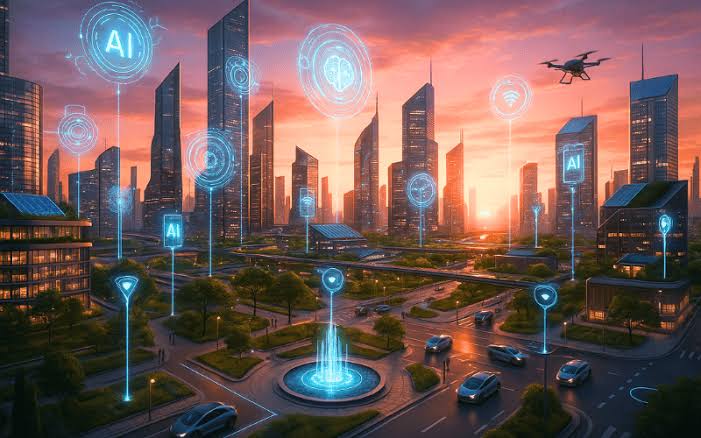

Introduction: How Smart City Technology Is Transforming America
American cities are facing increasingly complex challenges. Growing populations, aging infrastructure, traffic congestion, energy demand, extreme weather, and pressure on public budgets are encouraging local governments to explore more efficient ways to manage urban services.
Smart city technology is emerging as one approach to addressing these challenges. By combining artificial intelligence (AI), connected sensors, cloud computing, data analytics, digital communication networks, and automated systems, cities can collect useful information about how their infrastructure operates and make better-informed decisions.
In 2026, smart city development is increasingly focused on practical outcomes rather than technology alone. Local governments are exploring tools that can help identify road damage, improve traffic coordination, monitor environmental conditions, manage public facilities, and deliver services more efficiently.
The US Department of Transportation has long supported research into intelligent transportation systems and connected vehicles. Meanwhile, the National Institute of Standards and Technology (NIST) has developed smart communities frameworks and technical resources focused on interoperability, security, reliability, and privacy. These efforts reflect an important principle: smart city systems work best when different technologies can communicate securely and serve clearly defined public needs.
AI is adding another dimension to this transformation. Instead of simply collecting information, connected systems can use analytics to identify patterns, forecast potential problems, and help city officials prioritize resources.
However, smart city development also introduces concerns about surveillance, cybersecurity, funding, data ownership, and unequal access to digital services.
This article explores smart city technology in the USA in 2026, its major applications, the organizations and technologies involved, the challenges cities must address, and the future of connected urban infrastructure.
1. What Is Smart City Technology?
Smart city technology refers to digital systems and connected infrastructure that help communities improve public services, manage resources, and respond to local needs.
A smart city does not necessarily need to replace all its existing infrastructure. Many projects begin by improving one specific service, such as traffic signals, street lighting, water monitoring, or public transportation.
A smart city system may include several components:
- Internet of Things (IoT) sensors: Collect information from roads, buildings, vehicles, utility systems, and public spaces.
- Artificial intelligence: Helps analyze data, identify patterns, and support operational decisions.
- Cloud computing: Provides computing resources and storage for applications and connected systems.
- Communication networks: Transfer information between devices, public agencies, and software platforms.
- Geographic information systems (GIS): Help visualize locations, infrastructure, and geographic data.
- Digital dashboards: Present operational information to city employees and decision-makers.
- Automation systems: Perform defined tasks based on schedules, sensor readings, or approved rules.
For example, a city might install sensors that monitor water levels in a drainage system. When readings indicate a potential problem, the system could alert maintenance staff, who can investigate before conditions become more serious.
The technology does not make a city intelligent by itself. The real value comes from combining accurate information with good planning, appropriate policies, trained personnel, and effective public services.
According to NIST’s smart cities research, standards-based solutions and interoperability are important for making systems scalable and trustworthy.
Source: https://www.nist.gov/programs-projects/cyber-physical-systemsinternet-things-smart-cities
2. Artificial Intelligence Is Changing City Management
Artificial intelligence is becoming an important tool for analyzing the large amounts of information generated by modern urban infrastructure.
Traditional city management often relies on reports, manual inspections, historical records, and information collected by separate departments. AI-supported systems can help bring these information sources together, allowing officials to identify patterns and prioritize work.
Predictive maintenance
Roads, bridges, water pipes, streetlights, and public buildings require regular maintenance. Waiting until equipment fails can increase repair costs and disrupt essential services.
AI-assisted predictive maintenance uses available information, such as equipment condition, sensor readings, inspection reports, and historical failures, to estimate which assets may require attention.
For example, a city maintenance department might use inspection images and historical records to prioritize roads showing signs of deterioration.
These predictions are not guarantees. Officials must validate the information and consider physical inspections, engineering requirements, and available resources.
Public service automation
AI can also help process routine administrative tasks. A city website might use an AI-assisted system to direct residents to relevant permit information, explain application procedures, or route service requests to the correct department.
Human review remains important when a request involves legal rights, eligibility decisions, emergencies, or other high-impact matters.
Better resource allocation
City managers must often decide how to allocate limited budgets among competing needs.
Data analytics can help identify areas with repeated infrastructure problems, unusually high service demand, or inefficient operations. This information can support planning, although budget decisions should also account for equity, community priorities, and local circumstances.
In July 2026, the US Department of Transportation announced an AI-focused initiative intended to modernize how American transportation infrastructure is designed, operated, and maintained. The initiative highlights the growing interest in applying AI to practical infrastructure challenges.
3. Intelligent Traffic Management and Connected Transportation
Traffic congestion is one of the most visible problems in many American metropolitan areas. Long commutes can waste time, increase fuel consumption, and make it harder for emergency vehicles and public transportation to move efficiently.
Smart transportation technology aims to help cities understand traffic conditions and coordinate their transportation systems more effectively.
Adaptive traffic signals
Traditional traffic signals may operate using fixed timing schedules. Adaptive systems can use information from vehicle detectors, cameras, or other sensors to adjust signal timing according to changing traffic conditions.
For example, a system may extend a green light when traffic demand is high on a particular approach, provided that the adjustment remains within the signal’s safety and operational rules.
The actual benefit depends on road design, traffic patterns, system quality, and coordination with nearby intersections.
Connected vehicles
Connected vehicle technology allows vehicles and infrastructure to exchange certain information using wireless communication.
Vehicle-to-vehicle (V2V) communication can share information between suitably equipped vehicles. Vehicle-to-infrastructure (V2I) communication can allow vehicles and roadside equipment to exchange relevant information.
Potential applications include warnings about hazards, work zones, sudden braking, and selected traffic conditions.
The US Department of Transportation identifies vehicle-to-everything communication as a technology with potential applications in road safety and transportation efficiency. Its benefits depend on compatible equipment, deployment quality, and appropriate security safeguards.
Source: https://www.transportation.gov/research-and-technology/how-connected-vehicles-work
Public transportation coordination
Smart transportation systems can combine information about buses, trains, passenger demand, traffic conditions, and service disruptions.
Transit agencies may use this information to improve scheduling, communicate delays, and evaluate where additional service could be useful.
For residents, reliable travel information can make public transportation easier to use. For city planners, operational data can help identify routes where service improvements may have the greatest impact.
4. Smart Streetlights and Connected Public Infrastructure
Street lighting is an important part of public infrastructure, affecting nighttime visibility, pedestrian movement, and road safety.
Connected lighting systems can help municipalities monitor equipment and manage energy use more efficiently.
Intelligent lighting controls
Smart streetlights may adjust brightness according to schedules, ambient light, or approved sensor inputs. Maintenance teams can receive alerts when a lamp or controller stops working.
This can reduce the need for routine manual checks and help crews prioritize repairs.
Energy efficiency
Replacing older lighting equipment with energy-efficient alternatives can reduce electricity consumption. Connected controls may provide additional savings where reduced lighting levels are appropriate and permitted.
Cities must still maintain suitable visibility for drivers, cyclists, pedestrians, and emergency services.
Infrastructure monitoring
Connected streetlight networks may also provide locations for certain communication devices or environmental sensors, depending on the infrastructure design.
However, adding multiple functions increases the importance of secure configuration, maintenance planning, and clear data-management policies.
A city should evaluate the total lifecycle cost of these systems, including hardware replacement, software subscriptions, connectivity, cybersecurity, and staff training.
5. Smart Energy Systems and Sustainable Buildings
Energy management is another major area of smart city development. Cities operate public buildings, streetlights, water systems, transit facilities, and other infrastructure that consume electricity and fuel.
Digital monitoring can help identify waste and improve how energy is used.
Smart buildings
Connected building systems can monitor temperature, lighting, occupancy, and equipment performance. Depending on their design, these systems can adjust heating, ventilation, air conditioning, and lighting to match building requirements.
For example, an office building may reduce heating or cooling in selected areas when they are unoccupied, while maintaining safe and comfortable conditions.
Smart grids
Smart grid technology uses digital monitoring and communication to improve visibility into electricity generation, distribution, and consumption.
Utilities can use grid sensors and automated equipment to detect certain faults, monitor changing demand, and support restoration efforts.
Smart grids are particularly relevant as electricity systems integrate additional renewable generation, energy storage, electric vehicles, and other technologies that change how power is produced and consumed.
Electric vehicle charging
Connected charging infrastructure can help operators monitor charger availability, energy use, equipment status, and charging demand.
Cities can use this information to plan charging locations and understand whether public charging facilities are meeting local needs.
Smart charging may also help manage demand by shifting certain charging sessions to more suitable periods, depending on electricity prices, grid conditions, and user requirements.
6. Smart Water Management and Environmental Monitoring
Water infrastructure is essential to public health and urban resilience. Many communities need to manage aging pipes, changing water demand, stormwater, flooding, and environmental quality.
Smart monitoring systems can help officials identify potential problems earlier and direct inspections toward areas of concern.
Detecting water leaks
Water utilities may use pressure sensors, flow meters, acoustic monitoring, and data analysis to investigate unusual changes in water distribution networks.
These tools can help identify possible leaks or abnormal usage patterns, although further testing may be needed to determine the exact cause.
Flood monitoring
Sensors that measure rainfall, drainage levels, river conditions, or water accumulation can provide information for flood planning.
When connected to alert systems, the information may help local agencies communicate warnings and coordinate response activities.
Forecasting and warning systems still depend on data quality, weather information, infrastructure conditions, and effective emergency procedures.
Air quality monitoring
Environmental sensors can measure selected pollutants and other local conditions. City officials can use the information to investigate pollution patterns or assess changes over time.
Sensor readings require proper calibration and interpretation. Low-cost devices may not provide the same accuracy as certified monitoring instruments.
Waste management
Connected waste containers and route-planning software can help waste-management teams monitor collection needs and organize service routes.
The potential benefits include fewer unnecessary collection trips and improved operational planning, but results depend on equipment reliability, route constraints, and actual waste-generation patterns.
7. Smart Public Safety and Emergency Response
Technology can support public safety by helping emergency services collect information, coordinate resources, and communicate with residents.
However, public safety systems must be designed carefully because mistakes can have serious consequences.
Emergency communication
Digital alert systems can distribute information about severe weather, evacuation instructions, road closures, and other urgent situations.
Effective systems should be accessible to people with disabilities and provide information in languages commonly used by the community where feasible.
Emergency vehicle coordination
Connected traffic infrastructure may help emergency services communicate with traffic-management systems and identify suitable routes.
Any signal-priority system must preserve safe operation for pedestrians, cyclists, and other road users.
Disaster preparedness
Cities can combine geographic information, infrastructure records, weather forecasts, and historical incident data to support disaster planning.
For example, planners may use maps to identify vulnerable infrastructure or evaluate how flooding could affect evacuation routes.
Responsible use of surveillance technology
Cameras and other monitoring systems may be used for specific public safety purposes, but they also raise questions about privacy, retention, access, and the potential for misuse.
Cities should define clear policies for data collection and use, provide appropriate oversight, and evaluate whether less intrusive alternatives could achieve the same objective.
Smart public safety should improve the ability to protect residents without creating unnecessary or disproportionate surveillance.
8. Cybersecurity and Privacy in Smart Cities
A connected city may depend on thousands of devices and multiple software platforms. These systems create new opportunities, but they can also introduce vulnerabilities.
A compromised traffic-management system, utility network, or emergency communication platform could disrupt important services.
Why cybersecurity matters
Smart city devices may use different operating systems, communication methods, and maintenance schedules. Some devices may remain in service for many years, making consistent updates and security management challenging.
Cities need to understand which systems are connected, which data they collect, and what would happen if a component failed or was compromised.
Essential security practices
A responsible smart city program should consider:
- Strong authentication and access controls.
- Encryption where appropriate.
- Timely software updates and vulnerability management.
- Network segmentation to limit the spread of attacks.
- Secure procurement and supplier assessments.
- Backups and tested recovery procedures.
- Monitoring for unusual system behavior.
- Incident-response plans and staff training.
Cybersecurity should be included during system design and procurement, rather than added only after deployment.
Protecting residents’ privacy
Smart city projects may collect location information, images, vehicle data, or information about how public facilities are used.
Municipalities should identify the minimum data needed for a specific purpose and establish rules for access, sharing, storage, and deletion.
The NIST Cybersecurity Framework and Privacy Framework provide resources that organizations can use to manage security and privacy risks.
Official resource: https://www.nist.gov/cybersecurity-and-privacy
9. Major Smart City Technology Providers and the Innovation Ecosystem
The smart city industry includes technology companies, equipment manufacturers, software developers, telecommunications providers, utilities, universities, and municipal governments.
There is no single company responsible for building an entire smart city. Most projects involve multiple suppliers and public-sector organizations.
Cisco
Cisco develops networking and cybersecurity technologies that can support connected infrastructure and digital public services.
Reliable network design is important when traffic systems, public buildings, sensors, and administrative platforms need to exchange information.
Official website: https://www.cisco.com/
Siemens
Siemens operates across areas including building technology, automation, energy systems, and transportation infrastructure.
These capabilities can support municipal projects involving intelligent buildings, infrastructure controls, and transportation systems.
Official website: https://www.siemens.com/
IBM
IBM provides software, cloud, data, and AI-related services that organizations may use for analytics, operational planning, and digital transformation.
In municipal projects, the suitability of any platform depends on the city’s requirements, existing systems, security needs, and procurement process.
Official website: https://www.ibm.com/
Microsoft
Microsoft provides cloud computing, data analytics, AI, and cybersecurity services used across public and private organizations.
Such technologies may support municipal applications, but cities must assess data governance, costs, interoperability, and supplier dependence before adopting a particular platform.
Official website: https://www.microsoft.com/
Local technology companies and startups
Smaller firms may specialize in traffic analytics, environmental sensors, mapping, water monitoring, waste collection, or public-service software.
These companies can help cities address specific challenges without replacing every existing system.
The most suitable supplier is not necessarily the one offering the most advanced technology. It is the one that can deliver measurable benefits, meet public requirements, and support the system throughout its lifecycle.
10. Real-World Smart City Development in the United States
Smart city development in the United States does not follow one universal model. Different communities have different budgets, population sizes, infrastructure conditions, and priorities.
Some projects focus on transportation, while others emphasize public utilities, emergency management, or digital government services.
Connected transportation initiatives
The US Department of Transportation’s Smart Community Resource Center describes how intelligent transportation systems can connect infrastructure, vehicles, and communication networks to support safer and more efficient travel.
Such systems include technologies already familiar to many drivers, such as electronic toll collection, traffic cameras, ramp meters, and traveler information services.
Newer initiatives explore connected vehicles, automation, and AI-supported transportation management.
Official resource: https://its.dot.gov/scrc/index.html
Research and technical frameworks
NIST has worked with public and private stakeholders to develop frameworks and guidance for smart cities and communities.
These resources emphasize that connected systems should be interoperable, scalable, trustworthy, and useful for communities of different sizes.
That matters because a technology that works in a controlled pilot may require additional planning before it can be deployed across an entire city.
Practical implementation
A municipality considering smart city investment should begin with a clearly defined public problem.
For example, if road maintenance is the main concern, officials can evaluate inspection software, mobile reporting, asset databases, and sensor technologies before committing to a larger platform.
Starting with measurable objectives makes it easier to compare alternatives and determine whether the project provides sufficient value.
11. Challenges and Costs of Building Smart Cities
Smart city technology can create benefits, but implementing it is rarely as simple as purchasing sensors and installing software.
High upfront costs
Projects may require devices, communication infrastructure, installation, software licenses, integration work, training, and long-term maintenance.
Smaller municipalities may find these costs difficult to manage, especially when they have other urgent infrastructure needs.
Integrating older systems
Many cities rely on infrastructure built over decades. Older equipment may not support modern communication standards or easy integration with new platforms.
Upgrading everything at once can be expensive and disruptive, so cities often need a phased approach.
Vendor dependence
If a city relies on a proprietary system, moving to another supplier may be costly or technically difficult.
Contracts should address data portability, interoperability, maintenance responsibilities, software updates, and what happens when a vendor stops supporting a product.
Skills and staffing
Connected systems require people who can maintain devices, interpret data, manage suppliers, and respond to technical incidents.
Municipalities may need to invest in employee training or collaborate with universities and specialist service providers.
Measuring real benefits
A technology project should be evaluated against clear performance indicators.
Depending on the project, useful measures may include maintenance response time, energy consumption, service reliability, travel delays, water loss, or resident satisfaction.
Without a baseline and ongoing evaluation, it can be difficult to determine whether the technology has improved the service.
12. The Future of Smart City Technology in the USA
The future of smart cities will likely be shaped by the integration of AI, connected infrastructure, resilient utilities, and more effective public services.
Several developments are worth watching.
AI-assisted city operations: Municipalities may increasingly use AI to summarize service requests, identify infrastructure patterns, and support maintenance planning. Important decisions will still require suitable human oversight.
Connected transportation: Improvements in vehicle-to-infrastructure communication could help transportation systems share relevant safety and traffic information.
Digital infrastructure models: Cities may develop more detailed digital representations of buildings, roads, utilities, and other assets to support planning and maintenance.
Resilient utility networks: Better monitoring and analysis may help utilities understand equipment conditions and respond to disruptions more effectively.
Energy-efficient public buildings: Connected building systems could help reduce energy waste while maintaining appropriate indoor conditions.
Improved environmental monitoring: Sensor networks may help communities monitor local conditions and prioritize environmental investigations.
More emphasis on cybersecurity: As connected infrastructure becomes more important, security and recovery planning will remain essential.
Greater focus on accessibility: Smart city services may increasingly be designed to work across different devices, languages, abilities, and levels of digital access.
The future will not be defined by how many sensors a city installs. It will depend on whether technology helps solve real problems, improves public services, protects residents, and remains affordable over time.
Conclusion
Smart city technology in the USA in 2026 is bringing together artificial intelligence, connected sensors, intelligent transportation, digital infrastructure, and data analytics to improve the way communities operate.
Applications such as adaptive traffic signals, connected vehicles, smart buildings, water monitoring, and digital public services demonstrate how technology can support everyday urban needs.
At the same time, smart city projects must address funding, cybersecurity, privacy, interoperability, and long-term maintenance. The most successful initiatives are likely to be those that begin with clear public objectives and measure their results carefully.
Organizations such as NIST and the US Department of Transportation provide useful frameworks and research resources for cities evaluating these technologies. Their work reinforces the importance of reliable systems, compatible standards, and responsible implementation.
Ultimately, a smart city is not simply a city filled with connected devices. It is a community that uses information and technology thoughtfully to improve services, manage resources, and create a better quality of life for its residents.
Frequently Asked Questions (FAQs)
1. What is smart city technology?
Smart city technology uses connected devices, data analytics, AI, and digital communication systems to improve public services, transportation, utilities, infrastructure, and urban planning.
2. What are examples of smart city technology in the USA?
Examples include adaptive traffic signals, connected vehicle systems, smart streetlights, energy-monitoring systems, digital public services, environmental sensors, and connected water infrastructure.
3. How does AI help smart cities?
AI can help analyze infrastructure data, identify patterns, prioritize maintenance, forecast demand, and support certain administrative tasks. Results depend on data quality and appropriate oversight.
4. Which companies provide smart city technology?
Companies such as Cisco, Siemens, IBM, and Microsoft provide technologies that may support different smart city applications. Local specialist firms and public-sector technology teams also play important roles.
5. How do smart traffic lights work?
Smart traffic signals may use vehicle detectors, cameras, or other sensors to adjust timing according to traffic conditions while following applicable safety and operating rules.
6. What is the Internet of Things in a smart city?
The Internet of Things refers to connected devices that collect or exchange information. In a city, these devices may monitor lighting, water systems, buildings, roads, and environmental conditions.
7. Can smart cities reduce energy consumption?
They may reduce energy use through efficient lighting, connected building controls, and improved utility management. The actual savings depend on the equipment, implementation, and operating conditions.
8. How do smart cities improve public safety?
Technology may support emergency alerts, traffic coordination, disaster planning, and infrastructure monitoring. Systems should be designed with suitable safety procedures and privacy protections.
9. What are the biggest challenges of smart city projects?
Common challenges include high upfront costs, integration with older systems, cybersecurity, privacy, vendor dependence, staff training, and measuring long-term benefits.
10. Are smart cities vulnerable to cyberattacks?
Connected infrastructure can be vulnerable if systems are poorly secured. Network segmentation, access controls, software updates, monitoring, and recovery planning can help manage these risks.
11. What is the role of NIST in smart city technology?
NIST develops technical resources, frameworks, and guidance that can help communities and technology providers build more interoperable, reliable, secure, and trustworthy systems.
12. What is the future of smart cities in America?
Likely areas of development include AI-assisted services, connected transportation, digital infrastructure models, energy efficiency, environmental monitoring, and stronger cybersecurity practices.
13. Can small cities use smart city technology?
Yes. Smaller communities can begin with targeted projects such as streetlight monitoring, digital service requests, traffic management, or water-system monitoring rather than implementing a large platform all at once.
14. How can a city measure whether a smart city project is successful?
A city can compare results against baseline measurements, using indicators such as service response times, energy use, maintenance costs, infrastructure reliability, traffic conditions, and resident satisfaction.











No responses yet