
Introduction
Air travel connects people, businesses, and economies across the world. Every day, commercial aircraft transport passengers, deliver important goods, and support international trade. In the United States, aviation is a major part of the transportation system, supporting millions of journeys and a large network of airports, airlines, manufacturers, and logistics companies.
However, aviation faces a difficult environmental challenge. Commercial aircraft require energy-dense fuel to travel long distances, and conventional jet fuel is produced from petroleum. Finding alternatives that can work with existing aircraft and airport infrastructure is therefore an important part of the industry’s future.
One technology receiving growing attention is Sustainable Aviation Fuel (SAF).
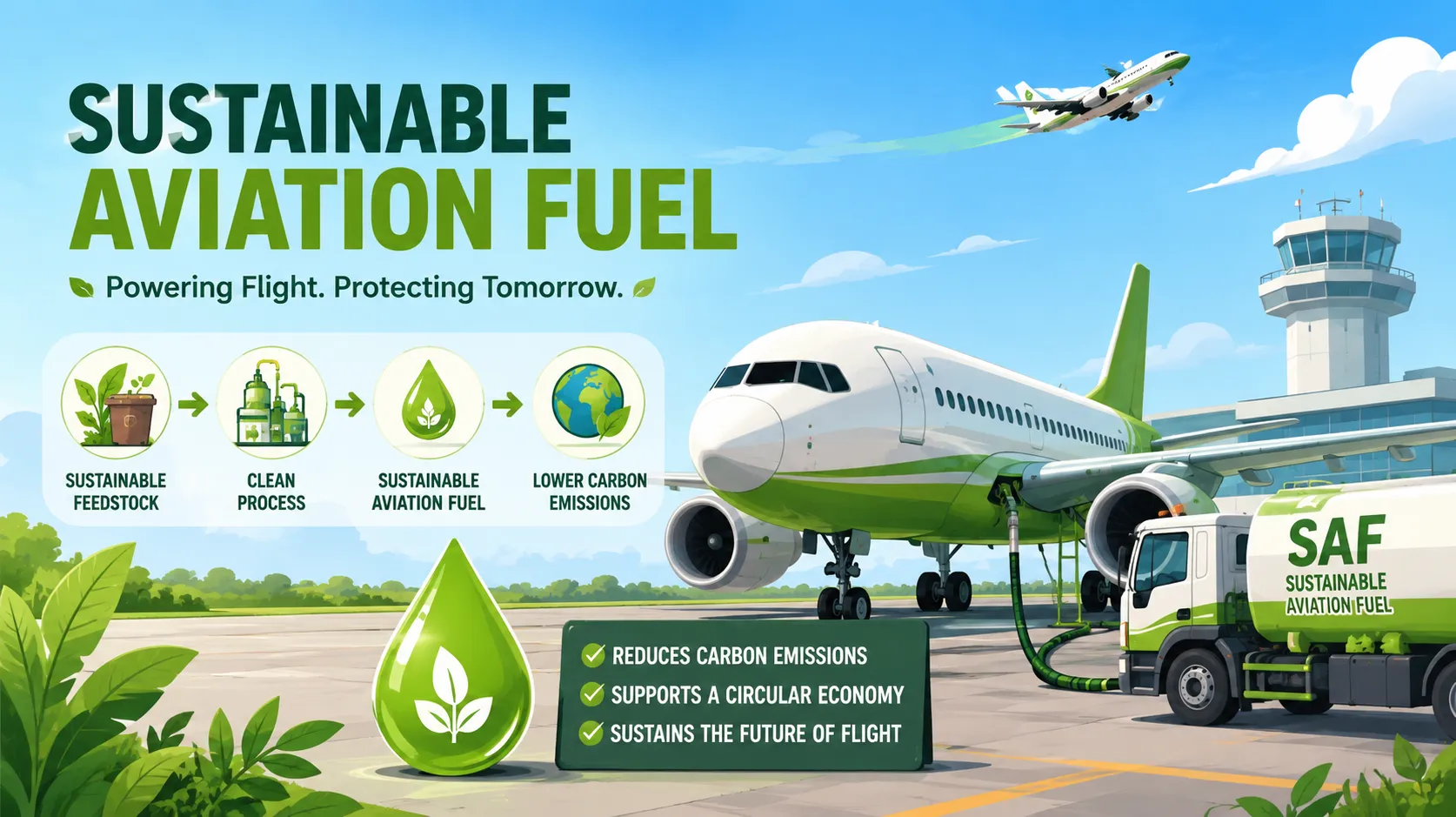
SAF is an alternative aviation fuel made through approved production pathways using eligible renewable or waste-based feedstocks, or through synthetic processes that combine captured carbon with low-emission energy. Depending on its production method and lifecycle emissions, SAF can reduce greenhouse gas emissions compared with conventional petroleum-based jet fuel.
In 2026, the United States is seeing important developments in this industry. Companies are expanding renewable fuel production, airlines are signing supply agreements, and technology developers are demonstrating new ways to manufacture synthetic aviation fuel using carbon dioxide and renewable electricity.
Projects involving American Airlines, FedEx, Twelve, Infinium, and Montana Renewables illustrate how the market is developing. At the same time, high production costs, limited supply, feedstock availability, and changing government incentives remain important challenges.
1. What Is Sustainable Aviation Fuel?
Sustainable Aviation Fuel, commonly known as SAF, is an alternative to conventional jet fuel that can be manufactured through approved production pathways using different types of feedstocks.
Depending on the technology, these feedstocks may include:
- Used cooking oil.
- Animal fats and waste fats.
- Agricultural residues.
- Forestry residues.
- Certain municipal and industrial waste materials.
- Renewable alcohols.
- Captured carbon dioxide.
- Renewable electricity and hydrogen.
The objective is to produce aviation fuel with lower lifecycle greenhouse gas emissions than conventional fossil-based jet fuel.
Lifecycle emissions are important because they consider more than the fuel burned inside an aircraft engine. They also account for relevant stages of production, feedstock processing, transportation, and fuel distribution.
For example, a fuel produced from waste materials may offer emissions advantages, but its environmental performance still depends on how those materials are collected, processed, transported, and converted into usable fuel.
SAF is not one single technology. It includes multiple production pathways, each with different costs, feedstock requirements, technical challenges, and environmental characteristics.
2. Why the United States Is Investing in Sustainable Aviation Fuel
The United States has one of the world’s largest aviation markets. Airlines operate extensive domestic and international networks, while airports support passenger travel, cargo transportation, business aviation, and emergency services.
Replacing the entire conventional aviation fuel supply is not a simple task. Aircraft need reliable, high-energy-density fuel, and aviation infrastructure must operate under strict safety requirements.
SAF offers a possible route to reducing aviation emissions without requiring every aircraft to be replaced.
Several factors are encouraging investment in American SAF production.
Reducing aviation emissions
Airlines are exploring SAF as one way to reduce the lifecycle emissions associated with their fuel consumption.
Unlike some emerging aircraft technologies, approved SAF pathways can be used in compatible aircraft when blended according to applicable fuel specifications.
Strengthening domestic energy production
Producing alternative aviation fuel within the United States can support domestic manufacturing and create additional sources of aviation energy.
This can also help develop new markets for waste-based feedstocks and advanced fuel-production technologies.
Supporting innovation
SAF projects require expertise in chemistry, engineering, renewable energy, industrial manufacturing, and aviation fuel distribution.
Investment in these projects can support research, infrastructure development, and specialized employment.
Meeting customer and corporate sustainability goals
Airlines, technology companies, and other large businesses are exploring ways to address emissions associated with business travel and air transportation.
Long-term fuel agreements can help producers obtain the commercial commitments needed to develop new facilities.
3. How Sustainable Aviation Fuel Is Produced
SAF can be manufactured using several different production pathways. The most appropriate method depends on available feedstocks, technology maturity, production costs, and fuel specifications.
Hydroprocessed Esters and Fatty Acids (HEFA)
HEFA is one of the more established pathways for producing SAF.
It uses suitable fats, oils, and greases as feedstocks. These materials undergo processing that removes unwanted oxygen and converts the feedstock into hydrocarbons suitable for further refining.
Used cooking oil and certain animal fats are examples of materials that may be used.
HEFA technology has an important role in the current SAF market because it is based on processes that have already been demonstrated at commercial scale.
However, the supply of suitable waste oils and fats is limited. Expanding production significantly requires careful attention to feedstock availability and sustainability.
Alcohol-to-Jet (AtJ)
The alcohol-to-jet pathway converts suitable alcohols into aviation-range hydrocarbons.
Alcohols may be produced from eligible agricultural materials, waste-derived resources, or other suitable feedstocks.
The process involves chemical conversion, upgrading, and refining to produce a fuel that meets applicable aviation specifications.
In January 2026, the World Economic Forum’s Global Aviation Sustainability Outlook highlighted LanzaJet’s successful production of SAF at commercial scale using its alcohol-to-jet technology at its Georgia facility.
This development is important because it demonstrates an alternative to relying entirely on waste oils and fats.
Fischer-Tropsch technology
Fischer-Tropsch synthesis converts suitable gas mixtures into liquid hydrocarbons.
Depending on the production pathway, the gas can be derived from biomass, waste-based resources, or other eligible sources.
The resulting synthetic fuel can be upgraded to produce aviation fuel components.
This technology is particularly relevant to projects exploring waste-derived and synthetic fuel production.
Power-to-liquid and electro-sustainable aviation fuel
Power-to-liquid technology uses electricity to help produce synthetic liquid fuels.
In an eSAF process, renewable electricity can be used to produce hydrogen through water electrolysis. Hydrogen is then combined with a suitable carbon source, such as captured carbon dioxide, to create synthetic hydrocarbons.
The process can offer significant lifecycle emissions reductions when powered by genuinely low-carbon electricity and supplied with appropriately sourced carbon.
However, producing eSAF requires substantial amounts of energy, specialized equipment, and reliable access to carbon dioxide and renewable electricity.
4. Twelve’s AirPlant One: A Major US E-Fuel Development
One of the most interesting American developments in 2026 came from Twelve, a technology company developing ways to produce fuels and chemicals using captured carbon and renewable electricity.
On June 10, 2026, Twelve announced the opening of AirPlant One in Moses Lake, Washington.
The company described the facility as the first commercial-scale US plant producing its E-Jet sustainable aviation fuel using a power-to-liquid pathway.
The production process uses carbon dioxide, water, and renewable electricity to manufacture synthetic fuel.
The announcement was made alongside partners including Alaska Airlines and Microsoft.
Why this project matters
Traditional renewable aviation fuel projects often depend on biological or waste-based feedstocks.
Power-to-liquid technology offers another approach by using captured carbon and electricity to manufacture liquid fuels.
This could eventually provide additional production options in locations where suitable renewable electricity and carbon sources are available.
Twelve stated that its E-Jet fuel meets applicable ASTM specifications for use in commercial aviation and is designed as a drop-in fuel compatible with existing aircraft and infrastructure under the approved conditions.
The company also announced plans for Alaska Airlines to operate domestic flights using fuel produced at the facility.
AirPlant One is an important commercial milestone, although expanding production to volumes large enough to serve a substantial share of US aviation demand remains a much bigger challenge.
5. American Airlines and Infinium Demonstrate Commercial E-SAF Use
Another important development involves American Airlines and Infinium.
In 2026, the companies announced a milestone involving the delivery of electro-sustainable aviation fuel to a commercial airport for use in a passenger flight.
The fuel was produced at Infinium’s Project Pathfinder facility in Corpus Christi, Texas.
The project uses waste carbon dioxide and renewable energy to manufacture synthetic fuels.
The eSAF was blended with conventional jet fuel and tested against the applicable ASTM fuel specification before being delivered into the airport’s fuel supply system.
The fuel was then allocated to an American Airlines flight from Corpus Christi International Airport to Dallas Fort Worth International Airport.
Why this demonstration is important
The development demonstrates how synthetic aviation fuel can move beyond laboratory experiments and pilot production into an actual commercial aviation supply chain.
It also illustrates the importance of collaboration.
Fuel producers need airline customers, financing partners, airport infrastructure, technical approvals, and reliable sources of energy and carbon.
American Airlines has also supported the development of future eSAF supply through its commercial arrangements with Infinium.
The company’s Project Roadrunner in Texas is expected to begin producing and delivering eSAF in 2027. At full capacity, the project is expected to produce more than five million gallons annually.
These developments do not mean synthetic aviation fuel is already available in unlimited quantities. They demonstrate that commercial production is beginning to progress through real-world aviation applications.
6. American Airlines and Google Sign a Major SAF Agreement
Demand from airlines and corporate customers is an important factor in the growth of SAF production.
On November 2026, American Airlines and Google announced a sustainable aviation fuel certificate agreement covering 35 million gallons of SAF over three years.
The agreement was described by the companies as the largest publicly announced SAF certificate agreement between an airline and a single corporate customer at the time of the announcement.
American Airlines plans to purchase and receive physical SAF for Chicago O’Hare International Airport. The fuel is expected to be produced from waste feedstocks, including used cooking oil.
Google will receive the associated environmental benefits through a traceable book-and-claim certificate system to address emissions associated with employee business travel.
What is a SAF certificate?
A SAF certificate can represent the environmental attributes associated with the use of sustainable aviation fuel.
Under a book-and-claim approach, the physical fuel may be delivered to an airport or aviation operation while a separate customer receives the associated environmental attributes through an accounting and tracking system.
This approach can help companies support SAF development even when their employees do not fly from the airport where the fuel is physically supplied.
The system requires transparent accounting and credible tracking to avoid double counting environmental benefits.
Why long-term agreements matter
Fuel producers need confidence that customers will purchase their output.
Long-term agreements can help demonstrate demand, support financing discussions, and encourage investment in additional production capacity.
The American Airlines and Google partnership also shows how airlines and companies outside the aviation industry can work together to support alternative fuel markets.
7. FedEx Is Expanding SAF Across Its US Air Network
Air cargo operations are another important area for sustainable aviation fuel.
Cargo airlines operate extensive networks that transport packages, industrial components, medicines, electronics, and other goods.
In September 2026, FedEx announced new agreements expected to secure more than 20 million gallons of neat SAF across five US airports through 2027.
The airports covered by the agreements include:
- Newark Liberty International Airport.
- Oakland International Airport.
- Miami International Airport.
- John F. Kennedy International Airport.
- Dallas Fort Worth International Airport.
The announced SAF blends are expected to range from 30% to 50%, depending on the location and applicable supply arrangements.
FedEx has also stated its goal of sourcing 30% of its jet fuel from alternative sources by 2030.
Why cargo airlines matter
Cargo operations create substantial demand for aviation fuel.
When freight companies commit to purchasing SAF, they can help create a stronger commercial market for producers.
These agreements can also encourage fuel suppliers to develop distribution infrastructure at more airports.
For FedEx, expanding SAF use is part of a broader effort to improve the environmental performance of its air transportation network.
8. Montana Renewables Is Expanding SAF Production Capacity
Montana Renewables is another important participant in the American alternative aviation fuel market.
The company is part of Calumet and operates a renewable fuels facility in Great Falls, Montana.
On September 1, 2026, Calumet announced a revised expansion plan intended to increase Montana Renewables’ SAF production capacity to approximately 200 million gallons annually by the end of 2028.
The company said it planned to reduce the remaining capital requirement by repurposing existing equipment from an adjacent refining facility.
This approach is intended to make the expansion more capital-efficient than the original project plan.
Why existing refinery infrastructure matters
Building a completely new fuel-production facility can require significant capital, construction time, and specialized equipment.
Repurposing suitable existing infrastructure may reduce some costs and speed up selected stages of development.
However, not every refinery component can be used for every renewable fuel process. Equipment must meet technical, operational, and safety requirements.
Montana Renewables’ expansion demonstrates how companies are evaluating existing industrial assets as part of the wider transition toward alternative aviation fuels.
9. What Role Do Government Policies and State Incentives Play?
Government policy can strongly influence the economics of sustainable aviation fuel.
SAF is generally more expensive to produce than conventional petroleum-based jet fuel. Producers must therefore consider whether market prices, customer agreements, tax incentives, and financing conditions can support commercial operations.
Federal incentives
Federal tax policies and energy programs can influence investment decisions for renewable fuels and alternative energy projects.
However, eligibility requirements, emissions calculations, and program rules can change. Companies must evaluate the regulations that apply to each project rather than assume that every SAF pathway receives the same financial support.
State-level incentives
Individual US states are also supporting SAF production and consumption through different policy approaches.
Illinois, for example, has adopted a SAF tax credit that helped support the American Airlines and Google arrangement involving physical fuel supply at Chicago O’Hare.
Other states have introduced or considered incentives intended to attract renewable fuel production and expand airport availability.
Why policy stability matters
Building a fuel-production facility requires long-term planning.
Investors need to understand the likely market conditions, applicable regulations, and expected revenue over the life of a project.
Frequent policy changes can create uncertainty and make it harder for companies to commit capital.
Stable and transparent rules can help manufacturers and airlines make longer-term decisions.
10. Environmental Benefits and Limitations of SAF
SAF can reduce lifecycle greenhouse gas emissions compared with conventional jet fuel, but the amount of reduction varies significantly.
Some approved production pathways can achieve substantial lifecycle reductions. Certain synthetic fuel pathways may also offer high reductions when they use renewable electricity and appropriately sourced carbon.
However, it is important not to assume that all SAF has the same environmental performance.
Potential benefits
- Lower lifecycle greenhouse gas emissions.
- Greater use of eligible waste materials.
- Additional demand for renewable electricity.
- Opportunities for domestic fuel production.
- Reduced dependence on conventional petroleum feedstocks.
- Compatibility with existing aircraft when approved blending requirements are followed.
Important limitations
- Production can be more expensive than conventional jet fuel.
- Sustainable feedstocks are not unlimited.
- Some pathways require large amounts of electricity.
- Carbon sourcing affects lifecycle emissions.
- Manufacturing facilities require substantial investment.
- Fuel distribution and airport availability remain uneven.
The environmental performance of SAF should be evaluated using credible lifecycle analysis rather than relying only on the label used to describe the fuel.
11. Major Challenges Facing the US SAF Industry
Despite important progress, sustainable aviation fuel still represents a small share of the aviation fuel market.
Several barriers must be addressed before production can expand substantially.
High production costs
SAF can cost considerably more than conventional jet fuel.
Production costs depend on feedstock prices, energy requirements, equipment, transportation, financing, and the technology used.
Airlines operate with demanding cost structures, so the higher fuel price can create commercial pressure.
Limited feedstock availability
Waste oils, fats, and other suitable biological materials are not unlimited.
If demand increases rapidly, producers may face competition for the same feedstocks.
Sustainable sourcing is also essential. A fuel should not be considered environmentally beneficial simply because it uses a biological material.
Renewable electricity requirements
Synthetic SAF production can require significant electricity.
To achieve meaningful lifecycle emissions reductions, producers need access to reliable low-carbon power.
This can make project locations, electricity prices, grid connections, and energy contracts important factors.
Infrastructure development
SAF must be transported, stored, blended where required, tested, and delivered through suitable aviation fuel systems.
Airports may need additional equipment, supplier agreements, and operational procedures.
Financing and market uncertainty
Large SAF plants can take years to develop.
Investors need confidence that fuel producers will have access to customers and that projects can operate economically.
Long-term airline agreements can help, but they do not remove all investment risks.
12. The Future of Sustainable Aviation Fuel in the USA
The next stage of the American SAF industry will likely involve several technologies operating alongside one another.
Growth in synthetic aviation fuel
Power-to-liquid technology may become more important as renewable electricity, electrolyzers, carbon capture, and synthetic fuel systems improve.
More airline procurement agreements
Airlines and cargo operators may continue signing long-term agreements with producers to secure supplies and encourage new investment.
Expansion of commercial production
Facilities using HEFA, alcohol-to-jet, Fischer-Tropsch, and other approved pathways may contribute to a more diverse domestic fuel market.
Better airport availability
More supply agreements and distribution infrastructure could make SAF available at additional US airports.
Improved production efficiency
Advanced process controls, automation, digital monitoring, and AI-supported optimization may help manufacturers improve plant performance.
Greater transparency
Customers and investors are likely to demand clearer information about fuel origins, production pathways, lifecycle emissions, and environmental claims.
The long-term success of SAF will depend on whether producers can deliver reliable fuel at prices that airlines and other customers can afford.
Conclusion
Sustainable aviation fuel is becoming an important part of the future of American aviation. It offers a way to reduce lifecycle emissions from air travel while making use of existing aircraft and airport infrastructure under approved fuel specifications.
Developments in 2026 show that the industry is moving forward through several different approaches. Twelve’s AirPlant One is demonstrating power-to-liquid fuel production, American Airlines and Infinium have shown how eSAF can enter a commercial aviation fuel supply chain, and major airlines and cargo companies are signing agreements to increase SAF procurement.
Montana Renewables is also planning a significant production expansion, while American Airlines and Google are demonstrating how corporate customers can help create demand for alternative aviation fuels.
However, the industry still faces major challenges involving cost, feedstock availability, renewable electricity, infrastructure, and investment certainty.
The future of sustainable aviation fuel will depend on continued cooperation between technology developers, fuel manufacturers, airlines, airports, policymakers, and investors.
SAF is not a complete solution to every environmental challenge facing aviation, but it is an important technology in the industry’s effort to develop cleaner and more resilient air transportation.
As production technologies improve and commercial projects expand, the United States has an opportunity to become an important center for the next generation of aviation fuel manufacturing.
Frequently Asked Questions (FAQs)
1. What is sustainable aviation fuel?
Sustainable aviation fuel is an alternative jet fuel produced through approved pathways using eligible renewable or waste-based feedstocks, or synthetic processes. It is designed to reduce lifecycle greenhouse gas emissions compared with conventional jet fuel.
2. Is sustainable aviation fuel used in US commercial flights?
Yes. SAF is already being used in commercial aviation in the United States through approved fuel pathways and blending arrangements. Availability varies by airport and supplier.
3. Can aircraft fly using 100% SAF?
Most commercial aircraft currently operate using approved blends of SAF and conventional jet fuel. Certain fuel pathways are approved for blending up to specified limits, commonly as high as 50%. Wider use of 100% SAF requires additional fuel approvals and compatibility work.
4. Which companies are developing SAF in the USA?
Companies involved in American SAF production and development include Twelve, Infinium, LanzaJet, Montana Renewables, and other renewable fuel producers.
5. What is eSAF?
E-SAF, or electro-sustainable aviation fuel, is synthetic aviation fuel produced using electricity-based processes. A typical pathway uses renewable electricity to produce hydrogen and combines it with an appropriate carbon source.
6. Is SAF better for the environment than conventional jet fuel?
SAF can provide lower lifecycle greenhouse gas emissions, but the actual reduction depends on its feedstock, production method, electricity source, transportation, and lifecycle assessment.
7. Why is SAF more expensive?
SAF production can require expensive feedstocks, specialized equipment, renewable electricity, and additional processing. Commercial production is also still developing, which can increase costs.
8. What is the difference between bio-based SAF and eSAF?
Bio-based SAF uses eligible biological or waste-based materials as feedstocks. E-SAF uses synthetic processes involving electricity, hydrogen, and carbon sources. Both aim to produce alternative aviation fuel, but their production methods and resource requirements differ.
9. Can SAF work with existing airplanes?
Approved SAF pathways can be blended with conventional jet fuel and used in compatible aircraft under applicable specifications. This is one of the technology’s major advantages because it does not require every airline to replace its aircraft immediately.
10. What is the future of SAF in the United States?
The industry is expected to develop through additional production facilities, synthetic fuel technology, airline procurement agreements, improved feedstock processing, and expanded airport distribution. Cost and supply availability will remain important factors.











No responses yet