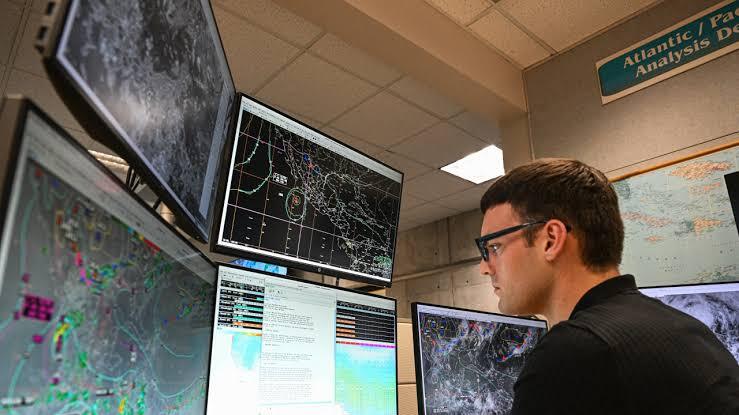

Weather forecasting technology in the USA in 2026 is entering an important new phase as artificial intelligence, advanced satellites, high-performance computing, and next-generation weather models transform how scientists predict atmospheric conditions. From hurricanes and tornadoes to flash floods, winter storms, heatwaves, and droughts, modern forecasting systems are helping meteorologists understand changing weather patterns and provide information that communities can use to prepare.
Weather forecasts influence almost every part of American life. Airlines use weather information to plan flight routes, farmers depend on forecasts to manage crops, energy companies monitor temperature and wind conditions, and emergency services use severe-weather warnings to protect communities.
However, predicting the weather accurately is a complicated scientific challenge. The atmosphere is constantly changing, and small differences in temperature, humidity, wind speed, or pressure can influence how a storm develops. Traditional forecasting systems rely on complex mathematical models and enormous amounts of observational data. New AI-based technologies are adding another layer of capability by helping researchers analyze patterns and generate predictions more efficiently.
One of the most significant developments arrived in November 2026, when the National Oceanic and Atmospheric Administration (NOAA) introduced its next-generation Rapid Refresh Forecast System, known as RRFS. The system is designed to deliver frequently updated, high-resolution weather predictions across North America.
At the same time, NOAA is expanding its use of commercial satellite observations and modern computing infrastructure. These developments demonstrate how the United States is combining government research, private-sector technology, and scientific innovation to improve weather prediction.
1. Why Weather Forecasting Technology Is Important in the United States
The United States experiences a wide variety of weather conditions because of its large geographical area and diverse climate regions.
Some states regularly experience hurricanes and tropical storms, while others face tornadoes, blizzards, wildfires, droughts, or extreme summer temperatures. Coastal communities also deal with changing ocean conditions, storm surges, and heavy rainfall.
Accurate forecasting is important because weather-related decisions often need to be made before an event occurs.
Protecting people and communities
Weather warnings give people time to prepare for dangerous conditions. A forecast indicating possible flash flooding can help residents avoid flooded roads, while an early hurricane forecast can support evacuation planning and emergency response.
The value of a forecast is not limited to predicting what the weather will be. It also depends on how quickly useful information reaches the people who need it.
Supporting agriculture
American agriculture depends heavily on weather conditions. Farmers need information about rainfall, soil moisture, frost, temperature, wind, and drought risks.
Weather forecasting systems can help agricultural businesses plan irrigation, planting, harvesting, and field operations.
A reliable short-term forecast may help farmers avoid spraying crops before heavy rain, while longer-range seasonal information can support decisions about water availability and crop planning.
Improving transportation
Airlines, shipping companies, trucking businesses, and public transportation agencies depend on weather information.
Thunderstorms, heavy snow, strong winds, freezing rain, and reduced visibility can affect transportation schedules and safety.
More detailed forecasting can help operators evaluate weather-related risks and make better decisions about routes, delays, and operational planning.
Supporting energy production
Electricity demand can change significantly with temperature. Hot weather increases air-conditioning demand, while cold conditions can raise heating requirements.
Wind and solar energy production are also influenced by weather. Wind forecasts help operators estimate turbine output, while cloud and sunlight predictions can help solar facilities plan electricity generation.
For these reasons, improved forecasting is important for both energy reliability and infrastructure management.
2. NOAA’s New Rapid Refresh Forecast System in 2026
One of the biggest American weather technology developments of November 2026 is the introduction of NOAA’s Rapid Refresh Forecast System.
NOAA announced that the National Weather Service implemented the new system on November 3, 2026. It replaces a collection of older regional forecasting systems and combines important capabilities from existing models into a more unified approach.
The RRFS is designed to provide detailed, frequently updated weather predictions across North America.
According to NOAA, the system combines the hourly updating capabilities and high resolution of the High-Resolution Rapid Refresh model with the broader geographical coverage of the North American Mesoscale model.
For the contiguous United States, RRFS extends forecast lead time to 84 hours, compared with 48 hours for the previous HRRR model.
Official announcement: https://www.noaa.gov/news-release/noaa-weather-modeling-hits-key-milestone-with-rapid-refresh-forecast-system-debut
What makes RRFS different?
The system brings several important improvements to regional forecasting.
Frequent updates: Weather conditions can change rapidly, especially when thunderstorms or severe weather develop. Hourly updates provide meteorologists with refreshed model guidance.
High-resolution predictions: The system uses detailed forecasting grids that help represent local atmospheric conditions and smaller-scale weather events.
Broader geographical coverage: RRFS covers North America, including Alaska, Hawaii, and Puerto Rico, as well as surrounding regions.
Longer forecast range: Its extended forecast period provides additional time for planning and decision-making.
Why high-resolution forecasting matters
A general weather forecast might predict rain across a large region. However, individual communities within that region may experience very different conditions.
One location might receive heavy rainfall, while another experiences only light showers.
Higher-resolution models can represent smaller geographical features and local atmospheric processes in greater detail. This can improve guidance for events such as thunderstorms, flash flooding, and localized precipitation.
It is important to remember that a higher-resolution forecast does not guarantee perfect accuracy. Actual forecast performance still depends on observations, model physics, atmospheric conditions, and uncertainty.
3. Artificial Intelligence Is Changing Weather Forecasting
Artificial intelligence is becoming an important part of modern weather prediction.
Traditional numerical weather prediction systems use mathematical equations to simulate the physical behavior of the atmosphere. These models process information about temperature, humidity, air pressure, wind, and other atmospheric variables.
AI weather models use machine learning to identify patterns in large collections of historical and observational weather data.
Instead of relying exclusively on traditional numerical calculations, AI systems can learn relationships between atmospheric conditions and future weather patterns.
How AI weather models work
AI forecasting systems are trained using historical weather information and atmospheric observations.
During training, machine-learning models analyze how different atmospheric conditions develop over time. They learn patterns that can help estimate future weather conditions.
Once trained, a model can generate predictions using current atmospheric information.
Some AI models can produce forecasts much faster than traditional physics-based systems, although performance varies depending on the model, forecast task, and available computing resources.
NOAA’s AI weather prediction models
NOAA has introduced AI-driven global forecasting models as part of its broader modernization work.
Its AI forecasting suite includes:
- AIGFS: Artificial Intelligence Global Forecast System.
- AIGEFS: Artificial Intelligence Global Ensemble Forecast System.
- HGEFS: Hybrid Global Ensemble Forecast System.
The hybrid approach combines physical and AI-based forecasting methods. This is important because different models can provide complementary information.
For example, ensemble forecasting generates multiple possible weather scenarios rather than relying on only one predicted outcome.
This helps meteorologists understand uncertainty and evaluate how likely different weather conditions may be.
NOAA’s announcement about its AI-driven global forecasting models is available here: https://www.noaa.gov/news-release/noaa-deploys-new-generation-of-ai-driven-global-weather-models
AI is not replacing meteorologists
Artificial intelligence can process large amounts of information and generate useful forecast guidance, but professional meteorologists remain essential.
Weather experts interpret model outputs, evaluate uncertainty, consider local conditions, and communicate warnings.
A forecast system may identify a possible storm pattern, but meteorologists must assess the information and determine how it should influence official forecasts and public safety decisions.
The strongest approach combines machine learning, traditional atmospheric science, reliable observations, and expert judgment.
4. Commercial Satellite Data Is Improving Weather Predictions
Satellites are among the most important sources of information used in modern weather forecasting.
They observe clouds, atmospheric moisture, temperatures, storms, ocean conditions, and other environmental characteristics from space.
These observations help meteorologists understand weather systems across large geographical areas, including places where ground-based measurements are limited.
In September 2026, NOAA announced an expansion of its use of commercial environmental satellite data through a long-term procurement arrangement.
The agreement includes 14 industry partners and covers multiple categories of environmental observations. These measurements are intended to support weather prediction, space weather monitoring, and scientific research.
Official announcement: https://www.noaa.gov/news-release/noaa-expands-use-of-commercial-satellite-data-to-enhance-weather-forecasting
What information do weather satellites collect?
Different satellite instruments collect different types of information.
Temperature observations: Help scientists understand atmospheric temperature patterns.
Humidity measurements: Provide information about moisture in the atmosphere, which influences cloud formation and precipitation.
Cloud imagery: Helps meteorologists observe storm development and movement.
Ocean observations: Support analysis of sea-surface conditions and environmental patterns that influence weather.
Atmospheric profiling: Certain satellite techniques provide information about the structure of the atmosphere at different altitudes.
Commercial companies are becoming important partners
Government weather agencies increasingly work with private companies that develop and operate satellite systems.
Commercial providers can supply additional observations that complement government-operated satellites and other measurement networks.
This approach can expand the amount and variety of available environmental data.
However, satellite observations must be carefully calibrated, evaluated, and integrated into forecasting systems before they can improve operational predictions.
5. Cloud Computing and Supercomputers Are Modernizing Weather Prediction
Weather forecasting requires enormous computing resources.
A modern numerical weather prediction model processes observations and performs complex calculations to estimate how atmospheric conditions may evolve.
These calculations can involve millions of data points and multiple possible weather scenarios.
Historically, major weather agencies relied heavily on dedicated high-performance computing infrastructure. However, cloud computing is creating additional opportunities for flexible computing capacity.
NOAA’s cloud computing modernization
In July 2026, NOAA announced that it was moving its Weather and Climate Operational Supercomputing System operations to commercial cloud infrastructure, with Google Cloud selected as the primary provider.
The modernization is intended to support more flexible computing operations and improvements to weather forecasting models.
NOAA’s announcement: https://www.noaa.gov/news-release/noaas-use-of-cloud-infrastructure-grows-to-include-weather-prediction-models
Benefits of cloud-based forecasting
Cloud computing can provide several potential advantages.
Flexible computing capacity: Forecasting workloads can change depending on operational requirements. Cloud infrastructure can provide additional computing resources when needed.
Faster development: Researchers can use shared computing environments to test new models and forecasting methods.
Improved collaboration: Scientists and developers from different organizations can work with shared datasets and computing resources.
Scalability: Cloud infrastructure can support different workloads without requiring every research group to operate its own large computing facility.
Challenges of cloud-based systems
Moving important forecasting operations to commercial cloud infrastructure also introduces considerations.
Weather agencies must manage cybersecurity, service reliability, data transfer, operating costs, and system availability.
Forecasting services are essential infrastructure. Any modernization must maintain reliable access to critical data and operational systems.
6. Predicting Hurricanes and Tropical Storms with Modern Technology
Hurricanes are among the most dangerous weather events affecting the United States.
They can bring destructive winds, storm surges, heavy rainfall, inland flooding, and long-lasting infrastructure damage.
Predicting their movement and intensity is a major scientific challenge.
Hurricane track forecasting
A hurricane’s track describes the direction and path it is expected to follow.
Accurate track predictions help coastal communities understand which areas may be affected and when preparations should begin.
Satellite observations, ocean measurements, aircraft reconnaissance, radar information, and numerical weather models all contribute to hurricane forecasting.
Hurricane intensity forecasting
Predicting how strong a hurricane will become is more complicated.
Storm intensity depends on factors such as ocean temperature, atmospheric moisture, wind shear, and the internal structure of the storm.
AI models are being researched and used to support tropical cyclone prediction, but intensity forecasts remain challenging.
AI and hurricane forecasting
AI-based models can analyze large historical datasets to identify patterns associated with storm movement and development.
These models may provide additional guidance to meteorologists, particularly when evaluating different possible storm scenarios.
NOAA has also worked with technology companies and research organizations to explore AI-supported tropical forecasting.
Readers can learn more about NOAA’s collaboration with Google on AI hurricane and tropical weather models here:
The important point is that AI is a supporting forecasting tool. Official hurricane forecasts and warnings continue to depend on NOAA’s operational processes and expert meteorological analysis.
7. Better Forecasting for Tornadoes, Thunderstorms, and Flash Floods
Severe local weather can develop quickly, making short-term forecasting especially important.
Thunderstorms may produce heavy rain, lightning, damaging winds, hail, and tornadoes.
Flash flooding can also occur when intense rainfall overwhelms drainage systems or causes rivers and streams to rise rapidly.
Radar technology
Weather radar is a critical source of information for monitoring storms.
Doppler radar measures changes in the frequency of reflected signals to help estimate precipitation movement and wind patterns.
Meteorologists use radar observations to identify developing storms, examine precipitation intensity, and monitor potential severe-weather conditions.
Short-term forecasting
Short-term forecasting, sometimes called nowcasting, focuses on conditions over the next several minutes or hours.
It uses current observations, radar, satellite imagery, and rapidly updating models to identify developing weather hazards.
These systems are especially useful for transportation authorities, emergency managers, airports, and local communities.
The importance of local observations
Forecast models become more useful when they receive reliable observations from different locations.
Weather stations, radar systems, aircraft, satellites, and other measurement networks help provide a more complete picture of atmospheric conditions.
Combining these observations with high-resolution forecasting can improve situational awareness during severe weather.
8. Weather Forecasting Technology and American Agriculture
Agriculture is one of the industries that can benefit significantly from improved weather prediction.
Farmers must make decisions about planting, irrigation, fertilization, harvesting, and crop protection while dealing with changing weather conditions.
Rainfall forecasting
Rainfall predictions can help farmers decide when to irrigate and when to delay field operations.
However, rainfall can vary significantly across short distances, making localized forecasting important.
Frost and temperature monitoring
Frost can damage sensitive crops and reduce agricultural production.
Weather monitoring systems can provide information about temperature changes, allowing farmers to prepare protective measures when conditions create a risk.
Drought monitoring
Drought conditions can develop over long periods and affect water supplies, soil moisture, and crop growth.
Weather observations and forecasting models can support drought assessment and agricultural planning.
Smart farming integration
Weather information can be combined with GPS equipment, soil sensors, irrigation systems, and farm-management software.
For example, a farm-management platform may use weather forecasts alongside soil-moisture measurements to help farmers make irrigation decisions.
The result is a more connected agricultural environment in which weather data becomes part of everyday farm operations.
9. Weather Prediction and the American Energy Industry
The energy sector is becoming increasingly dependent on accurate weather forecasts.
Electricity providers need to understand how weather may influence demand and renewable energy generation.
Forecasting solar power production
Solar power output depends on sunlight, cloud cover, temperature, and other environmental conditions.
Weather forecasts can help energy operators estimate how much electricity solar facilities may generate.
More detailed cloud and precipitation predictions can improve planning, although actual performance still depends on the equipment and local environment.
Forecasting wind energy
Wind farms depend on wind speed and direction.
Forecasting systems help operators estimate future wind conditions and plan electricity production.
Wind prediction is particularly important because wind conditions can change over time and vary between locations.
Predicting electricity demand
Temperature forecasts help utilities estimate heating and cooling requirements.
During extreme heat, electricity demand may increase because of air-conditioning use. During severe cold, heating demand can rise.
Better forecasts can support energy purchasing, grid operations, and preparation for periods of high demand.
10. The Economic Opportunities in the U.S. Weather Technology Industry
Weather forecasting is not only a scientific activity. It also supports a growing ecosystem of technology, research, data, and service providers.
Satellite technology businesses
Companies developing satellites, sensors, and environmental data services can support government agencies and private-sector customers.
Demand for additional observations may create opportunities for specialized satellite providers.
AI and software developers
Artificial intelligence companies can develop forecasting models, data-processing platforms, visualization tools, and decision-support applications.
Businesses may use these services to improve operational planning and evaluate weather-related risks.
Cloud computing providers
Weather prediction requires substantial computing capacity, creating opportunities for cloud infrastructure providers and high-performance computing specialists.
Weather data services
Private weather companies can provide tailored forecasts and analytics for agriculture, transportation, insurance, energy, construction, and logistics.
For example, an airline may need detailed forecasts for airport operations, while an agricultural business may need rainfall and soil-moisture information.
Research and education
Universities and research institutions play an important role in improving atmospheric science, developing forecasting algorithms, and training future meteorologists.
Collaboration between government agencies, private companies, and academic institutions can help bring new scientific methods into practical forecasting operations.
11. Challenges Facing Modern Weather Forecasting
Even with better technology, forecasting the weather remains difficult.
Several challenges influence how accurately scientists can predict future atmospheric conditions.
Unpredictable atmospheric behavior
The atmosphere is a complex system. Small differences in initial conditions can lead to significant changes in later predictions.
This is one reason forecasts generally become less certain as the prediction period increases.
Data quality and coverage
Forecasting models depend on observations from satellites, radar, weather stations, aircraft, ocean buoys, and other sources.
Missing, delayed, inconsistent, or inaccurate data can affect model performance.
Improving the quality and geographical coverage of observations remains important.
AI model limitations
AI systems learn from historical and available data. They may perform differently when encountering unusual conditions or situations that are not well represented in their training datasets.
AI predictions also require scientific validation and ongoing performance evaluation.
Forecast uncertainty
A forecast should not always be understood as a guaranteed prediction.
Ensemble forecasting helps communicate uncertainty by generating multiple possible outcomes. Meteorologists can use this information to assess the range of potential conditions and explain risks more effectively.
Infrastructure and cybersecurity
Weather forecasting systems depend on digital infrastructure, communications networks, computing facilities, and data services.
These systems must remain reliable and secure because interruptions could affect important forecasts and warnings.
12. The Future of Weather Forecasting Technology in the USA
The next phase of American weather forecasting will likely involve deeper integration between traditional atmospheric science, AI, satellites, cloud computing, and local observation networks.
Several developments are worth watching.
More advanced AI models: Machine-learning systems may become more capable of analyzing complex atmospheric patterns and producing additional forecast scenarios.
Higher-resolution regional models: Systems such as RRFS may support more detailed forecasts for local weather conditions.
Expanded satellite observations: Commercial and government satellite programs may provide more environmental data for operational forecasting.
Improved computing infrastructure: Cloud and high-performance computing systems can support larger simulations and faster research cycles.
Better severe-weather guidance: Improvements in radar, satellite data, and rapidly updating models may help meteorologists evaluate dangerous weather conditions.
More personalized weather services: Businesses and individuals may receive forecasts tailored to their location, industry, and operational requirements.
These developments are promising, but they do not mean that every storm, tornado, or flood can be predicted perfectly. Weather forecasting will continue to involve uncertainty, scientific research, and human decision-making.
13. November 2026 Weather Policy Developments in the United States
Technology modernization is also accompanied by policy discussions about the future of American weather forecasting.
On November 10, 2026, the U.S. Senate unanimously passed the Weather Research and Forecasting Innovation Reauthorization Act of 2026, also known as the Weather Act.
The legislation is intended to reauthorize several NOAA weather forecasting, research, and hazard communication programs. At the time of the Senate announcement, further action in the House and completion of the legislative process were still anticipated.
The Senate announcement is available here:
This development matters because modern weather forecasting depends on more than computer models. It also requires scientific research, observation networks, public communication systems, trained professionals, and sustained investment.
Long-term support for these areas can help strengthen the infrastructure behind weather predictions and severe-weather warnings.
Conclusion
Weather forecasting technology in the USA in 2026 is advancing through a combination of artificial intelligence, satellite observations, high-performance computing, advanced numerical models, and improved regional forecasting systems.
NOAA’s new Rapid Refresh Forecast System represents an important development in short-term weather prediction, while its AI forecasting initiatives and expanded commercial satellite partnerships demonstrate the growing importance of modern data and computing technologies.
These improvements have practical applications across emergency management, agriculture, transportation, energy production, and business operations.
However, the future of forecasting is not simply about replacing traditional systems with AI. It is about combining reliable observations, scientific models, advanced computing, and expert meteorological judgment.
As technology continues to develop, American communities and industries may gain access to more detailed weather information and better tools for understanding potential risks.
Accurate forecasting will never remove all uncertainty from the atmosphere, but better technology can provide valuable additional time and information for making safer and more informed decisions.
Frequently Asked Questions (FAQs)
1. What is weather forecasting technology?
Weather forecasting technology includes satellites, radar systems, weather stations, computer models, artificial intelligence, and high-performance computing used to predict future atmospheric conditions.
2. What is NOAA’s Rapid Refresh Forecast System?
The Rapid Refresh Forecast System, or RRFS, is a next-generation NOAA weather prediction system implemented in November 2026. It provides frequently updated, high-resolution forecasts across North America and extends forecast lead time for the contiguous United States to 84 hours.
3. How is AI changing weather forecasting in the USA?
AI helps analyze historical weather information and atmospheric observations to generate predictions and additional forecast scenarios. NOAA is using AI-driven and hybrid forecasting approaches alongside traditional numerical weather prediction.
4. Are AI weather forecasts more accurate than traditional forecasts?
Performance depends on the weather event, prediction period, model, and evaluation method. AI systems can offer speed and useful predictive capabilities, but traditional physics-based models remain important. Combining different approaches can provide additional forecast guidance.
5. Why are satellites important for weather forecasting?
Satellites collect information about clouds, temperature, atmospheric moisture, ocean conditions, and other environmental characteristics. These observations help meteorologists monitor large weather systems and improve forecasting models.
6. How does weather forecasting help farmers?
Farmers use forecasts to plan planting, irrigation, harvesting, and crop protection. Information about rainfall, frost, temperature, and drought conditions can support better agricultural decisions.
7. Can modern technology predict hurricanes accurately?
Modern technology can help forecast hurricane tracks, intensity, and development, but uncertainty remains. Satellites, aircraft observations, radar, computer models, and meteorological expertise all contribute to hurricane prediction.
8. What is the role of cloud computing in weather prediction?
Cloud computing can provide flexible computing capacity for weather models, scientific research, and data processing. NOAA’s modernization efforts include moving operational weather and climate computing operations to commercial cloud infrastructure.
9. Which industries benefit from advanced weather forecasting?
Agriculture, aviation, transportation, energy, insurance, construction, shipping, logistics, and emergency management can all benefit from improved weather information.
10. What is the future of weather forecasting in America?
Future developments may include more advanced AI models, higher-resolution regional predictions, additional satellite observations, improved computing infrastructure, and more tailored weather information for businesses and communities.











No responses yet