
Introduction
NASA’s newest space telescope has taken its first images—and they’re already hinting at what’s to come.
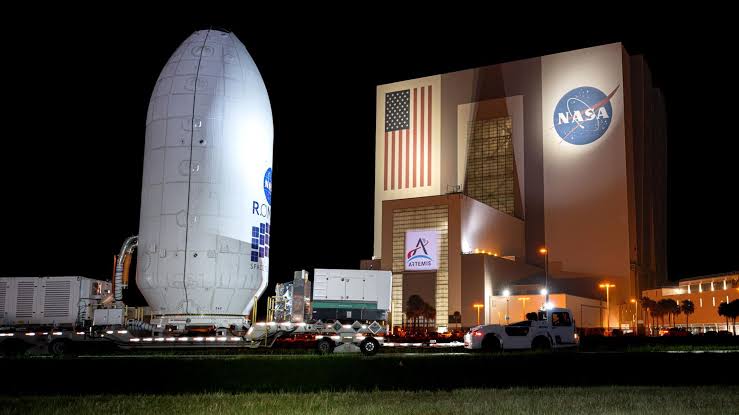
The Nancy Grace Roman Space Telescope, launched on August 30, 2026, from Kennedy Space Center, has successfully activated its Wide Field Instrument (WFI) and captured initial test images of distant stars . The images show faint, blurry circles of green, yellow, and blue against a dark background—the result of an uncalibrated sensor that will eventually produce sharp, focused images of the cosmos .
The milestone marks the beginning of a months-long commissioning phase that will prepare the $4 billion observatory for its mission to explore dark energy, dark matter, and exoplanets .
The 300-Megapixel Wide Field Instrument
The Wide Field Instrument is the telescope’s primary camera—and it’s unlike anything NASA has flown before.
The 300-megapixel infrared camera is designed to capture enormous areas of the sky in a single exposure. Each image will cover an area larger than the diameter of Earth as seen from the Moon, while maintaining a sharpness comparable to the Hubble Space Telescope .
To prepare the instrument for operation, the Roman team followed a rigorous process. After launch, the telescope underwent a 10-day drying period to remove moisture and residual chemicals. The team then cooled the instrument to -143°C (-225°F) before activating its 18 infrared detectors . The sensors operate at -183°C, a temperature cold enough to eliminate thermal interference from the instrument itself .
Once fully operational, Roman is expected to transmit approximately 1.4 terabytes of data to Earth daily .
The Coronagraph: Blocking Starlight to See Planets
In addition to the Wide Field Instrument, NASA has successfully activated the Roman Coronagraph Instrument—a complex system of optics, masks, self-flexing mirrors, and sensors designed to block the glare from stars .
The coronagraph’s job is to make it possible to directly image planets orbiting other stars. By blocking the blinding light of a parent star, the instrument can reveal the faint reflected light from planets in orbit around it . This is one of the most difficult challenges in astronomy, and the Roman coronagraph is designed to demonstrate the most advanced technologies ever flown in space for this purpose.
The coronagraph power-on began at 7:27 a.m. EDT and completed at 8:22 a.m. on September 1, 2026. It will undergo a months-long series of calibrations and tests before beginning full science operations .
A Mission Twice as Long as Planned
One of the most surprising outcomes of the mission so far is the telescope’s expected lifespan. Thanks to a precise launch and flawless execution of orbital correction maneuvers, NASA estimates that Roman’s remaining fuel could extend its operational life from 10 years to 22 years .
The telescope is currently on a 100-day journey to the second Lagrange point (L2), located approximately 1.5 million kilometers from Earth . Once there, it will begin its mission to survey the cosmos with a field of view roughly 100 times wider than Hubble’s .
What Roman Will Study
The Nancy Grace Roman Space Telescope is named after Dr. Nancy Grace Roman, NASA’s first chief of astronomy and the first woman to hold a high-level executive position at the agency .
The telescope’s scientific objectives are ambitious. It is designed to explore dark energy and dark matter, the mysterious substances that make up most of the universe but remain invisible to direct observation. It will also search for exoplanets using multiple methods, including microlensing, transits, and direct imaging . Scientists hope Roman will uncover hundreds of millions of galaxies and enable new discoveries that change astronomy for decades .
NASA expects to release Roman’s first high-resolution scientific images by early 2027 .
Conclusion
The Nancy Grace Roman Space Telescope is still months away from full operation, but its first images already demonstrate that the hardware is working. The 300-megapixel Wide Field Instrument and the Coronagraph Instrument represent significant advances in space-based astronomy—and the telescope’s extended 22-year lifespan means it will have more time than expected to use them.
The first scientific images, expected in early 2027, will show what Roman can really do. For now, the mission is on track, and the telescope is performing as designed.











No responses yet