
Introduction
NASA is preparing for what it calls one of the most complex missions in its history—and the destination isn’t the Moon.
Artemis III, scheduled for 2027, will send four astronauts to low Earth orbit, where they will rendezvous and dock with prototype lunar landers built by SpaceX and Blue Origin. The mission is a dress rehearsal for Artemis IV, which aims to put astronauts on the lunar surface in 2028 .
The plan represents a significant change from NASA’s original architecture. Artemis III was initially intended to be the first crewed lunar landing since Apollo 17 in 1972. But in February 2026, NASA Administrator Jared Isaacman announced a major overhaul of the Artemis program. The agency added a new demonstration mission in Earth orbit, citing delays in lander development and the need to test critical systems closer to home .
“The mission will require the most awe-inspiring coordination of heavy-lift rocket launches in history,” Isaacman said when announcing the crew in June 2026 .
Why Artemis III Changed
The decision to move Artemis III to Earth orbit was driven by hard technical realities. SpaceX’s Starship, selected as one of two Human Landing Systems, requires orbital refueling—a capability that has not yet been demonstrated. A March 2026 Government Accountability Office report found that SpaceX had made “limited progress maturing the technologies needed for in-orbit refueling and cryogenic propellant storage” .
Starship is so heavy that it cannot reach the Moon without being refueled in Earth orbit first. This involves launching a fleet of tanker vehicles that transfer cryogenic liquid methane and liquid oxygen across in sequence—a highly ambitious maneuver that has never been tested .
Blue Origin, the other lander provider, faced its own setback in May 2026 when its New Glenn rocket exploded during a routine engine test at Cape Canaveral. The launch pad was extensively damaged, and Blue Origin has no other pad to fall back on .
“It would not surprise me at all if China gets there first,” Dr. Simeon Barber, a lunar scientist at the Open University, told BBC News .
The Crew
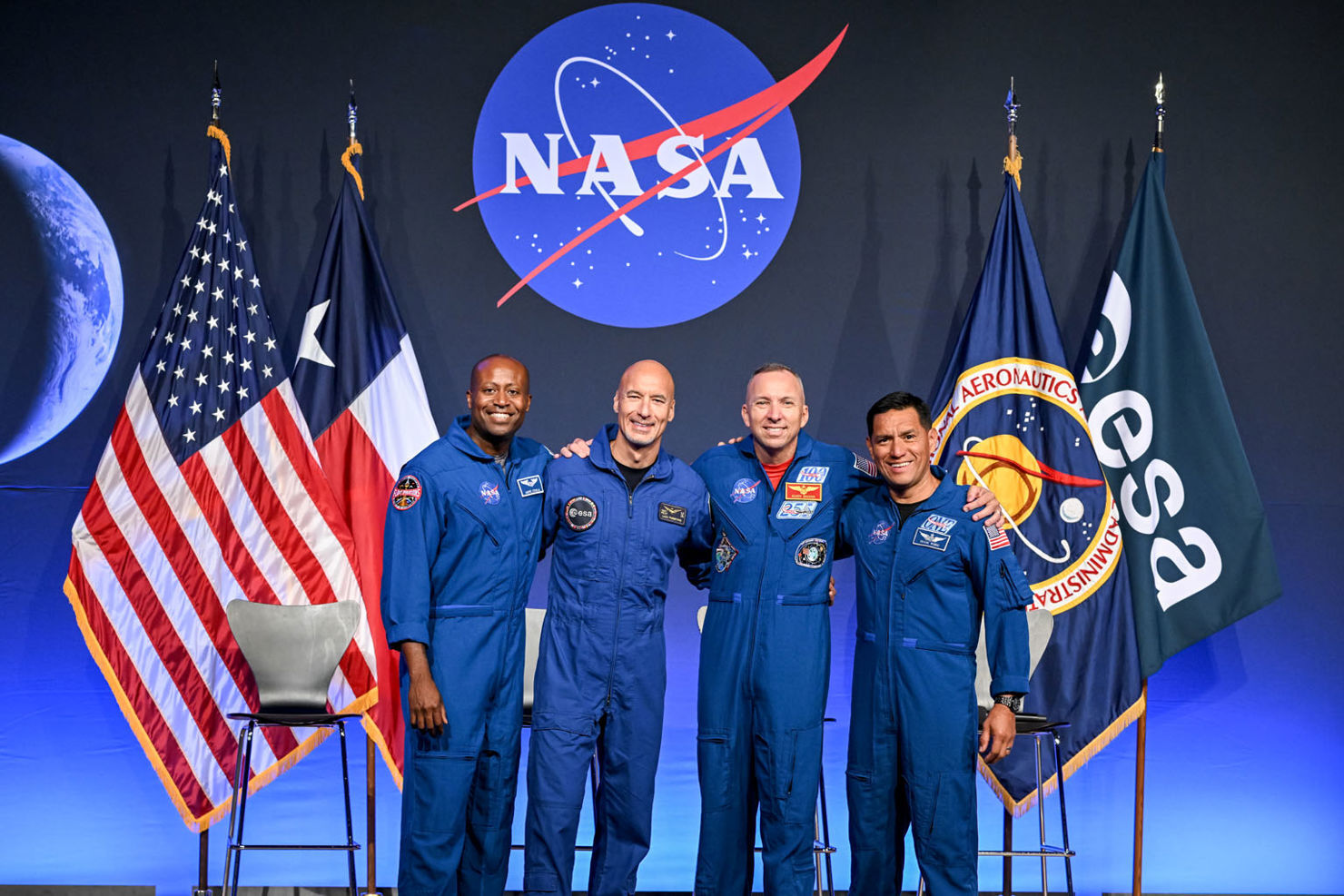
In June 2026, NASA named the four astronauts who will fly Artemis III:
- NASA astronaut Randy Bresnik – Commander
- ESA astronaut Luca Parmitano – Pilot
- NASA astronaut Andre Douglas – Mission Specialist
- NASA astronaut Frank Rubio – Mission Specialist
NASA astronaut Bob Hines was named as backup crew .
This is the first time a European Space Agency astronaut has been assigned to an Artemis mission. Parmitano, an Italian astronaut, brings extensive operational experience, including a 2013 spacewalk during which his helmet filled with water—an emergency he handled with composure that ESA cited in his selection .
“Artemis III will push the boundaries of spacecraft operations in orbit,” said Josef Aschbacher, ESA’s director general. “Luca’s assignment as pilot reflects the depth of European expertise in human spaceflight” .
How the Mission Works
Artemis III is a carefully choreographed sequence involving three launches and three spacecraft. NASA calls it a “space ballet” .
Step 1: Blue Origin’s Lander Launches First
Blue Origin’s Blue Moon Mark 2 test lander will launch first on a New Glenn rocket. The spacecraft is designed to loiter in a “parking orbit” for up to 30 days, allowing mission planners to sequence the rest of the mission without pressure .
Blue Origin’s test vehicle is based on the Mark 2 crewed lander architecture, incorporating the major avionics, flight software, and control systems needed to ensure that flight operations from this demonstration can directly translate to crewed lunar flights .
Step 2: Orion Launches and Docks with Blue Moon
NASA’s Space Launch System rocket will launch the Orion spacecraft with the four-person crew. Once in orbit, Orion will rendezvous and dock with the Blue Moon lander .
The docking will be a critical test. Up to two astronauts wearing orange Orion Crew Survival System suits will open the hatch and enter the lander’s cabin, verifying the Environmental Control and Life Support System and internal functions . The Blue Moon lander will also carry a lunar surface spacesuit mass simulator—similar to the “Moonikin” that flew on Artemis I—to provide real-time feedback about the cabin environment .
Step 3: Starship Launches and Docks with Orion
After the Blue Moon test is complete, SpaceX’s Starship test vehicle will launch and rendezvous with Orion. This docking will test a very different set of challenges .
Starship is massive—52 meters tall in its lunar configuration. Orion will dock nose-to-nose with Starship, unlike the side docking with Blue Moon. The test will evaluate controllability and communications between the two spacecraft . Astronauts will not enter the Starship test lander during Artemis III .
Step 4: Return to Earth
Once both docking tests are complete, the crew will return to Earth aboard Orion, splashing down in the Pacific Ocean .
The Launch Cadence Challenge
One of the most demanding aspects of Artemis III is the launch schedule. NASA, SpaceX, and Blue Origin will launch three of the world’s most powerful rockets within a short timeframe of one another, exercising ground processing, launch crews, facilities, and control centers across the country .
“This launch cadence offers a unique opportunity to practice launch processing and operations,” said Jeremy Parsons, Artemis program manager. “The demonstration mission will set the stage before our next giant leap” .
For future crewed missions to the Moon, NASA and one of the commercial lander partners will execute a “dual launch campaign”—prepositioning the lander in orbit to await a crewed Orion. Artemis III offers a chance to rehearse that process for the first time .
What Comes After: Artemis IV and the Moon Base
If Artemis III succeeds, Artemis IV will target a lunar landing in early 2028. The crew will transfer from Orion to a commercial lunar lander for transportation to the surface of the Moon—the first time humans will walk on the lunar surface since 1972 .
NASA’s ambitions extend far beyond a single landing. The agency plans to establish an initial lunar base by 2030, with semi-permanent crew presence by 2032 . The first phase of the Moon Base program includes 25 launches, 21 landings, and four metric tons of cargo by 2029 .
The urgency is partly geopolitical. China has announced a target of a crewed Moon landing by 2030. A Trump executive order in December 2025 directed NASA to return astronauts to the Moon by 2028 and establish initial base elements by 2030 .
The Risks Ahead
Artemis III is designed to reduce risk, but it doesn’t eliminate it. The mission depends on hardware that is still in development, launch vehicles that have experienced recent failures, and a schedule that most independent experts regard as ambitious .
John Couluris, a vice president at Blue Origin, said NASA and Blue Origin were working around the clock to be ready for launch in 2027. But the New Glenn explosion has raised questions about whether that timeline is achievable .
NASA’s margin for error is thin. The refueling technology for Starship has yet to be demonstrated. A key commercial partner no longer has a functioning launch pad. And the first lunar landing now depends on a sequence of things that have never been done before all going right in the right order .
“The question now is how much time recovery will take, and whether the calendar can absorb it,” BBC News reported .
Conclusion
Artemis III represents a new approach to lunar exploration: test everything in Earth orbit before committing to the Moon. The mission will be the most complex orbital operation NASA has attempted in decades, involving three launches, three spacecraft, and two commercial landers.
If it succeeds, Artemis IV will follow in 2028. If it fails, NASA will have learned critical lessons without risking a crew on the lunar surface. Either way, the era of Apollo-style single-agency missions is over. The return to the Moon will be a partnership between NASA and private industry—with all the promise and risk that entails.











No responses yet