
Introduction
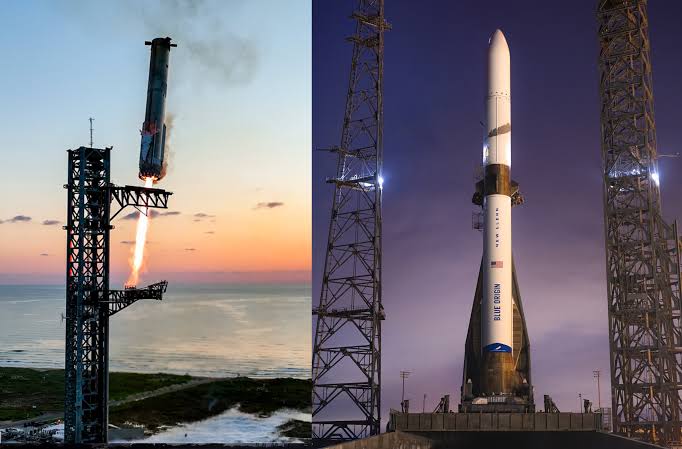
2026 has been a turbulent year for the American space industry. SpaceX’s Starship completed its 13th test flight, successfully deploying next-generation Starlink V3 satellites and demonstrating in-orbit engine relight. NASA’s Artemis II mission sent four astronauts around the Moon and returned them safely to Earth—the first crewed lunar flyby since 1972. And Blue Origin’s New Glenn rocket exploded during a static fire test on the pad, casting a shadow over the company’s already-delayed lunar landing plans.
Taken together, these three events paint a clear picture: American spaceflight is accelerating, but the path forward is anything but smooth.
Starship Flight 13: The V3 Era Takes Shape
On July 24, 2026, Starship lifted off from SpaceX’s Starbase facility in Texas for its 13th flight test. The mission had three core objectives: deploy next-generation Starlink satellites, demonstrate in-orbit engine relight, and validate the thermal protection performance of the upgraded V3 vehicle.
The V3 Vehicle’s First Real Test
The 13th flight used the V3 version of Starship and Super Heavy, which first flew on the 12th test flight in May 2026. The V3 vehicle features upgraded Raptor 3 engines and launched from the newly designed Pad 2. During the 12th flight, Starship reached space and completed its splashdown, but the vehicle exploded shortly after landing. SpaceX said engineers subsequently implemented software updates to address the issue.
On Flight 13, the Super Heavy booster completed its return burn test, with some engines successfully relighting, though the booster ultimately made a hard splashdown in the Gulf of Mexico. The Starship upper stage successfully completed its ascent burn and deployed all 20 next-generation Starlink V3 satellites at the planned velocity and trajectory. The satellites burned up on reentry as planned. Engineers successfully established communications with the satellites and collected critical telemetry data.
In-Orbit Engine Relight: A Critical Capability for Deep Space
During the flight, Starship successfully relit a single Raptor engine in space. This capability is essential for future orbital missions—whether traveling to the Moon, Mars, or executing maneuvers that require multiple burns. The ability to restart engines in microgravity is a prerequisite for any vehicle expected to operate beyond low Earth orbit.
Starlink V3: The Next Generation of Satellite Internet
The 20 Starlink V3 satellites deployed on Flight 13 represent a significant upgrade over previous generations. The V3 satellites are larger and more capable than their predecessors, with higher bandwidth and improved connectivity. SpaceX plans to use Starship’s greater payload capacity to deploy these satellites in larger batches, accelerating the expansion of the Starlink constellation.
Heat Shield Performance
The flight also tested upgrades to Starship’s heat shield. SpaceX has been iterating on the thermal protection system, which must withstand the extreme temperatures of reentry. The company did not report any anomalies with the heat shield during Flight 13, suggesting the upgrades performed as expected.
Artemis II: Humans Return to Lunar Orbit
While Starship pushes the boundaries of what’s possible, NASA’s Artemis program reached a historic milestone of its own. The Artemis II mission sent four astronauts on a free-return trajectory around the Moon—the first crewed lunar flyby since Apollo 17 in 1972.
The Crew
The Artemis II crew included NASA astronauts Reid Wiseman (commander), Victor Glover (pilot), and Christina Koch (mission specialist), along with Canadian Space Agency astronaut Jeremy Hansen (mission specialist). Koch became the first woman to travel to the Moon, and Hansen the first non-American.
The Mission
Artemis II launched on the Space Launch System (SLS) rocket, carrying the Orion spacecraft. The crew spent approximately 10 days in space, traveling around the far side of the Moon and returning to Earth. The mission tested Orion’s life support systems, communications, and heat shield under real crewed conditions.
The spacecraft splashed down safely in the Pacific Ocean, where recovery teams retrieved the crew and capsule. NASA declared the mission a complete success.
What Comes Next
Artemis II was a test flight—a shakedown cruise for the systems that will carry astronauts to the lunar surface on Artemis III. That mission, which will use SpaceX’s Starship Human Landing System, is targeting a lunar south pole landing in the coming years. NASA has not announced a specific date, but the success of Artemis II keeps the program on track.
Blue Origin’s New Glenn Explosion: A Setback for Lunar Ambitions
Not all the news from 2026 was positive. In a major setback for Blue Origin, the company’s New Glenn rocket exploded during a static fire test on the launch pad. The anomaly destroyed the vehicle and damaged ground infrastructure.
What Happened
The explosion occurred during a hot fire test—a routine procedure in which engines are ignited while the rocket remains anchored to the pad. Static fire tests are designed to validate engine performance and ground systems before launch. The cause of the explosion has not been publicly disclosed, and Blue Origin has not announced a timeline for returning to flight.
The Impact on Lunar Plans
The New Glenn explosion is particularly significant because Blue Origin is one of two companies—along with SpaceX—selected by NASA to develop human landing systems for the Artemis program. Blue Origin’s Blue Moon lander is designed to carry astronauts to the lunar surface.
With New Glenn grounded, Blue Origin’s timeline for demonstrating its lander is now uncertain. The company was already behind SpaceX in developing its lunar capability. The explosion compounds those delays.
A Broader Setback for Competition
New Glenn was intended to be Blue Origin’s answer to SpaceX’s Falcon 9—a reusable, heavy-lift rocket that could compete for commercial and government launch contracts. The vehicle had already flown successfully before the explosion. Losing a vehicle on the pad is a significant financial and schedule setback for a company that has invested billions in the program.
The Broader Picture: America’s Space Industry in 2026
These three events—Starship’s progress, Artemis II’s success, and New Glenn’s failure—illustrate the state of American spaceflight in 2026.
SpaceX continues to dominate. Starship is the most capable rocket ever built, and its iterative development approach is producing rapid progress. The V3 vehicle is flying, Starlink V3 satellites are deploying, and in-orbit engine relight is now demonstrated. SpaceX is positioning itself as the primary vehicle for both commercial and government deep-space missions.
NASA’s Artemis program is delivering. Artemis II proved that Orion and SLS can safely carry astronauts to lunar orbit and back. The program is expensive and has faced delays, but it is working. The next step—landing astronauts on the Moon—depends on Starship and Blue Origin’s landers.
Blue Origin faces a critical moment. The New Glenn explosion is a serious setback for a company that has long been seen as SpaceX’s primary competitor. Blue Origin has the resources and the contracts to recover, but the path forward is now more difficult.
The American space industry is not a single story. It is a collection of companies, programs, and ambitions, some succeeding spectacularly and others stumbling. 2026 has shown both sides of that equation. What happens next will determine whether the United States maintains its lead in space—or whether the gap narrows.











No responses yet