
Introduction
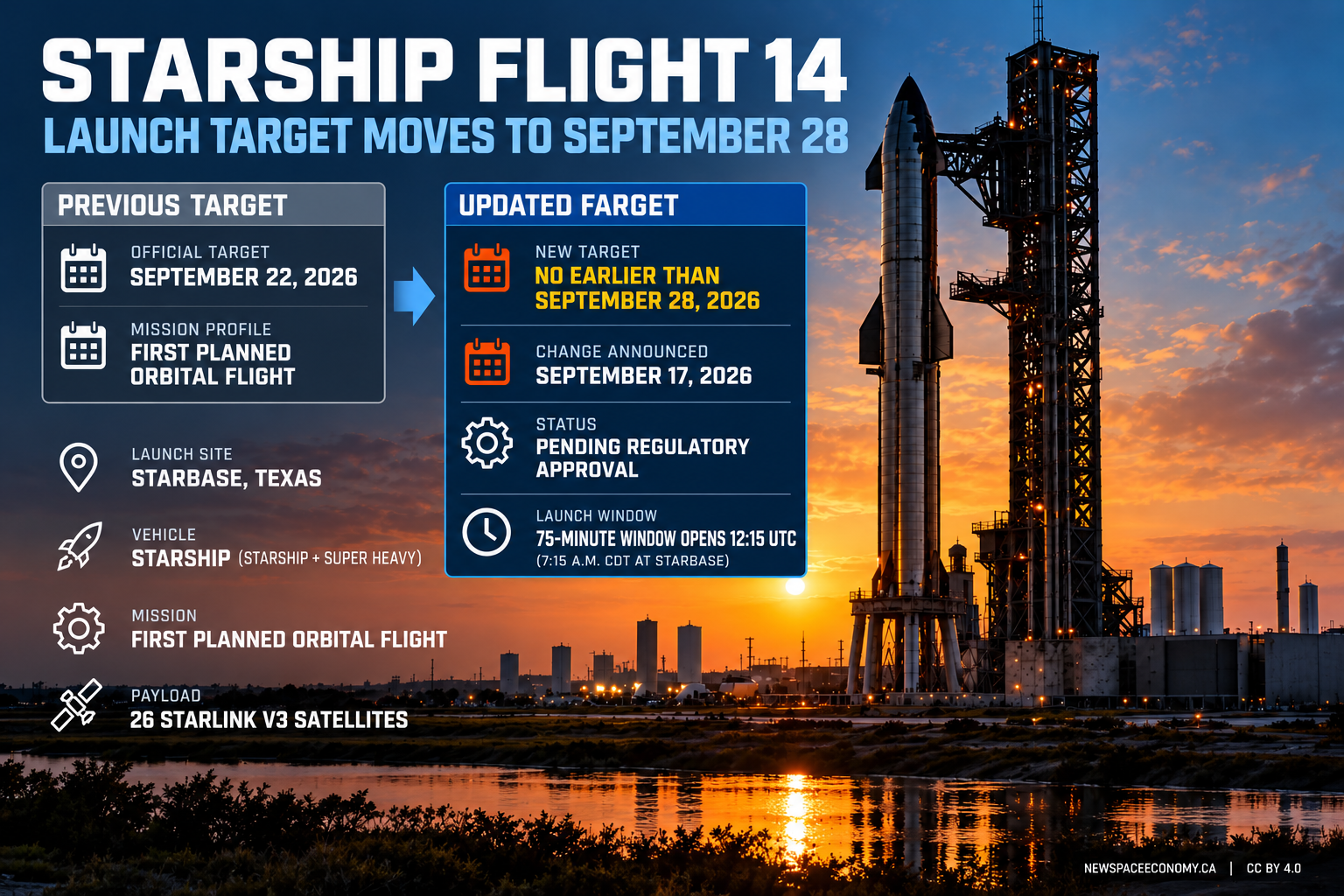
SpaceX is preparing for the most ambitious Starship test yet. Flight 14, targeting launch as early as September 22, 2026, from the company’s Starbase facility in Texas, has one primary objective: put the Starship upper stage into Earth orbit for the first time.
Across the first 13 test flights, Starship has flown suborbital trajectories—reaching space but never achieving the velocity required to sustain orbit. Flight 14 changes that.
Mission Overview: Six Orbits, Ten Hours
According to SpaceX’s published plan, the Starship upper stage will enter a low Earth orbit at an altitude of roughly 275 kilometers, circle the planet approximately six times over about 10 hours, and splash down in the Pacific Ocean west of Chile.
That flight profile is fundamentally different from previous tests. Suborbital flights are “up and down” missions. Orbital flight requires the vehicle to achieve sufficient velocity to stay in space, operate for hours, perform a deorbit burn, survive reentry, and execute a controlled splashdown.
The launch window opens at 7:15 a.m. Central Time and lasts 75 minutes. The flight is still pending final approval from the Federal Aviation Administration, though the FAA has already incorporated Flight 14 into its air traffic management planning.
Payload: 26 Starlink V3 Satellites to Orbit
Flight 14 will carry 26 Starlink V3 satellites—the first time V3 satellites will be placed in a sustainable orbit.
On Flight 13, Starship successfully deployed 20 V3 satellites, but that was a suborbital release test. The satellites were sent on a trajectory that guaranteed they would burn up in the atmosphere. On Flight 14, those satellites will enter orbits they can maintain, allowing them to begin functioning as part of the Starlink communications network.
According to SpaceX, a single Starlink V3 satellite can add 1 Tbps of communications capacity. If all 26 satellites are deployed, they would add 26 Tbps of bandwidth to the Starlink network. Three of the satellites carry cameras to film the Starship heat shield during reentry, providing critical data for future thermal protection design.
Super Heavy Booster: Return and Catch Attempt
The Super Heavy booster will follow a profile similar to recent flights. After separating from the upper stage, it will perform a boostback burn to return toward the launch site.
SpaceX has not confirmed whether it will attempt a tower catch with the launch tower’s “chopstick” arms on Flight 14. The company has successfully caught the booster on multiple previous flights, but each attempt carries risk. If conditions or vehicle performance are not ideal, the booster will perform a controlled splashdown in the Gulf of Mexico instead.
The booster used on Flight 14 is a V3 variant, featuring upgraded Raptor 3 engines. On Flight 13, the booster completed its return burn but ultimately made a hard splashdown. SpaceX has not detailed what changes, if any, have been made to the booster for this flight.
Heat Shield and Reentry
The heat shield remains one of the most challenging aspects of Starship’s development. Reentry from orbital velocity generates significantly more heat than suborbital reentry, and the thermal protection system must withstand those conditions for the vehicle to survive.
SpaceX has been iterating on the heat shield design across multiple flights. The company has tested different tile materials, attachment methods, and configurations. The cameras on three of the Starlink V3 satellites are specifically intended to capture imagery of the heat shield during reentry, giving engineers an unprecedented view of how the tiles perform under real conditions.
Flight 13 completed its reentry without reported heat shield anomalies, suggesting the latest design iteration is performing as expected. Flight 14 will subject the heat shield to more demanding conditions due to the higher energy of orbital reentry.
What Makes This Flight Different
Orbital velocity. The fundamental difference between Flight 14 and all previous flights is velocity. To reach orbit, Starship must accelerate to approximately 7.8 kilometers per second. That’s roughly 28,000 kilometers per hour. Achieving that velocity requires the upper stage to burn its engines for significantly longer than on suborbital missions and to manage propellant consumption carefully.
Extended mission duration. Six orbits over roughly 10 hours means the vehicle must operate in space for an extended period. Systems that were only tested for minutes on previous flights must now function for hours. Thermal management, power generation, communications, and attitude control all face more demanding requirements.
Satellite deployment in orbit. Deploying satellites into a sustainable orbit is fundamentally different from releasing them on a suborbital trajectory. The deployment mechanism must function reliably in microgravity, and the satellites must separate cleanly without imparting unwanted rotation or velocity to the upper stage.
Operational relevance. If successful, Flight 14 marks the point at which Starship transitions from a test vehicle to an operational launch system. The Starlink V3 satellites deployed on this flight will become part of the commercial Starlink network, generating revenue and providing service to customers.
What Comes Next
A successful Flight 14 would be a major milestone for SpaceX and for NASA’s Artemis program, which depends on Starship as the Human Landing System for crewed lunar missions. Orbital capability is a prerequisite for the refueling demonstrations, lunar landing tests, and operational missions that lie ahead.
SpaceX has not announced a specific date for Flight 15 or subsequent tests, but the company’s iterative approach suggests that if Flight 14 succeeds, the next flight could follow relatively quickly. If it encounters anomalies, SpaceX will analyze the data, implement fixes, and try again.
The company’s philosophy has been consistent throughout the Starship program: fly, learn, iterate, repeat. Flight 14 is the next step in that process—and potentially the one that transforms Starship from an experimental vehicle into a working spacecraft.











No responses yet