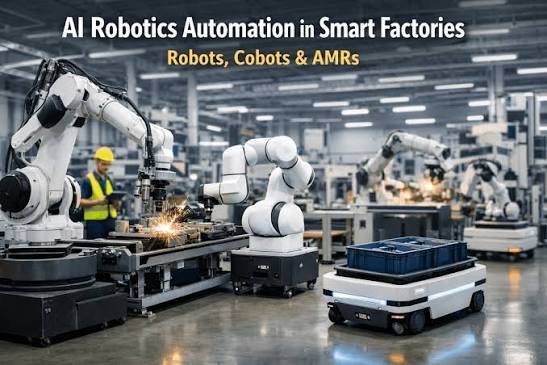

Introduction
Robotics and industrial automation are becoming important parts of the American technology landscape. From automobile manufacturing plants to food processing facilities, warehouses, hospitals, and agricultural operations, robots are helping businesses perform repetitive, physically demanding, and precision-sensitive tasks.
In 2026, the industry is moving beyond traditional industrial robots that follow carefully programmed instructions. Artificial intelligence, machine vision, improved sensors, and advanced computing are enabling machines to respond to changing environments and perform more flexible tasks.
This shift is creating new opportunities for American manufacturers seeking to improve productivity, address workforce challenges, strengthen supply chains, and compete in international markets.
The growing interest in automation is supported by recent industry data. According to the International Federation of Robotics, industrial robot installations in the United States increased by 11% year over year in 2025, reaching approximately 38,000 units. The automotive industry remained the largest adopter, while installations in the food industry increased by 30%.
These developments show that automation is expanding beyond traditional manufacturing applications.
However, the industry also faces challenges, including high equipment costs, integration difficulties, cybersecurity risks, worker training requirements, and uncertainty about how quickly advanced AI-powered robots can perform complex tasks reliably.
This article examines the robotics industry in the United States in 2026, the technologies driving its development, the companies shaping the market, and the opportunities that may emerge in the years ahead.
What Is Robotics and Industrial Automation?
Robotics is the field of technology concerned with designing, building, programming, and operating machines that perform physical tasks. Industrial automation uses machines, sensors, software, and control systems to complete processes with limited manual intervention.
Although the terms are closely related, they are not identical. Automation can involve conveyor belts, software-controlled machinery, sensors, and production systems without requiring a robot.
Robotics introduces programmable machines that can move, handle objects, inspect products, or interact with their surroundings.
Modern industrial automation often combines several technologies:
- Robotic arms: Machines used for welding, painting, assembly, packaging, and material handling.
- Machine vision: Cameras and image-processing software that identify objects, inspect products, and guide robot movements.
- Artificial intelligence: Systems that help machines recognize patterns, interpret information, and make decisions within defined operating limits.
- Sensors: Devices that measure position, temperature, pressure, force, distance, and other physical conditions.
- Autonomous mobile robots: Machines that transport materials through warehouses, factories, and distribution centers.
- Industrial control systems: Hardware and software that coordinate machinery and maintain production processes.
- Digital twins: Virtual representations of physical equipment or production systems used for simulation, monitoring, and optimization.
When these technologies work together, businesses can build production environments that are more connected, measurable, and adaptable.
Why Robotics Is Growing in the United States in 2026
Several factors are contributing to the expansion of robotics and industrial automation across American industries.
1. Demand for Higher Manufacturing Productivity
American manufacturers face pressure to deliver products efficiently while maintaining quality and controlling costs.
Robots can perform repetitive tasks with consistent timing and precision. In suitable applications, they can operate for extended periods and help reduce production bottlenecks.
For example, a robotic arm may repeatedly position components for assembly, apply a controlled amount of adhesive, or inspect products using cameras.
Automation can also improve production consistency by reducing variation in tasks that are difficult to perform identically by hand.
However, robots do not automatically improve every production line. A poorly designed automation system can create bottlenecks, increase maintenance expenses, or reduce flexibility.
Businesses must evaluate the complete process before investing in new equipment.
2. Reshoring and Domestic Manufacturing
Some American companies are exploring ways to produce more goods domestically or reduce their dependence on distant suppliers.
Domestic production can provide greater control over quality, delivery schedules, and certain supply chain risks. Yet manufacturing in the United States can involve relatively high labor, property, and operating costs.
Robotics may help companies make domestic production more competitive by automating suitable tasks.
For example, manufacturers may use robots for machine tending, welding, material movement, inspection, and packaging.
Automation is not a complete substitute for an international supply chain, and it does not eliminate the need for skilled employees. Instead, it can help businesses redesign production systems to improve efficiency.
The success of these investments depends on equipment costs, production volume, product complexity, worker availability, and the reliability of the automation system.
3. Advances in Artificial Intelligence
Traditional industrial robots usually follow predefined movements and operate within carefully controlled environments.
AI-powered systems can introduce greater flexibility by helping machines interpret camera images, identify objects, and respond to certain changes in their surroundings.
For example, a warehouse robot equipped with suitable perception software may identify packages in different positions rather than depending entirely on one fixed arrangement.
AI can also support predictive maintenance by analyzing equipment data to identify patterns associated with wear or potential failure.
Nevertheless, physical environments are more unpredictable than many digital tasks. Objects may be damaged, surfaces may be slippery, lighting may change, and unexpected obstacles may appear.
AI-powered robotics therefore requires extensive testing, appropriate safety systems, and human oversight for tasks where mistakes could cause injury or significant damage.
Major Robotics Trends in the USA in 2026
AI-Powered Robotics and Physical AI
One of the most discussed developments in robotics is the combination of AI models with physical machines.
This approach, often called physical AI, aims to connect perception, reasoning, planning, and movement.
A robot may use cameras to observe its surroundings, software to determine the next step, and sensors to adjust its movements while performing a task.
The technology is attracting interest because it could make robots more useful in environments where every object cannot be placed in exactly the same position.
Research and development efforts are exploring applications in manufacturing, logistics, healthcare, and domestic environments.
However, impressive demonstrations do not necessarily mean a robot is ready for reliable commercial deployment. Businesses need systems that work consistently, handle exceptions, recover from errors, and operate safely over long periods.
Collaborative Robots
Collaborative robots, commonly called cobots, are designed for applications where robots and people may work near one another under appropriate safety conditions.
They are often used for tasks such as machine tending, inspection, packaging, and light assembly.
Cobots can be attractive to small and medium-sized manufacturers because some models are relatively easy to program and redeploy compared with larger, highly customized industrial systems.
Their suitability depends on the task, payload, speed, workspace, and required safety measures.
Importantly, a robot described as collaborative is not automatically safe for every situation. A proper risk assessment and appropriate safeguards are still necessary.
Autonomous Mobile Robots
Autonomous mobile robots transport materials through warehouses, factories, and distribution facilities.
They can move inventory, carry components between workstations, and help reduce the distance employees need to travel while completing their work.
Some systems use maps and sensors to navigate around obstacles. Others coordinate with warehouse software to receive tasks and report their progress.
Mobile robots are particularly useful where facilities handle large quantities of goods and internal transportation is a significant part of operating costs.
Their effectiveness depends on floor conditions, traffic patterns, charging requirements, network reliability, and integration with existing workflows.
Humanoid Robots
Humanoid robots are designed with human-like features, such as a torso, arms, legs, or hands.
The interest in these machines comes partly from the possibility of operating in spaces designed for people. In theory, a robot that can navigate human environments and manipulate familiar objects may perform multiple tasks without requiring an entirely redesigned workplace.
American technology companies and startups are investing in humanoid robotics research, including systems for industrial handling and other physical tasks.
However, humanoid robots still face significant challenges involving battery life, balance, dexterity, cost, safety, and reliable performance in unpredictable environments.
For many businesses, a specialized robotic arm or mobile robot may remain more economical and dependable than a humanoid machine.
The most practical applications will depend on whether a humanoid robot can perform useful work safely and at a competitive cost.
American Companies Shaping the Robotics Industry
The US robotics ecosystem includes established automation suppliers, AI and computing companies, warehouse technology providers, and emerging startups.
NVIDIA
NVIDIA is widely associated with graphics processors and AI computing. Its hardware and software platforms also support robotics research and development.
Robotics systems can use accelerated computing to process camera images, simulate environments, train models, and develop perception and control capabilities.
Simulation is particularly valuable because engineers can test many scenarios virtually before deploying a robot in a real facility.
However, simulation must be validated against real-world behavior. Differences between simulated and physical environments can affect a robot’s performance.
NVIDIA’s role illustrates how semiconductor technology and AI infrastructure can support the development of physical machines.
Rockwell Automation
Rockwell Automation provides industrial automation, control systems, and related software and services.
Its technologies help manufacturers coordinate machinery, monitor production, manage operational information, and improve industrial processes.
As factories become more connected, companies increasingly need automation systems that integrate equipment, software, safety procedures, and production data.
This creates opportunities for suppliers that can help businesses modernize existing facilities rather than replacing every machine at once.
Teradyne and Universal Robots
Teradyne operates in industrial automation and is associated with Universal Robots, a major supplier of collaborative robotic arms.
Collaborative robots are used in applications including assembly, machine tending, packaging, and inspection.
Their appeal comes from flexibility: a properly configured robot may be redeployed to different tasks as production requirements change.
For smaller manufacturers, the ability to automate a specific process without undertaking a massive factory redesign can be especially valuable.
Symbotic
Symbotic develops automation systems for warehouse and supply chain operations.
Large distribution centers must receive goods, store inventory, retrieve products, and prepare orders for shipment. These processes involve substantial amounts of movement and coordination.
Automated systems can help organize inventory and transport products more efficiently, although their installation often requires significant planning and integration.
Recent reporting on Walmart’s warehouse automation efforts has also highlighted a practical lesson: large-scale automation can deliver operational benefits, but replacing manual handling across every process is difficult. Irregular packages, equipment failures, maintenance, and unexpected operating conditions remain important challenges. Source: The Wall Street Journal.
Emerging Robotics Startups
Startups are exploring robots that can handle unfamiliar objects, perform more flexible industrial tasks, and operate in environments that were previously difficult to automate.
Some companies focus on humanoid robots, while others specialize in robotic manipulation, warehouse systems, medical applications, or automation software.
Startups can move quickly and experiment with new approaches, but commercial success depends on more than technical demonstrations.
They must prove that their products are safe, dependable, maintainable, and economically useful for customers.
How Robotics Is Transforming American Manufacturing
Manufacturing remains one of the most established applications of industrial robotics.
Robots are widely used in automobile production, electronics manufacturing, metalworking, food processing, and other industries.
Automotive Manufacturing
Automobile factories use robots for welding, painting, assembly, material handling, and inspection.
These tasks often require consistent movements and repeatable positioning.
Robotics is also important in electric vehicle production, where manufacturers must assemble battery components, manage materials, and perform precise manufacturing operations.
However, automotive production lines require careful coordination. A robot that stops unexpectedly can affect multiple stages of production.
Companies therefore need preventive maintenance, spare parts, skilled technicians, and systems for quickly identifying and resolving faults.
Electronics and Precision Manufacturing
Electronics production often requires accurate positioning and careful handling of small components.
Robots can support component placement, inspection, packaging, and material transfer.
Machine vision can help identify defects, verify assembly steps, and detect products that do not meet quality requirements.
As products become more compact and complex, manufacturers may combine robotics with specialized tools and automated inspection systems.
Food and Beverage Production
Food manufacturing has become an important area of US robotics adoption.
Robots can assist with packaging, sorting, palletizing, case handling, and selected food-processing tasks.
Automation can help businesses maintain consistent production rates and reduce repetitive manual handling.
Food applications also introduce special requirements involving hygiene, washdown procedures, temperature, contamination prevention, and product variability.
Systems must be designed to meet the industry’s operational and safety standards.
Robotics in Warehousing and E-Commerce
The growth of online shopping has increased demand for efficient distribution centers.
Warehouses must process incoming goods, maintain inventory, retrieve products, pack orders, and ship them within tight delivery windows.
Robotics can support several stages of this process.
Automated Picking and Sorting
Automated sorting systems can direct packages to the appropriate locations based on their destination or order information.
Robotic picking systems attempt to identify and grasp items from shelves, bins, or conveyor belts.
Picking is particularly challenging because products vary in size, shape, weight, texture, and packaging.
An object that is easy for a person to pick up may be difficult for a robot if it is flexible, slippery, tangled, or partially hidden.
Improved sensors and AI may expand the range of items robots can handle, but human workers remain important for unusual cases and exception handling.
Inventory Movement
Mobile robots can transport goods between storage areas, packing stations, and loading zones.
Warehouse software helps coordinate routes, assign tasks, and manage traffic.
These systems may reduce unnecessary walking and improve material flow when they are integrated effectively.
Businesses must still plan for charging, maintenance, network outages, software updates, and manual intervention when problems occur.
The Human Role in Automated Warehouses
Automation changes the type of work performed in warehouses.
Some repetitive material-handling tasks may require fewer manual steps, while other roles focus more on monitoring equipment, maintaining robots, troubleshooting software, and managing exceptions.
The effects on employment vary by facility and company. Automation can eliminate certain tasks, create new technical roles, and change the skills required for existing positions.
It is therefore misleading to assume that every warehouse robot simply replaces one employee or that automation has no effect on workers.
The real outcome depends on how a company redesigns its operations and manages the transition.
Robotics in Healthcare and Medical Technology
Healthcare is another area where robotics can provide specialized assistance.
Medical and laboratory robots can support repetitive, controlled tasks, while robotic systems may assist clinicians during selected procedures.
Surgical Robotics
Surgical robotic systems allow trained clinicians to control specialized instruments through a computer-assisted interface.
These systems can provide precise instrument movement and visualization for certain procedures.
They do not operate as independent replacements for surgeons in routine clinical practice. The clinician remains responsible for treatment decisions and the procedure, subject to the system’s approved use.
The benefits and limitations vary by procedure, device, patient, and clinical setting.
Laboratory Automation
Laboratories may use robots to handle samples, move plates, prepare materials, and perform repetitive testing steps.
Automation can improve consistency and help facilities process larger workloads.
However, laboratory systems must be validated carefully because sample mix-ups, contamination, and processing errors can have serious consequences.
Hospital Logistics
Hospitals can use mobile robots to transport supplies, linens, meals, or selected materials between departments.
This can help reduce time spent on routine transportation and allow staff to focus on patient care.
Successful deployment requires safe navigation around patients, visitors, beds, and medical equipment, as well as integration with hospital workflows.
Robotics in Agriculture and Food Production
American agriculture faces changing labor requirements, environmental pressures, and growing demand for efficient food production.
Robotics can help automate selected agricultural tasks, although outdoor environments introduce challenges that are less common in factories.
Precision Agriculture
Robotic and automated equipment can use cameras, GPS, sensors, and software to monitor crops and support field operations.
Depending on the system, automation may assist with planting, spraying, harvesting, and monitoring crop conditions.
Precision technologies can help farmers apply inputs more selectively, but performance depends on crop type, terrain, weather, and the quality of available data.
Harvesting and Crop Monitoring
Some agricultural robots are designed to identify ripe produce or assist with harvesting.
Fruit and vegetable harvesting can be especially difficult because produce varies in shape, ripeness, and position, and must be handled without causing damage.
Robotics research aims to improve object recognition, gripping, and navigation in these environments.
Commercial adoption will depend on whether systems can work reliably at a cost that makes economic sense for growers.
The Economic Benefits of Industrial Automation
Automation can provide several benefits when implemented appropriately.
Higher productivity: Robots can perform repetitive tasks at consistent speeds and reduce certain bottlenecks.
Improved consistency: Automated processes may reduce variation in tasks requiring precise positioning or repeatable movements.
Worker safety: Robots can take on selected tasks involving heavy loads, hazardous materials, high temperatures, or repetitive physical strain.
More predictable production: Automated systems can help manufacturers coordinate processes and measure performance.
Better use of data: Sensors and connected software can provide information about production rates, downtime, equipment condition, and quality.
Greater operational flexibility: Some modern robotic systems can be reprogrammed or redeployed as production needs change.
These advantages are not guaranteed. Businesses need to account for installation, programming, maintenance, training, energy use, downtime, and integration expenses when calculating the financial return on an automation project.
Challenges Facing Robotics Companies in the USA
Despite growing interest, robotics companies and their customers face several obstacles.
High Initial Investment
Robotic equipment can require substantial upfront spending.
The total project cost may include the robot, tools, safety equipment, software, installation, engineering, training, and changes to the production environment.
A business should compare these expenses with realistic expected savings and productivity improvements.
Difficult Integration
Factories and warehouses often use equipment from multiple suppliers.
Connecting robots to existing machinery, databases, inventory software, and production control systems can be complicated.
Poor integration may lead to delays, data errors, or inefficient workflows.
Reliability and Maintenance
Robots contain mechanical, electrical, and software components that require maintenance.
Sensors can become dirty or misaligned, grippers can wear out, and software updates can introduce unexpected problems.
Businesses need maintenance plans, spare parts, qualified technicians, and procedures for safe recovery when equipment fails.
Safety and Cybersecurity
Robots can create physical hazards if they move unexpectedly or operate outside their intended workspace.
Safety engineering, risk assessment, guarding, and appropriate operating procedures are essential.
Connected robots also introduce cybersecurity considerations. Unauthorized access or compromised control systems can disrupt production and potentially create physical risks.
Companies should apply access controls, secure network configurations, timely updates, monitoring, and tested recovery plans.
Shortage of Specialized Skills
Automation requires people who understand robotics, electronics, software, industrial networking, maintenance, and workplace safety.
Employers may need to invest in training existing workers as well as recruiting new specialists.
Community colleges, technical schools, universities, and industry partnerships can help develop the necessary skills.
Will Robots Replace American Workers?
The effect of robotics on employment is one of the most important questions surrounding automation.
Robots can reduce the need for people to perform particular repetitive tasks. At the same time, automated systems require people to design, install, program, maintain, supervise, and improve them.
The overall effect on employment depends on the industry, the speed of adoption, the growth of demand, and the way companies reorganize their operations.
For example, a factory might automate a repetitive welding process while hiring technicians to maintain the robotic cell. A warehouse might introduce mobile robots while changing the responsibilities of inventory and operations staff.
Some workers may need to learn new skills or move into different roles.
Employers can make the transition more effective by providing retraining, communicating changes clearly, and involving workers in the redesign of production processes.
For job seekers, practical knowledge of robotics maintenance, industrial networking, programming, and automation safety can create new opportunities.
Future Trends in US Robotics and Automation
Several developments could influence the American robotics industry over the next five to ten years.
More Flexible AI-Driven Robots
Robots may become better at handling variations in objects, layouts, and production requirements.
This could expand automation into tasks that previously required too much manual adjustment.
Commercial performance will still depend on reliability, speed, cost, and safety.
Greater Adoption by Small Businesses
As robotic equipment and software become easier to deploy, more small and medium-sized manufacturers may automate specific processes.
Rather than redesigning an entire facility, businesses may begin with one repetitive task and expand when results justify further investment.
Improved Human-Robot Collaboration
Robots may increasingly operate alongside workers in carefully designed workspaces.
Better sensing and control systems can help machines respond to people and obstacles, but appropriate safety measures will remain essential.
More Automated Logistics
Warehouses and distribution centers are likely to continue exploring robotic picking, sorting, inventory movement, and fleet coordination.
The most successful systems will be those that work reliably with existing operations and deliver measurable improvements.
Expansion of Robotics in Healthcare
Laboratory automation, hospital logistics, rehabilitation technologies, and selected medical applications may continue developing.
Adoption will depend on clinical evidence, safety requirements, regulatory approval, and the ability to integrate technology into healthcare workflows.
Robotics and Energy Efficiency
Manufacturers may use automation software and monitoring tools to reduce waste, improve equipment utilization, and optimize energy consumption.
The environmental impact will depend on the energy required by the machines, the materials used to build them, and the operational improvements they deliver.
Career Opportunities in Robotics and Industrial Automation
The US robotics industry offers career paths for people with different educational backgrounds.
Potential roles include:
- Robotics engineer.
- Automation engineer.
- Electrical engineer.
- Mechanical engineer.
- Industrial maintenance technician.
- Robot programmer.
- Machine vision specialist.
- Controls engineer.
- Mechatronics technician.
- Industrial cybersecurity specialist.
- Robotics software developer.
- Manufacturing systems engineer.
Some positions require a bachelor’s or advanced degree, while others can be reached through technical certificates, apprenticeships, associate degrees, or employer training.
People interested in robotics can begin by learning programming, electronics, mechanical systems, mathematics, and problem-solving.
Hands-on experience with sensors, microcontrollers, industrial equipment, or robot simulation tools can also be useful.
As automation expands, employers are likely to value professionals who can combine technical skills with practical knowledge of manufacturing processes and workplace safety.
Conclusion
Robotics and industrial automation in the USA in 2026 are entering a new stage of development. Traditional industrial robots continue to support manufacturing, while AI, machine vision, mobile robotics, and more flexible control systems are expanding the range of possible applications.
American companies are exploring automation to improve productivity, strengthen domestic manufacturing, support logistics operations, and address specific workplace challenges.
At the same time, the industry must overcome high investment costs, technical limitations, maintenance requirements, cybersecurity concerns, and workforce training needs.
Robotics is not a universal solution for every business problem. The strongest results are likely to come from identifying suitable tasks, choosing reliable technology, involving workers, and measuring real operational outcomes.
As AI and physical automation continue to advance, robotics will remain an important area of American technology research and industrial investment. Businesses and workers who understand both the opportunities and limitations of these systems will be better prepared for the changes ahead.
Frequently Asked Questions (FAQs)
1. What is industrial automation?
Industrial automation uses machines, sensors, control systems, and software to perform manufacturing or operational tasks with reduced manual intervention. Robotics is one important part of industrial automation.
2. Is the robotics industry growing in the USA in 2026?
Yes. The International Federation of Robotics reported that US industrial robot installations increased by 11% in 2025, reaching approximately 38,000 units. Adoption is expanding across manufacturing and other sectors.
3. Which companies are important in American robotics?
Companies and technology providers active in the US robotics ecosystem include NVIDIA, Rockwell Automation, Teradyne, Universal Robots, and Symbotic, alongside many specialized suppliers and startups.
4. How is AI changing robotics?
AI can help robots interpret camera images, recognize objects, plan selected actions, and respond to variations in their environment. Reliable deployment still requires testing, safety controls, and careful integration.
5. Are humanoid robots ready for widespread industrial use?
Some humanoid robots are being tested for specific tasks, but broad adoption remains limited by reliability, dexterity, operating costs, battery life, and safety requirements. Specialized industrial robots are often more practical for established production tasks.
6. Will industrial robots eliminate jobs?
Robots can reduce demand for some tasks while creating or changing jobs in programming, maintenance, engineering, and operations. The employment impact varies by industry and how companies implement automation.
7. What skills are useful for a robotics career?
Useful skills include programming, electronics, mechanical engineering, control systems, machine vision, industrial networking, troubleshooting, and safety practices.
8. What is the future of robotics in American manufacturing?
Future development is likely to include more flexible AI-driven systems, collaborative robots, automated logistics, advanced machine vision, and greater adoption among businesses seeking measurable productivity improvements.











No responses yet