
Introduction
Reliable internet access has become essential for education, business, healthcare, communication, entertainment, and everyday life. Most Americans connect through fiber-optic networks, cable broadband, or mobile services. However, high-speed connectivity remains difficult to provide in some rural communities, remote properties, mountainous regions, and areas where traditional infrastructure is expensive to build.
Satellite internet is becoming an increasingly important part of the solution.
Unlike conventional broadband services that depend on cables running to homes and businesses, satellite internet sends data between a user’s equipment, satellites in space, and ground-based internet infrastructure. This approach can deliver connectivity to locations that traditional providers struggle to reach.
In 2026, the US satellite internet industry is evolving rapidly. SpaceX’s Starlink network continues expanding, Amazon is developing its Amazon Leo satellite broadband service, and telecommunications companies are exploring ways to connect ordinary mobile phones directly to satellites.
These developments could change how people access the internet, particularly in areas with limited broadband coverage.
The industry is also attracting attention from airlines, shipping companies, emergency response organizations, government agencies, and businesses that need connectivity beyond traditional network boundaries.
This article explores the latest satellite internet trends in the United States, the companies competing in this market, the benefits and limitations of satellite broadband, and what consumers can expect in the coming years.
What Is Satellite Internet and How Does It Work?
Satellite internet provides internet connectivity through communications satellites orbiting Earth. Instead of relying entirely on underground cables or nearby cellular towers, users communicate with a satellite network using specialized equipment.
A typical satellite broadband connection involves three main components.
1. User equipment
Customers generally install a satellite dish or electronic antenna at their home, office, vehicle, vessel, or other location. The equipment sends and receives signals from compatible satellites.
2. Satellites in orbit
Satellites relay data between the user and the broader communications network. The distance between the satellite and Earth, along with network design and available capacity, influences connection speed and latency.
3. Ground infrastructure
Ground stations, fiber-optic connections, network gateways, and internet exchange infrastructure connect satellite traffic to websites, applications, cloud services, and other online destinations.
When a user opens a website, the request travels through this communications system and the response returns to the user’s device.
Modern satellite networks use sophisticated antennas, routing systems, and network management software to improve performance.
Low Earth Orbit Versus Traditional Satellite Internet
Satellite internet services use different orbital designs.
Traditional geostationary satellites operate approximately 35,786 kilometers above Earth’s equator. Their position relative to the ground remains nearly fixed, making it possible to serve large geographic areas with relatively few satellites.
However, the long distance introduces considerable latency, which can affect video calls, online gaming, and other interactive applications.
Low Earth orbit, or LEO, satellites operate much closer to Earth. These networks generally require many satellites moving through orbit to provide continuous coverage.
Because the signal travels a shorter distance, LEO services can offer lower latency than traditional geostationary systems. Actual performance still depends on network congestion, equipment, routing, weather conditions, and the service provider.
This difference is one reason LEO satellite internet has attracted so much investment in recent years.
Why Satellite Internet Is Growing in the USA in 2026
Several major developments are contributing to the growth of the American satellite internet market.
1. Rural Communities Need Better Broadband
Building fiber-optic infrastructure can be expensive in locations with widely separated homes, difficult terrain, or relatively few potential customers.
Traditional broadband providers may struggle to justify the cost of extending their networks to every remote location.
Satellite internet offers another option because its coverage does not depend on laying a cable along every road.
Rural households can use satellite connections for remote work, online learning, video calls, entertainment, and digital services. Small businesses can use the technology for payments, cloud applications, inventory systems, and communication with customers.
Satellite broadband does not automatically solve every connectivity problem. Customers still need suitable equipment, a clear view of the sky where required, and access to an available service plan. Nevertheless, it can provide an important alternative when terrestrial broadband is unavailable or inadequate.
2. Demand for Reliable Remote Connectivity
Connectivity is increasingly important for people who live or work far from major population centers.
Farmers may need internet access for equipment monitoring, precision agriculture, weather information, and operational management. Construction companies may need temporary connectivity at new project sites. Researchers and field workers may need access to cloud platforms in isolated environments.
Satellite services can support these activities without waiting for conventional network infrastructure to be constructed.
Businesses also use satellite connectivity as a backup connection. If a terrestrial connection fails, a properly configured satellite link can help maintain access to essential applications.
The value of this backup depends on network availability, equipment setup, power supplies, and the organization’s ability to switch connections when necessary.
3. More Advanced Satellite Networks
Satellite technology has improved considerably over the past decade.
Modern LEO networks can use electronically steered antennas, inter-satellite laser links, advanced routing, and more sophisticated ground infrastructure.
These technologies can help networks move data efficiently and provide connectivity across large geographic areas.
Competition is also encouraging providers to develop new hardware, improve network capacity, and offer services to different customer groups.
The result is an increasingly diverse market that includes residential broadband, enterprise connectivity, maritime internet, aviation Wi-Fi, and emerging satellite-to-phone services.
Starlink: A Major Force in American Satellite Internet
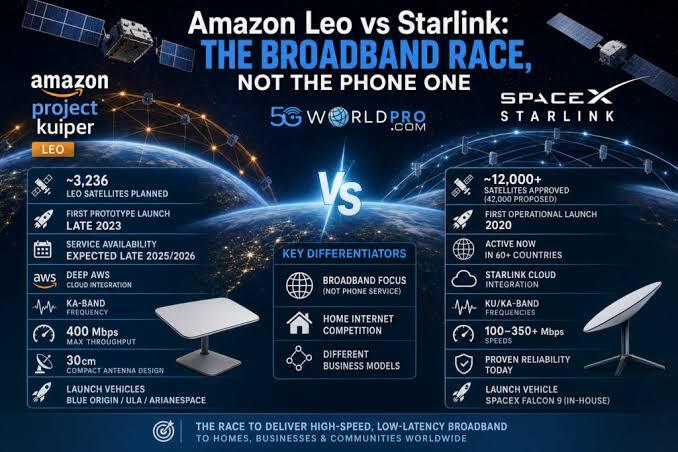
SpaceX’s Starlink is one of the best-known satellite broadband networks serving customers in the United States.
The system uses a large constellation of low Earth orbit satellites and customer terminals designed to communicate with the network.
Starlink’s approach differs from traditional satellite internet because its satellites operate much closer to Earth, supporting lower-latency connections when network conditions are favorable.
Customers generally use a compatible terminal and Wi-Fi equipment to connect their devices.
Starlink’s Expanding Satellite Network
Network size and capacity are important because satellite providers must serve customers across different locations and at different times.
On January 9, 2026, the Federal Communications Commission authorized SpaceX to construct, deploy, and operate an additional 7,500 second-generation Starlink satellites, bringing the authorized Gen2 total to 15,000 satellites worldwide. The authorization supports expanded broadband capacity and additional mobile connectivity capabilities. Source: FCC announcement.
This authorization is a regulatory milestone, not evidence that every authorized satellite has already been launched or become operational.
The expansion could allow Starlink to improve coverage and capacity as deployment progresses. Actual service quality will continue to depend on how much network capacity is available in a particular area.
Starlink for Homes and Businesses
Residential customers often consider Starlink when fiber or cable broadband is unavailable.
Businesses may choose satellite connectivity for remote offices, temporary sites, backup communications, or operations that move between locations.
Potential benefits include access to broadband in areas with limited terrestrial infrastructure and relatively flexible installation compared with building a new wired network.
However, customers should consider equipment costs, subscription pricing, installation requirements, weather exposure, network congestion, and the availability of alternatives before choosing a service.
For locations already served by reliable fiber broadband, a satellite connection may not offer enough additional value to justify switching.
Starlink and Aviation Connectivity
Satellite internet is also changing the passenger experience in commercial aviation.
In October 2026, American Airlines announced plans to expand its Starlink Wi-Fi installation program to its entire mainline fleet of more than 1,000 aircraft, with installation beginning in 2027. The announcement illustrates growing airline interest in high-performance satellite connectivity. Source: Reuters.
For airlines, connectivity can support passenger entertainment, messaging, online work, and other onboard digital services.
Aircraft require specialized equipment and regulatory approval, so aviation satellite services are different from installing a home satellite terminal.
Amazon Leo: A New Competitor in Satellite Broadband
Amazon is developing a satellite communications network originally known as Project Kuiper and renamed Amazon Leo in November 2025.
The project aims to provide broadband connectivity to households, businesses, governments, and other customers beyond the reach of traditional internet infrastructure.
Amazon’s entry could introduce another major competitor into a market where Starlink has established a substantial early position.
Amazon’s Satellite Deployment Strategy
Amazon Leo uses a planned constellation of thousands of low Earth orbit satellites.
The company has been investing in satellite production, launch agreements, antennas, software, and supporting ground infrastructure.
Amazon’s official updates reported more than 375 satellites in orbit following a launch in July 2026, while the company continues working toward a much larger planned constellation. Deployment progress is important because broadband capacity and geographic availability depend on the network becoming sufficiently developed. Source: Amazon Leo.
Amazon has said it plans to expand service availability during 2026 as more satellites are launched and network capacity increases. Actual availability, speeds, pricing, and coverage should be confirmed directly with the company as its rollout develops.
How Amazon Leo Could Change the Market
A new large-scale competitor could give customers more choices.
Competition may encourage providers to improve service reliability, introduce different equipment options, develop enterprise products, and explore new pricing structures.
Amazon also has experience operating cloud computing and e-commerce infrastructure. Its broader technology ecosystem could create opportunities for satellite connectivity to work alongside cloud applications and business services.
However, satellite broadband is a capital-intensive business. Building a constellation requires spacecraft manufacturing, launch capacity, ground infrastructure, regulatory approvals, and ongoing network operations.
Amazon must demonstrate that it can deliver reliable service at a competitive cost while expanding coverage.
Satellite-to-Phone Technology: Connecting Beyond Cell Towers
One of the most significant developments in satellite communications is the effort to connect compatible mobile phones directly to satellites.
Traditional mobile networks depend on cellular towers and other terrestrial infrastructure. In remote areas, phones may lose service because no suitable tower is available.
Satellite-to-phone systems aim to extend selected communications capabilities beyond these conventional coverage boundaries.
Depending on the technology and service, capabilities may include emergency messaging, ordinary text messaging, location sharing, and eventually more extensive voice or data services.
SpaceX and Starlink Mobile
SpaceX is expanding its ambitions beyond fixed broadband through satellite-to-cellular connectivity.
In October 2026, SpaceX announced an agreement to acquire a portfolio of low-band wireless spectrum from Grain Management for approximately $8 billion. The proposed acquisition, which requires regulatory approval, is intended to support its broader mobile connectivity strategy. Source: Reuters.
Low-band spectrum can help signals travel across wider areas and penetrate buildings more effectively than some higher-frequency signals, although performance depends on the complete network design.
The development shows how satellite companies are exploring a combination of space-based connectivity and terrestrial wireless capabilities.
It does not mean that every existing phone can already receive unrestricted satellite broadband. Device compatibility, spectrum permissions, network deployment, service plans, and local coverage remain important considerations.
Amazon Leo and Direct-to-Device Services
Amazon is also developing a satellite-to-device strategy.
In April 2026, Amazon announced a definitive agreement to acquire Globalstar and an agreement with Apple concerning satellite services for supported iPhone and Apple Watch models. Amazon said its planned next-generation direct-to-device system would begin deployment in 2028, subject to development and regulatory requirements. Source: Amazon announcement.
This strategy could expand satellite-based messaging and emergency communications for compatible devices and support future services through mobile network partnerships.
The distinction between current features and future plans is important. Satellite messaging capabilities vary by device, country, network, and service provider.
How Satellite Internet Can Help During Emergencies
Natural disasters can damage communications infrastructure.
Hurricanes, wildfires, floods, severe storms, and earthquakes may disrupt electricity supplies, fiber-optic cables, cellular towers, or local internet facilities.
Satellite connectivity can provide an additional communications option when terrestrial networks are unavailable or overloaded.
Emergency Response and Disaster Recovery
Emergency teams may use satellite terminals to establish communications at temporary command centers, shelters, field hospitals, and remote locations.
Relief organizations can use connectivity to coordinate supplies, share information, and communicate with teams working across large geographic areas.
Local authorities and businesses may also include satellite internet in disaster recovery plans.
However, satellite services are not completely independent of ground conditions. Terminals require power, equipment must be available, and network capacity must be sufficient. Severe weather can also affect some satellite links.
For critical operations, organizations should plan backup power, equipment redundancy, alternative communication methods, and staff training.
Supporting Rural Healthcare and Remote Work
Satellite broadband can help rural medical facilities access digital records, telehealth platforms, remote consultations, and cloud-based applications where terrestrial connectivity is limited.
Remote workers may also use satellite internet to participate in video meetings, transfer files, and access business systems.
These activities require more than simply having a satellite signal. Providers must deliver adequate bandwidth, stable latency, appropriate security features, and reliable service for the applications involved.
For healthcare and other sensitive uses, organizations must also follow applicable privacy, security, and regulatory requirements.
Benefits of Satellite Internet for American Consumers
Satellite broadband offers several potential advantages.
Wider geographic reach: Satellite networks can provide connectivity in places where conventional broadband infrastructure is limited.
Alternative connectivity: Consumers can compare satellite services with fiber, cable, fixed wireless, and mobile broadband.
Useful backup connections: Businesses and households with critical connectivity needs may use satellite internet as a secondary link.
Support for mobile operations: Specialized satellite equipment can serve vessels, aircraft, field teams, and certain remote work sites.
New communications possibilities: Satellite-to-phone technology could extend selected mobile services into areas without conventional cellular coverage.
Potential for greater competition: New providers may encourage innovation and give customers additional service choices.
These benefits vary by location and use case. Satellite broadband is not automatically the fastest or least expensive option for every household.
Challenges Facing the Satellite Internet Industry
Despite its promise, satellite internet faces several technical, financial, and environmental challenges.
1. Equipment and Subscription Costs
Satellite internet generally requires compatible customer equipment.
The total cost may include a terminal, mounting hardware, installation, a router, a monthly subscription, and additional fees for specialized services.
Equipment and pricing vary between providers and service plans. Consumers should compare the total cost over time rather than considering only the advertised monthly price.
2. Weather and Physical Obstructions
Satellite signals can be affected by environmental conditions.
Heavy rain can degrade certain frequency bands, while trees, buildings, terrain, and other obstructions may interfere with a terminal’s view of the sky.
A careful site assessment can help determine whether a particular installation is suitable.
3. Network Congestion
Satellite capacity is shared among users within the network’s service areas.
If demand grows faster than available capacity, customers may experience lower speeds or less consistent performance during busy periods.
Satellite providers must continually invest in satellites, ground infrastructure, spectrum, and network optimization to accommodate additional customers.
4. Space Debris and Orbital Management
Large satellite constellations raise concerns about space traffic, orbital debris, collisions, and interference with astronomy.
Operators need effective tracking, collision avoidance, satellite disposal procedures, and coordination with other space users.
Responsible constellation management is important because satellites share the orbital environment with scientific missions, government systems, and other commercial spacecraft.
5. Regulatory and Spectrum Challenges
Satellite companies must comply with licensing requirements and coordinate the use of radio frequencies.
Spectrum is a limited resource, and satellite systems can interact with terrestrial wireless networks or other satellite services if not properly coordinated.
International operations add further complexity because regulatory rules differ between countries.
These challenges can affect rollout schedules, available services, and the regions in which particular technologies can operate.
Satellite Internet vs. Fiber, Cable, and 5G
Choosing an internet connection depends on the customer’s location and requirements.
| Technology | Main advantage | Important limitation |
|---|---|---|
| Fiber broadband | High speeds, strong performance, and low latency | Availability depends on local infrastructure |
| Cable broadband | Widely available in many urban and suburban areas | Performance may vary with network conditions |
| Fixed wireless or 5G home internet | Wireless installation and convenient access where covered | Signal strength and capacity vary by location |
| Satellite internet | Can reach many locations beyond wired broadband coverage | Equipment costs, obstructions, weather, and capacity can affect performance |
For homes with reliable fiber service, fiber will often be an excellent option for speed and latency.
For remote properties where fiber or cable is unavailable, satellite internet may be one of the most practical broadband solutions.
The best option is the one that meets the user’s needs for reliability, performance, price, installation, and availability.
The Future of Satellite Internet in the USA
The next phase of satellite connectivity is likely to involve several developments.
Greater Network Capacity
Providers will continue deploying satellites and upgrading ground infrastructure to serve more users.
Increasing capacity can improve performance, but the outcome depends on the number of active customers, network design, and the distribution of demand.
More Satellite-to-Phone Services
Direct-to-device technology may expand beyond emergency messaging to support additional communications features.
The transition will depend on compatible hardware, spectrum access, regulatory approval, and the ability to deliver reliable service through small mobile antennas.
Integration with Cloud Computing
Businesses may combine satellite connectivity with cloud applications to operate remote facilities, monitor equipment, and transfer information from locations that lack conventional broadband.
This could be particularly useful for energy projects, transportation, agriculture, maritime operations, and environmental monitoring.
Expanded Aviation and Maritime Connectivity
Airlines and shipping companies need communications services that operate across long distances.
Satellite networks can support passenger Wi-Fi, business applications, vessel operations, and remote monitoring.
As providers expand capacity and develop specialized equipment, more organizations may adopt satellite connectivity for operational and customer-facing services.
Hybrid Connectivity Networks
Future networks may combine fiber, cellular, Wi-Fi, and satellite connections.
A device or organization could use terrestrial broadband when it is available and switch to satellite connectivity when operating beyond conventional coverage.
Such systems may improve resilience and extend connectivity, although automatic switching and seamless service depend on compatible hardware and network arrangements.
Career and Business Opportunities in Satellite Communications
The growth of satellite internet creates opportunities across engineering, software, manufacturing, telecommunications, and customer support.
Potential career paths include:
- Satellite communications engineer.
- Aerospace and spacecraft systems engineer.
- RF and antenna design specialist.
- Network operations engineer.
- Ground station technician.
- Telecommunications software developer.
- Satellite data analyst.
- Cybersecurity specialist.
- Space systems project manager.
- Customer installation and technical support specialist.
Businesses may also find opportunities in terminal installation, network integration, enterprise connectivity, satellite-enabled monitoring, and managed communications services.
People interested in this sector can benefit from studying telecommunications, electrical engineering, computer networking, aerospace engineering, programming, and cybersecurity.
Practical experience with network troubleshooting and communications equipment can be valuable for technical roles.
Conclusion
Satellite internet in the USA in 2026 is moving beyond its traditional role as a specialized solution for remote locations. Expanding low Earth orbit networks, growing demand for reliable broadband, aviation connectivity, and satellite-to-phone technology are creating new possibilities for consumers and businesses.
Starlink remains a major participant, while Amazon Leo is working to establish a competing satellite broadband network. Meanwhile, satellite-to-device initiatives could eventually extend selected mobile services into places that conventional cellular networks do not reach.
Nevertheless, the industry’s long-term success will depend on affordability, reliable performance, responsible satellite deployment, regulatory coordination, and the ability to serve customers sustainably.
Satellite internet is unlikely to replace fiber, cable, and cellular networks everywhere. Instead, it is becoming an increasingly important part of a broader communications ecosystem.
For rural communities, mobile businesses, emergency response teams, airlines, and organizations operating in remote environments, satellite connectivity could play an increasingly valuable role in the future of American technology.
Frequently Asked Questions (FAQs)
1. What is satellite internet?
Satellite internet provides internet connectivity using satellites in space, customer antennas, and ground-based network infrastructure. It can deliver broadband to locations where traditional wired networks are unavailable or difficult to build.
2. Is satellite internet available in rural America?
Yes, satellite internet is available in many rural areas, depending on the provider, coverage, equipment, and service plan. Customers should verify availability for their exact location before purchasing equipment.
3. What is the difference between Starlink and Amazon Leo?
Starlink is SpaceX’s satellite broadband network, while Amazon Leo is Amazon’s satellite connectivity project, formerly called Project Kuiper. Both use low Earth orbit satellite technology, but their network deployments, equipment, coverage, and commercial offerings differ.
4. Can satellite internet replace fiber broadband?
It can be a practical alternative where fiber is unavailable. However, fiber generally offers excellent speed and latency where it is available. The better option depends on local coverage, pricing, performance, and the customer’s needs.
5. Can a regular smartphone connect directly to a satellite?
Some compatible smartphones already support specific satellite messaging or emergency features. Broader satellite-to-phone connectivity is developing, but capabilities depend on the phone model, service provider, network availability, and regulatory approvals.
6. Does bad weather affect satellite internet?
Yes, some weather conditions, particularly heavy rain, can reduce signal quality. Physical obstructions such as trees and buildings can also affect reception. The extent of the impact depends on the technology, frequency band, and installation.
7. Is satellite internet useful during natural disasters?
It can provide an alternative communications link when terrestrial infrastructure is damaged. However, users still need working equipment, electricity or backup power, suitable coverage, and sufficient network capacity.
8. What is the future of satellite internet in the USA?
Future developments may include larger satellite networks, more capacity, satellite-to-phone services, improved aviation and maritime connectivity, and closer integration with conventional broadband and mobile networks.











No responses yet