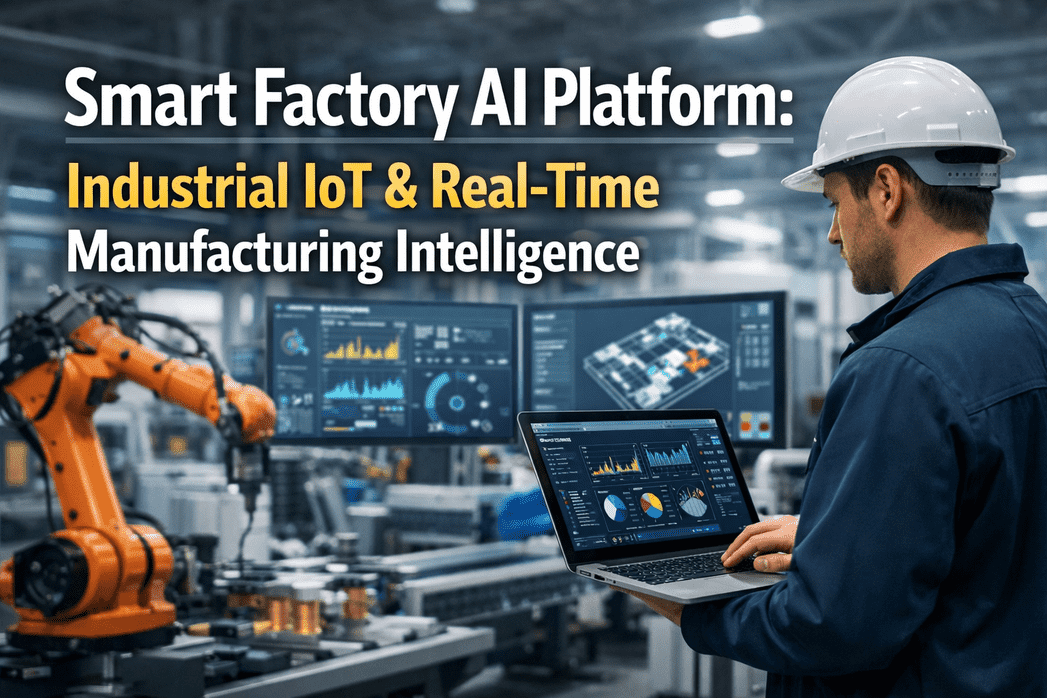

The Industrial Internet of Things (IIoT) in the USA in 2026 is becoming an important part of America’s manufacturing and industrial technology transformation. Factories, warehouses, energy facilities, transportation networks, and other industrial businesses are increasingly connecting machines, sensors, software, and computing systems to improve productivity and monitor operations.
Traditional industrial equipment generally operates through separate control systems and machinery. Modern connected industrial environments take this a step further by allowing machines to exchange information, report operating conditions, and communicate with centralized platforms. This creates opportunities for companies to understand their operations in greater detail and make decisions using real-time information.
The technology is particularly relevant as American manufacturers invest in automation, artificial intelligence, digital infrastructure, and domestic production capabilities. Companies want to reduce unexpected equipment failures, improve product quality, manage energy consumption, and make supply chains more visible.
However, industrial connectivity also introduces new challenges. Connected devices can create additional cybersecurity risks, especially when equipment that controls physical operations becomes connected to corporate networks or external services.
Recent developments demonstrate how important this subject has become. In September 2026, the U.S. Government Accountability Office (GAO) published a report highlighting security concerns involving networked Internet of Things devices used across federal agencies. Meanwhile, NIST continued updating guidance for IoT product cybersecurity, and technology manufacturers announced new investments in American production.
1. What Is the Industrial Internet of Things?
The Industrial Internet of Things is a network of connected devices, machines, sensors, software platforms, and industrial systems that collect and exchange operational information.
These connected technologies are used in environments such as:
- Manufacturing plants and production facilities.
- Warehouses and distribution centers.
- Power generation and electricity infrastructure.
- Oil and gas operations.
- Transportation and logistics networks.
- Water treatment and industrial processing facilities.
- Agricultural equipment and food production.
The main purpose of IIoT is to make industrial operations more connected, observable, and manageable.
For example, imagine a manufacturing facility with hundreds of machines. Traditionally, workers might inspect equipment at scheduled intervals or respond when a machine produces an error.
With IIoT, sensors can continuously monitor information such as temperature, vibration, pressure, energy consumption, and operating speed. This information can be sent to an industrial monitoring platform where operators can identify unusual conditions.
The system may alert maintenance teams when a machine begins showing signs of abnormal operation.
This approach can help businesses investigate problems earlier instead of waiting for equipment to stop working.
IIoT versus consumer IoT
Consumer IoT includes connected devices used in everyday environments, such as smart thermostats, home security cameras, smart speakers, and connected appliances.
Industrial IoT has different priorities.
| Consumer IoT | Industrial IoT |
|---|---|
| Focuses on personal convenience | Focuses on industrial operations |
| Used in homes and personal environments | Used in factories and infrastructure |
| Often prioritizes user experience | Prioritizes reliability and safety |
| Devices may be replaced frequently | Equipment may operate for many years |
| Downtime may cause inconvenience | Downtime can cause financial or operational damage |
Industrial systems often require stronger operational controls because a failure can affect production lines, worker safety, equipment, or essential services.
2. Why American Manufacturers Are Investing in IIoT in 2026
The American manufacturing sector is experiencing changes driven by automation, digital technology, supply-chain requirements, and competition.
Businesses are exploring connected industrial systems to improve efficiency and understand how their facilities operate.
Improving production efficiency
Manufacturing facilities must coordinate machines, workers, materials, and production schedules.
Connected sensors can provide information about machine performance, production speed, and operational interruptions.
Managers can use this information to identify bottlenecks and investigate why certain production processes are slower than expected.
For example, if one machine repeatedly causes delays, production data may help identify whether the problem is related to maintenance, material quality, temperature, or operating settings.
Reducing equipment downtime
Unexpected equipment failures can interrupt production and create additional repair costs.
IIoT-based monitoring systems can identify warning signs that may indicate a developing problem.
This allows maintenance teams to investigate equipment conditions before a breakdown occurs.
However, sensor alerts do not guarantee that every failure can be predicted. Effective maintenance still requires qualified technicians, appropriate inspections, and reliable equipment information.
Improving product quality
Manufacturers must maintain consistent product quality.
Connected equipment can monitor operating conditions throughout production. When a process moves outside its expected parameters, operators can investigate the issue.
This may help identify production defects earlier and reduce unnecessary material waste.
Increasing operational visibility
Large manufacturing companies may operate several facilities across different states.
A connected industrial platform can bring information from different locations into a shared monitoring environment.
Managers can compare equipment performance, energy usage, production output, and maintenance requirements across facilities.
This can support more informed planning and resource allocation.
3. Artificial Intelligence Is Making Industrial IoT More Intelligent
Artificial intelligence is becoming an important component of connected industrial environments.
IIoT provides operational information, while AI systems can analyze that information to identify patterns, detect unusual activity, and support decision-making.
Together, these technologies are helping businesses explore more advanced forms of industrial automation.
AI-powered predictive maintenance
Predictive maintenance uses equipment data to estimate when machinery may require inspection or maintenance.
For example, a sensor attached to an industrial motor may measure vibration and temperature.
If the measurements begin changing in an unusual way, an analytical system can flag the machine for further investigation.
AI models can analyze historical equipment data to identify patterns associated with certain types of failures.
This approach may help maintenance teams prioritize inspections and schedule repairs more effectively.
Intelligent quality monitoring
AI-powered vision systems can inspect products moving along manufacturing lines.
Cameras capture images, and software analyzes them to identify visible defects such as scratches, incorrect dimensions, missing components, or surface irregularities.
When integrated with IIoT platforms, inspection information can be connected with production data.
This can help manufacturers investigate whether certain machines, materials, or operating conditions are associated with recurring quality problems.
Industrial decision-support systems
AI systems can also analyze information from production schedules, inventory platforms, equipment sensors, and maintenance databases.
They may help identify inefficient processes or recommend areas requiring additional attention.
Human operators remain important because industrial decisions can affect equipment safety, product quality, and business continuity.
AI-generated recommendations should be evaluated before being applied to critical production systems.
4. Edge Computing and Real-Time Industrial Monitoring
Edge computing is another important technology supporting Industrial IoT.
Instead of sending every piece of sensor information to a distant cloud server, edge computing allows some data processing to happen closer to the machines generating it.
This can be useful when industrial systems require rapid responses.
How edge computing works
An industrial facility may have sensors connected to local gateways or industrial computers.
These devices collect information and perform selected processing tasks before sending relevant data to a larger platform.
For example, an edge computer might monitor machine temperature and vibration locally.
If the system detects a condition that exceeds a configured safety threshold, it can send an alert or trigger an approved response through the facility’s control system.
Benefits of edge computing
Lower communication delays: Processing information locally can reduce the time needed to respond to certain events.
Reduced network traffic: Not every sensor measurement needs to be transferred to a remote platform.
Greater operational independence: Some local monitoring functions can continue when external connectivity is temporarily unavailable.
Improved data management: Companies can decide which information should be processed locally and which should be stored centrally.
Edge and cloud computing work together
Edge computing does not necessarily replace cloud infrastructure.
Many industrial businesses use a combination of both.
Local systems handle time-sensitive tasks, while cloud platforms support broader analysis, long-term storage, reporting, and coordination across multiple facilities.
The appropriate architecture depends on the application’s reliability, security, latency, and data requirements.
5. Industrial Sensors Are the Foundation of Connected Manufacturing
Sensors are among the most important components of IIoT because they provide information about the physical environment.
Without reliable measurements, connected industrial platforms cannot accurately understand what is happening inside a facility.
Different types of sensors are used depending on the industrial application.
Temperature sensors
Temperature sensors monitor heat levels in machinery, production equipment, storage facilities, and industrial processes.
Unexpected temperature changes may indicate equipment problems, cooling issues, or operating conditions that require attention.
Vibration sensors
Vibration monitoring is particularly useful for rotating equipment such as motors, pumps, fans, and industrial machinery.
Changes in vibration patterns can help maintenance teams investigate potential mechanical problems.
Pressure sensors
Pressure sensors measure conditions in pipes, tanks, hydraulic equipment, and industrial processing systems.
They can help identify unusual pressure changes that may affect operational performance.
Flow sensors
Flow sensors measure how liquids or gases move through industrial systems.
They are used in water treatment, chemical production, energy facilities, and other applications where controlling flow is important.
Location and tracking sensors
Industrial facilities also use tracking technologies to monitor equipment, vehicles, tools, and inventory.
These systems can help businesses understand where important assets are located and how they move through a facility.
6. Industrial IoT and the Expansion of American Manufacturing
The growth of IIoT is closely connected to the modernization of American manufacturing.
Factories increasingly use connected technologies to coordinate production, monitor machines, and improve operational planning.
A major development in 2026 was the continued expansion of domestic electronics manufacturing capabilities.
On September 2, 2026, Telit Cinterion announced plans to establish U.S.-based manufacturing operations in Bristol, Pennsylvania, through a partnership with MFG Innovations.
The company said production would begin in October 2026, covering selected cellular IoT modules and customer solutions. The operation was intended to provide assembly, testing, quality assurance, and fulfillment capabilities for the U.S. market.
This development is relevant because cellular IoT modules are important components in connected industrial equipment and infrastructure.
Read the company announcement:
Why domestic production matters
Manufacturing connected-device components within the United States can offer several potential benefits.
- Greater visibility into selected manufacturing processes.
- Additional domestic production capacity.
- More direct quality-control arrangements.
- Opportunities for local industrial employment.
- Improved supply-chain transparency for participating customers.
However, domestic manufacturing does not automatically eliminate supply-chain risks. Companies still need to evaluate component sourcing, production dependencies, security controls, and supplier reliability.
Industrial IoT and supply-chain resilience
Manufacturers often depend on complex networks of suppliers.
Connected systems can provide information about inventory, shipments, equipment availability, and production schedules.
This information may help companies identify delays and understand how disruptions could affect manufacturing operations.
When properly integrated, IIoT can support better coordination between factories, warehouses, suppliers, and transportation providers.
7. How IIoT Is Transforming Warehouses and Logistics
Warehouses and distribution centers handle large amounts of inventory, equipment, and transportation activity.
Industrial IoT can help organizations monitor assets and understand how goods move through their facilities.
Smart inventory tracking
Connected sensors, barcode systems, RFID technology, and location platforms can help businesses track inventory.
These technologies may reduce the time employees spend searching for products and help identify inventory discrepancies.
Monitoring warehouse equipment
Forklifts, conveyor systems, automated storage equipment, and industrial vehicles can be connected to monitoring platforms.
Operators may receive information about equipment usage, maintenance requirements, and operating conditions.
Cold-chain monitoring
Certain products, including food, pharmaceuticals, and temperature-sensitive materials, require controlled storage and transportation conditions.
Connected temperature sensors can record environmental conditions during storage and delivery.
If conditions move outside specified limits, monitoring systems can alert responsible teams.
Fleet and asset visibility
Companies can use connected devices and GPS technology to monitor vehicles, equipment, and shipments.
This can help logistics teams understand asset locations and improve operational coordination.
The value of these systems depends on accurate data, reliable communications, and integration with existing business software.
8. Industrial IoT in Energy and Critical Infrastructure
IIoT is also important outside traditional manufacturing.
Energy facilities, water utilities, transportation networks, and other infrastructure systems rely on equipment that can benefit from improved monitoring.
Electricity infrastructure
Connected sensors can monitor selected conditions in electrical equipment, substations, and distribution networks.
Operators may use this information to investigate abnormal conditions and schedule maintenance.
Oil and gas operations
Industrial sensors can monitor pressure, temperature, flow, and equipment performance across pipelines and processing facilities.
These systems can support operational monitoring and help identify conditions that require inspection.
Water and wastewater facilities
Water utilities use pumps, valves, meters, and treatment equipment to manage essential services.
Connected monitoring systems can provide information about flow rates, tank levels, equipment conditions, and selected water-quality measurements.
Transportation infrastructure
Connected sensors can support monitoring of bridges, tunnels, rail systems, traffic equipment, and other infrastructure.
Such applications can help authorities understand operating conditions and plan inspections.
These systems must be designed carefully because inaccurate information or unauthorized access can create safety and service risks.
9. Cybersecurity Is Becoming a Major IIoT Priority
As industrial devices become more connected, cybersecurity becomes increasingly important.
A traditional industrial facility may have included machinery that was separated from external computer networks. Modern facilities increasingly connect operational equipment to monitoring platforms, enterprise systems, cloud services, and remote-access tools.
This connectivity can improve visibility, but it can also create additional entry points for attackers.
Why industrial IoT devices are vulnerable
Industrial equipment may remain in service for many years.
Some devices have limited processing power or were not originally designed to operate in highly connected environments.
Other systems may rely on outdated software, weak authentication, insecure configurations, or insufficient monitoring.
If attackers compromise an industrial device, they may attempt to access other systems or interfere with operations.
A significant GAO warning in September 2026
On September 30, 2026, the U.S. Government Accountability Office published a report titled Internet of Things: OMB Action Needed to Ensure Agencies Secure Their Networked Devices.
The report examined federal agency practices involving networked IoT and operational technology devices.
GAO found that only some agencies maintained inventories that identified their networked devices and included required information about security controls. It also highlighted gaps in oversight and guidance.
The report demonstrates why organizations need to know which connected devices operate within their environments and how those devices are protected.
Official report:
NIST is updating IoT cybersecurity guidance
The National Institute of Standards and Technology (NIST) has also been working on updated guidance for IoT product security.
In June 2026, NIST released an initial public draft of SP 800-213 Revision 1, which focuses on establishing cybersecurity requirements for IoT products used by the federal government.
The draft addresses how IoT products should be considered during system risk assessments and how organizations can determine appropriate security requirements.
NIST also initiated work to revise its IoT cybersecurity requirement catalog in August 2026.
Official resources:
Important security practices for industrial businesses
Companies adopting IIoT should consider several protective measures:
- Maintain an accurate inventory of connected devices.
- Change default passwords and use strong authentication.
- Apply security updates when they are available and safely tested.
- Separate appropriate operational networks from general corporate networks.
- Restrict remote access to authorized users.
- Monitor network activity for unusual behavior.
- Maintain reliable backups and recovery procedures.
- Evaluate the security practices of equipment suppliers.
Cybersecurity should be included during system design and procurement rather than treated as an afterthought.
10. Challenges Businesses Face When Implementing Industrial IoT
Although IIoT offers many opportunities, implementation can be complicated.
Companies need to consider technology costs, compatibility, data management, workforce training, and operational risks.
High installation costs
Installing connected sensors and monitoring platforms can require investment in hardware, software, networking equipment, and integration services.
Large facilities may need thousands of devices, making deployment expensive.
Businesses should evaluate whether the expected operational benefits justify the investment.
Legacy equipment compatibility
Many manufacturing facilities operate machinery that was installed years or even decades ago.
Older equipment may not support modern communication protocols or direct connectivity.
Companies may need gateways, additional sensors, software upgrades, or equipment replacement to integrate older machines with new platforms.
Managing large amounts of data
Connected industrial devices can generate enormous quantities of information.
Businesses need suitable systems to store, organize, process, and protect this information.
Collecting more data does not automatically improve operations. Companies must identify which measurements are useful and how they will influence decisions.
Network reliability
Industrial facilities may require reliable communication between machines, sensors, and control systems.
Network interruptions can affect monitoring and certain connected operations.
Businesses should design networks with appropriate redundancy and ensure that critical safety functions do not depend unnecessarily on external connectivity.
Workforce training
Industrial IoT requires cooperation between manufacturing professionals, engineers, IT teams, cybersecurity specialists, and data analysts.
Employees may need training to operate connected platforms and interpret monitoring information.
Successful implementation depends on people understanding how technology supports their work.
11. The Business Opportunities Created by Industrial IoT
The growth of IIoT creates opportunities for companies that develop hardware, software, connectivity solutions, cybersecurity services, and industrial consulting.
IoT hardware development
Manufacturers can develop sensors, cellular modules, industrial gateways, tracking devices, and rugged computing equipment.
These components help connect physical equipment with digital platforms.
Industrial software platforms
Software businesses can develop applications for equipment monitoring, production analytics, asset tracking, maintenance planning, and operational reporting.
Industrial cybersecurity
As connected equipment becomes more common, businesses may need specialized cybersecurity services for operational technology environments.
These services can include network assessments, device inventories, security monitoring, access management, and incident response planning.
System integration
Industrial facilities often use equipment from multiple manufacturers.
System integrators can help connect machines, software platforms, and communication networks so that information can move between different systems.
Connectivity services
Cellular IoT, private wireless networks, industrial Ethernet, and other communication technologies provide the infrastructure needed to connect industrial devices.
Companies may offer network planning, device management, and connectivity services for manufacturing and infrastructure customers.
12. What Is the Future of Industrial IoT in the USA?
The future of Industrial IoT will likely involve deeper integration with artificial intelligence, edge computing, industrial automation, and advanced cybersecurity.
Several developments are worth watching.
AI-connected factories: Manufacturers may increasingly use AI systems to analyze production data and support maintenance and quality decisions.
More edge computing: Industrial facilities may process more information locally to support time-sensitive monitoring and reduce dependence on remote systems.
Improved device security: Businesses may place greater emphasis on secure device design, software updates, network segmentation, and supply-chain transparency.
Private wireless networks: Some facilities may use dedicated wireless networks to support connected machinery, sensors, and mobile industrial equipment.
Digital twins: IIoT data can help update digital representations of physical equipment and production environments, allowing companies to study operating conditions and evaluate possible changes.
More domestic technology manufacturing: Investment in American production of selected connectivity components may support supply-chain diversification and local manufacturing capabilities.
Greater industrial data integration: Companies may connect production information with inventory, logistics, maintenance, and enterprise-management systems.
These trends are not guaranteed to develop at the same speed across every industry. Adoption will depend on costs, technical requirements, workforce capabilities, cybersecurity, and the measurable benefits businesses receive.
13. How American Businesses Can Prepare for Industrial IoT Adoption
Businesses do not need to connect every machine immediately.
A practical approach begins by identifying a specific operational problem and determining whether connected technology can provide a measurable improvement.
Start with a business objective
A company might want to reduce equipment downtime, improve energy efficiency, monitor product quality, or track warehouse assets.
A clearly defined objective makes it easier to select appropriate technology.
Evaluate existing equipment
Before buying new sensors or software, businesses should understand which machines already provide useful operational data.
Some equipment may need only additional connectivity, while other systems may require upgrades or replacement.
Select compatible technology
Industrial devices should support appropriate communication protocols and integrate with existing systems.
Businesses should also consider the availability of technical support, software updates, spare parts, and long-term maintenance.
Include cybersecurity from the beginning
Connected equipment should be evaluated for security risks before it is introduced into production environments.
Companies should establish clear requirements for authentication, access control, network protection, monitoring, and device updates.
Begin with a pilot project
Testing a small group of machines can help a business understand whether the technology works as expected.
A pilot project can reveal integration problems, training requirements, and operating costs before the company expands the system across an entire facility.
Measure the results
Companies should evaluate performance using measurable indicators such as downtime, production output, maintenance expenses, energy consumption, and product quality.
The objective is not simply to install more connected devices. It is to use information to improve industrial operations.
Conclusion
Industrial Internet of Things technology in the USA in 2026 is helping reshape how manufacturers and infrastructure operators monitor equipment, manage production, and make operational decisions.
Connected sensors, AI analytics, edge computing, cellular connectivity, and cloud platforms are creating new possibilities for industrial businesses. These technologies can help identify equipment problems, improve quality monitoring, support logistics operations, and provide greater visibility into complex facilities.
Recent developments also demonstrate that industrial connectivity is becoming a national technology and security concern. Telit Cinterion’s announced U.S. manufacturing expansion illustrates activity in the connected-device supply chain, while GAO and NIST publications highlight the importance of protecting networked equipment.
The next stage of IIoT development will depend on combining reliable hardware, useful software, secure communications, and properly trained workers.
For American manufacturers, the biggest opportunity is not simply connecting more machines. It is using accurate operational information to make production more efficient, reliable, and secure.
As industrial businesses continue modernizing their facilities, IIoT is likely to remain an important foundation of America’s connected manufacturing and infrastructure ecosystem.
Frequently Asked Questions (FAQs)
1. What is Industrial IoT?
Industrial IoT is the use of connected sensors, machines, software, and communication networks to collect and exchange information in industrial environments. It supports equipment monitoring, predictive maintenance, production analysis, and operational management.
2. How is Industrial IoT different from regular IoT?
Regular IoT often focuses on consumer applications such as smart home devices. Industrial IoT is designed for manufacturing, infrastructure, energy, logistics, and other industrial environments where reliability, safety, and operational performance are important.
3. Why is Industrial IoT growing in the USA in 2026?
American businesses are investing in automation, connected manufacturing, AI, supply-chain visibility, and equipment monitoring. IIoT can help organizations understand their operations and identify opportunities to improve efficiency.
4. How does AI improve Industrial IoT?
AI can analyze sensor data to identify unusual equipment behavior, support predictive maintenance, detect product defects, and help businesses understand production patterns.
5. What are common Industrial IoT devices?
Common devices include temperature sensors, vibration sensors, pressure sensors, flow meters, industrial gateways, connected cameras, asset trackers, and machine-monitoring equipment.
6. Is Industrial IoT secure?
Industrial IoT can be secure when devices and networks are properly designed and maintained. Businesses should use strong authentication, network segmentation, software updates, device inventories, and continuous security monitoring.
7. What is predictive maintenance in Industrial IoT?
Predictive maintenance uses equipment information, sensor measurements, and analytical systems to identify possible signs of machinery problems. It helps maintenance teams investigate issues before equipment failure occurs.
8. What role does 5G play in Industrial IoT?
5G can provide wireless connectivity with capabilities that may support industrial monitoring, mobile equipment, and connected devices. Whether it is suitable depends on the facility’s coverage, latency, reliability, and security requirements.
9. What is edge computing in industrial environments?
Edge computing processes selected information close to the machines and sensors generating it. This can reduce communication delays and allow some monitoring functions to continue locally when external connectivity is unavailable.
10. What is the future of Industrial IoT in America?
Future developments may include AI-connected factories, improved industrial cybersecurity, private wireless networks, digital twins, advanced sensors, and greater integration between manufacturing and supply-chain systems.











No responses yet